


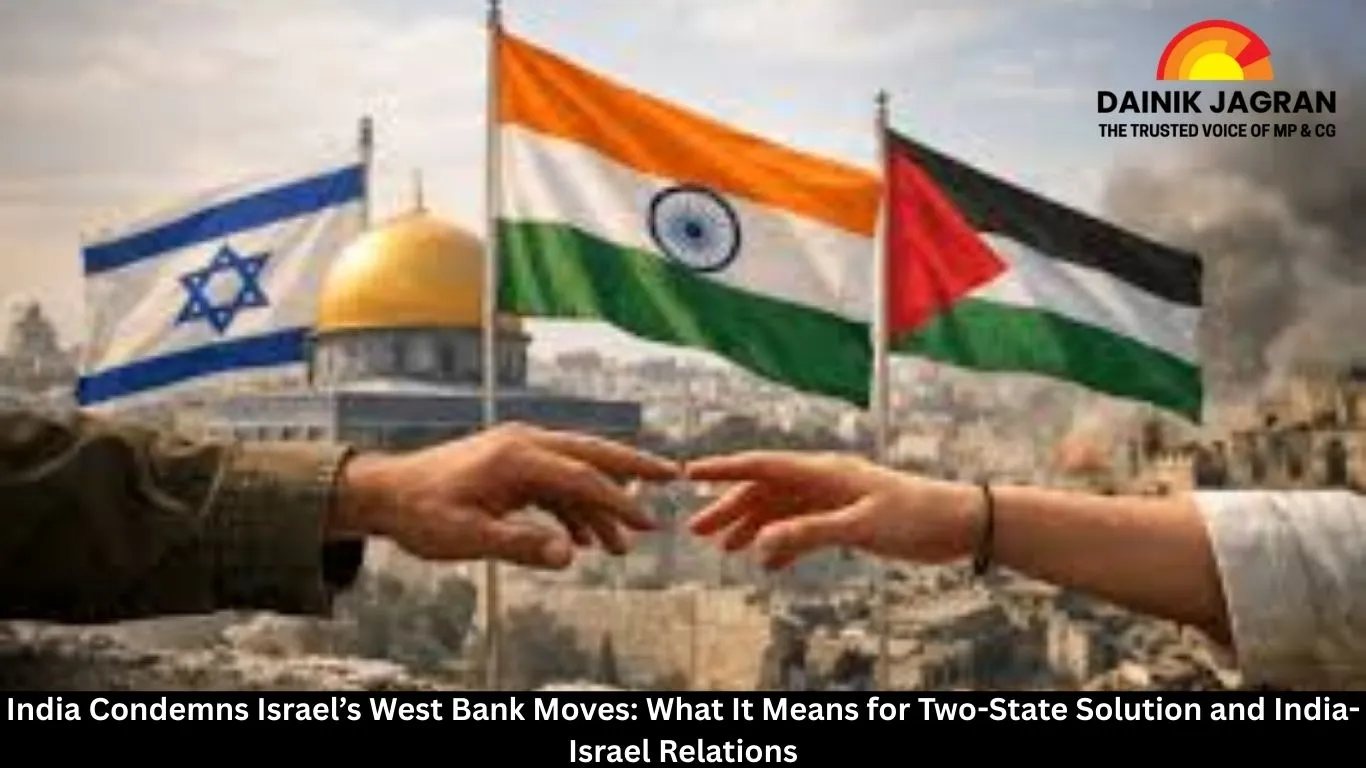
India Condemns Israel’s West Bank Moves: What It Means for Two-State Solution and India-Israel Relations
Digital Desk
India Backs UN Statement Criticising Israel’s West Bank Actions
In a significant diplomatic move, India condemns Israel West Bank measures by supporting a joint statement at the United Nations criticising Israel’s recent unilateral decisions in the occupied territory. The statement, backed by over 100 countries and international organisations, opposes Israeli settlement expansion and administrative changes in the West Bank.
This development is important because India shares strong strategic and defence ties with Israel, yet historically supports the Palestinian cause and the Two-State Solution framework. India’s decision to join the statement at the last moment highlights the delicate balance New Delhi is trying to maintain.
What Is Happening in the West Bank?
The West Bank has been at the centre of the Israel-Palestine conflict for decades. After the 1967 Arab-Israeli war, Israel took control of the territory, which was earlier administered by Jordan. Since then, the region has been considered “occupied territory” under international law.
Recently, Israel has reportedly:
Expanded civilian settlements
Allocated land for Israeli housing and infrastructure
Increased administrative control and land registration
Many countries argue that these unilateral measures violate international law, including provisions of the Fourth Geneva Convention. The concern is that such actions fragment Palestinian territories, making it difficult to establish a viable Palestinian state in the future.
Why the UN Joint Statement Matters
The UN Joint Statement strongly opposes:
Any form of annexation of occupied territories
Actions that undermine peace and stability
Measures that weaken the feasibility of the Two-State Solution
It calls for negotiations and mutual agreement rather than unilateral decisions.
India initially stayed away when 85 countries first supported the statement. However, as global backing grew, India added its name, reinforcing its long-standing support for a negotiated peace process.
Why Did India Condemn Israel?
The move may appear surprising given India’s deep defence and technology cooperation with Israel. However, India’s foreign policy has consistently supported:
Palestinian self-determination
A Two-State Solution
Respect for international law and multilateral processes
By supporting the statement, India signals that strategic partnerships do not override its commitment to international norms.
Experts believe this decision reflects India’s broader global positioning. As a rising power seeking a larger role in global governance, India wants to be seen as supportive of international law and diplomacy.
Will This Impact India-Israel Relations?
At present, major disruption in India-Israel ties seems unlikely. Defence, technology, and security cooperation remain strong pillars of the relationship.
Israel understands India’s historical stance on Palestine. Similarly, India continues to emphasise dialogue and diplomacy rather than confrontation.
However, diplomatically, this adds pressure on Israel amid growing global criticism over settlement expansion.
Why This Matters Now
The issue is timely as tensions in the Middle East continue to rise. Settlement expansion directly affects the future of peace negotiations. If territorial continuity is broken, creating a viable Palestinian state becomes increasingly difficult.
India’s decision sends a message that while geopolitical realities matter, international law and negotiated settlements remain central to long-term peace.
India’s move to support the UN statement shows the complexity of modern diplomacy. By condemning unilateral actions in the West Bank, India reaffirms its support for the Two-State Solution while maintaining strategic ties with Israel.
In a world shaped by shifting alliances and rising conflicts, India’s balanced stand reflects both principle and pragmatism.




.jpg)




