


India's 77th Republic Day Showcases Military Might, Strategic EU Pacts, and Padma Politics
Digital Desk
Beyond the Parade: Military Resolve, EU Alliance, and Political Messaging Mark India’s 77th Republic Day
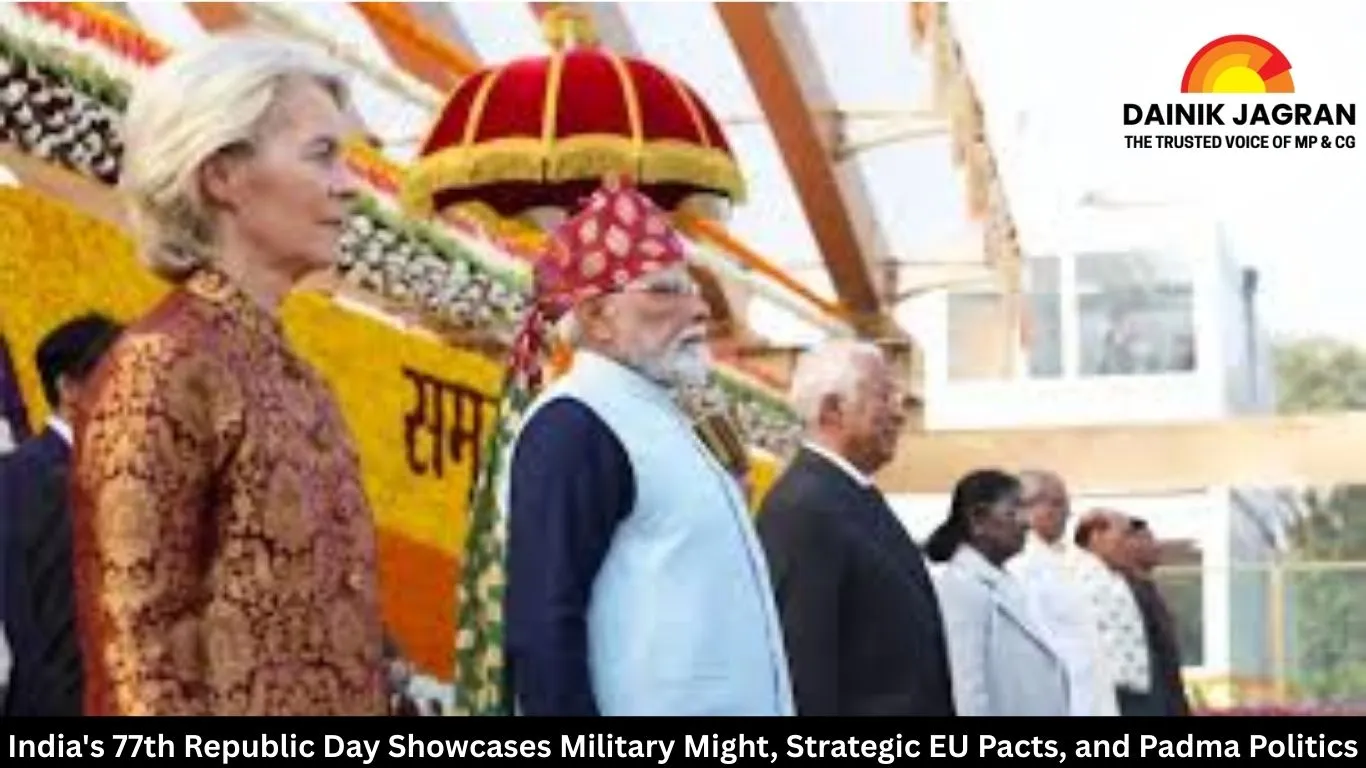
As the tricolor was unfurled on Kartavya Path today, India’s 77th Republic Day celebration transcended its traditional pomp to send powerful strategic, diplomatic, and political messages to both domestic and international audiences. The spectacle, anchored by a historic display of battle formations from Operation Sindhu, was set against the backdrop of a landmark trade deal with the European Union and the announcement of Padma Awards, which have ignited debates over political messaging.
Parade’s Centerpiece: A Live Re-Enactment of Operation Sindhu
The defining highlight of the Republic Day parade was the Indian Army’s unprecedented display of a “Faced Battle Array Formation”—a realistic, three-phase re-enactment of a combat scenario. This marked the first such display in parade history, directly referencing Operation Sindhu, the military action that followed.
The demonstration moved from reconnaissance phases with cavalry and drones to a full-scale simulated battlefield integrating ground and aerial assets. The display of indigenous weaponry like the T-90 and Arjun tanks, Nag missile systems, Akash air defence, and the BrahMos missile underscored a message of self-reliance and formidable defensive capability.
This show of strength finds validation in an international report. A recent study by Switzerland’s Centre for Military History and Perspective Studies (CHPMS) states that during Operation Sindhu, the Indian Air Force achieved air superiority, conducted long-range strikes within Pakistan, and neutralized key air defence assets, ultimately forcing a ceasefire.
Chief Guests & The "Mother of All Deals": India-EU Trade Pact
The presence of European Commission President Ursula von der Leyen and European Council President Antonio Costa as Chief Guests was rich with symbolism. Their attendance heralds the imminent announcement of the long-pending India-EU Free Trade Agreement (FTA), potentially on January 27.
Dubbed the "Mother of All Deals" by negotiators, this pact's urgency is amplified by geopolitical shifts. With the US under Donald Trump threatening tariffs on allies, the EU seeks to diversify its dependencies. For India, facing potential US tariffs, the deal offers a crucial opportunity to divert and diversify trade.
· Mutual Benefit: The EU gains access to India’s fast-growing, nearly $4 trillion GDP market. India seeks lower tariffs for its textiles, petroleum products, and machinery in Europe.
· Sticking Points: India remains cautious about opening its agricultural sector to European products like wine and olive oil, fearing impact on local farmers. Reports suggest a phased reduction of tariffs in sectors like automobiles, similar to the UK-India deal.
Padma Awards 2024: Recognition or Political Messaging?
The announcement of 131 Padma Awards, while celebrating luminaries like cricketer Rohit Sharma, actor Mammootty, and late star Dharmendra, has sparked analysis over political undertones. A notable 29% of awardees hail from five states/UTs—Assam, West Bengal, Tamil Nadu, Kerala, and Puducherry—slated for upcoming elections.
· Strategic Choices: The posthumous Padma Vibhushan for Kerala's former CM V.S. Achuthanandan (a rival of the current Left leadership) and Jharkhand Mukti Morcha founder Shibu Soren is seen by analysts as cross-party outreach to specific voter bases and regional sentiment.
· The Other Side: The government frames it as recognizing merit beyond political ideology, a hallmark of a mature democracy.
Conclusion: A Nation Forging its Path
The 77th Republic Day was more than a constitutional anniversary. It was a multi-layered narrative of a confident nation: showcasing military resolve to adversaries, cementing strategic economic alliances in a shifting world order, and navigating the complex domestic politics of recognition. The threads of defence, diplomacy, and domestic policy woven through the day’s events paint a picture of an India assertively charting its own sovereign course.


.jpg)




