

"Surrender or Strategy?" Parliament Erupts as Modi Government Defends US Trade Pact Amid 'Chokehold' Allegations
Digital Desk
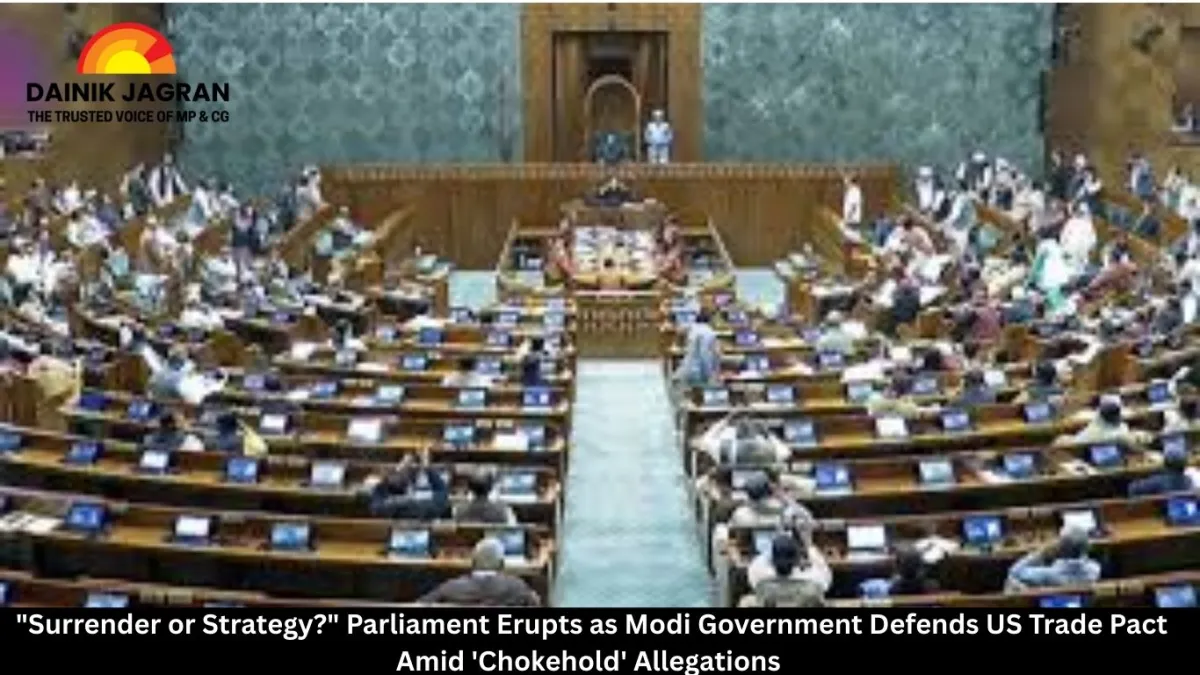
It was never meant to be just another budget debate. By the time Rahul Gandhi rose to speak in the Lok Sabha on Wednesday, the temperature had already crossed the boiling point. Outside, ministers from both sides were trading accusations near the Makar Dwar. Inside, the Leader of Opposition held up a poster that read “Narender Surrendered” — a mocking play on the Prime Minister’s name that sent the treasury benches into a frenzy .
What followed was not parliamentary debate in the classical sense. It was political theatre, yes. But beneath the sloganeering and the privilege notices lies a substantive question that neither the government nor the opposition has fully answered: In the rush to seal a trade deal with Donald Trump’s America, has India surrendered more than it has gained?
Or is this simply the price of strategic realignment in a multipolar world?
The 'Chokehold' Charge: Rhetoric or Realpolitik?
Rahul Gandhi’s central thesis was as stark as it was personal. “No Indian prime minister — not even Narendra Modi — would do this unless there is a chokehold on him,” he asserted, alleging that the Adani indictment in the US has left the Prime Minister with “no room to negotiate” .
The charge was breathtaking in its directness. Gandhi essentially accused the sitting Prime Minister of compromising national sovereignty under foreign legal pressure — and he did so on the floor of the House, with full immunity.
The government’s response, led by Parliamentary Affairs Minister Kiren Rijiju, was swift but procedural: expunge the remarks, demand authentication, cry privilege violation . What was missing was a point-by-point rebuttal of the substantive allegations. Instead, Union Minister Chirag Paswan dismissed the attack as “misleading the public” and insisted that farmer and dairy interests “will not be jeopardised” .
But here’s the problem: the government’s own actions suggest otherwise.
The Deal That Keeps Shifting
Let’s look at what we actually know about the India-US interim trade framework announced last week .
What India gave:
- Tariff elimination or reduction on all US industrial goods and a wide range of agricultural products (tree nuts, processed fruits, soybean oil, wine, spirits, and animal feed components like DDGS)
- An “intention” to purchase $500 billion worth of US goods over five years — nearly double current annual imports
- Commitments to address non-tariff barriers on medical devices and ICT goods
- Language in the US executive order confirming India has “committed to stop direct or indirect import of Russian oil”
What India got:
- US reciprocal tariff of 18% on select Indian exports (textiles, leather, chemicals, machinery)
- Future removal of tariffs on pharma, gems, and aircraft parts — once the full BTA is signed
- No mention of restored GSP benefits
What was allegedly walked back (per US fact sheet revisions):
- Digital Services Tax removal section withdrawn
- Specific pulse tariff concessions removed
- $500 billion purchase commitment softened to “intention” language
The picture that emerges is not of a clean win. It is of a negotiation where India blinked first — and then scrambled to correct the narrative.
The Russian Oil Paradox
Perhaps nowhere is the credibility gap wider than on energy security.
On paper, the US trade deal explicitly states that India has committed to halt Russian oil purchases. The Trump administration’s executive order is unambiguous: this was a precondition for tariff relief .
Yet Commerce Minister Piyush Goyal continues to maintain that oil purchases are “commercial decisions” for individual refineries. And those refineries — particularly Nayara Energy, majority-owned by Russia’s Rosneft — continue to process Russian crude. In January alone, Nayara imported 4.71 lakh barrels per day from Russia, accounting for 40 per cent of India’s total Russian oil imports .
So which is it? Has India stopped importing Russian oil, or hasn’t it?
The government’s refusal to give a straight answer suggests one of two things: either New Delhi is hoping Washington won’t strictly enforce the commitment, or it has made a quiet calculation that the geopolitical utility of Russian crude now outweighs the trade deal benefits.
Neither scenario inspires confidence in the government’s negotiation strategy.
The Epstein Diversion: Valid Query or Political Smokescreen?
Rahul Gandhi’s decision to drag Jeffrey Epstein’s name into the debate was always going to be incendiary. His specific allegation: that Anil Ambani’s name appears in the Epstein files, that Hardeep Singh Puri facilitated an introduction, and that this explains why Ambani has “not been jailed” .
Hardeep Puri’s response was detailed and personal. He acknowledged meeting Epstein “three or four times” between 2009 and 2017 as part of his role at the International Peace Institute, working on a UN reform commission chaired by a former Australian PM. He challenged Gandhi to check his website for full disclosure .
On substance, Puri’s explanation is plausible. Multilateral policy circles in New York intersected with Epstein’s philanthropic giving — many figures, from Prince Andrew to Bill Clinton, were caught in that web without criminal culpability.
But Gandhi’s broader point — about unequal application of legal scrutiny — lingers. If the US Department of Justice files indeed contain references to Indian industrialists and politicians, why has there been no parliamentary discussion or independent examination? The government’s reflexively defensive posture does it no favours here.
Farmers and the Forgotten Promise
Outside the Parliament’s heated chambers, a quieter alarm is sounding from India’s farmlands.
The joint statement may claim that “sensitive agricultural products” — wheat, rice, maize, soybeans, milk and milk products — remain protected . But trade experts note that tariff-rate quotas and expanded access for tree nuts, fruits, and alcoholic beverages are precisely how liberalisation creeps in. Today it’s almonds and wine. Tomorrow it could be cheese and poultry.
The Vande Mataram guidelines issued by the Home Ministry on January 28 — mandating the singing of all six stanzas at official events — were meant to be a moment of cultural assertion . Instead, they coincided with a trade deal that many farmers’ unions see as a betrayal of the swadeshi spirit.
There is an irony here that cannot be escaped: a government that has built its brand on national pride is now defending an agreement that opponents have successfully branded as “surrender.”
The Penguin Paradox: When a Book Becomes a Political Weapon
Amid the trade war and parliamentary warfare, the Four Stars of Destiny controversy offers a revealing subplot .
The Delhi Police have now sent notices to Penguin Random House, adding criminal conspiracy charges to an FIR over the alleged leak of former Army Chief M.M. Naravane’s unpublished memoir. The core question is simple: If the book was never published, how did Rahul Gandhi obtain a hardbound copy?
Penguin insists the book “has not been published, distributed, or made available to the public.” Yet Naravane’s own December 2023 social media post declared it “available now.” Someone is not telling the full truth.
For the ruling party, this is proof of opposition mischief — a manufactured controversy designed to embarrass the government on national security. For the Congress, it is evidence of a “culture of suppression” where uncomfortable military histories are buried.
Both narratives are self-serving. But the episode underscores a deeper dysfunction: India’s political class cannot agree even on the basic facts of what constitutes a published document.
So, Who Is Telling the Truth?
Here is what I believe after spending two days tracking this story.
The government entered the US trade negotiation from a position of genuine weakness. The Adani indictments, the Trump administration’s aggressive reciprocity doctrine, and India’s continued dependence on Russian energy created a perfect storm. The deal that emerged was the best available outcome under difficult circumstances — but it was not the strategic masterstroke that official briefings claim.
The opposition sees blood in the water and is exploiting every vulnerability. Rahul Gandhi’s “chokehold” theory may lack direct evidence, but it is politically potent precisely because it feels plausible to a public conditioned to see corruption everywhere. The Epstein allegations are a distraction — but a distraction that works, because the government has never convincingly explained its relationship with embattled industrialists.
The truth lies somewhere in the uncomfortable middle.
India has not “sold out” its farmers in any literal sense. The dairy sector remains protected. MSP isn’t being abolished. But the psychological barrier against agricultural liberalisation has been breached, and future governments — of any political colour — will find it harder to resist similar demands from other trading partners.
India has not surrendered its energy sovereignty. Russian oil continues to flow. But the public ambiguity over whether we have or haven’t committed to stopping it erodes trust in the government’s word.
And most importantly: India has not become a vassal state. But when the world’s most powerful president publicly claims credit for extracting concessions from New Delhi, perception becomes reality. Trump’s Truth Social post framing the deal as his victory is now the dominant global narrative. The government’s carefully worded press releases cannot compete with that.
The Bottom Line
This is not 1991. India is not knocking on the IMF’s doors with empty coffers. But this is also not 2014, when the world lined up to court a newly empowered India with unbridled optimism.
The India-US trade deal is a document of its time — negotiated by a weakened American president seeking quick wins and an Indian prime minister navigating unprecedented legal and geopolitical headwinds. It reflects the constraints, not the aspirations, of both countries.
The real test will come in the full BTA negotiations scheduled for March. Will India regain its footing and extract meaningful concessions on mobility, pharma patents, and data protection? Or will the “chokehold” — whether real or imagined — tighten further?
For now, the Parliament will continue to sloganeer. The anchors will continue to opine. And the rest of us will continue to wonder: when did “strategic autonomy” become such a difficult word to pronounce?
.jpg)




