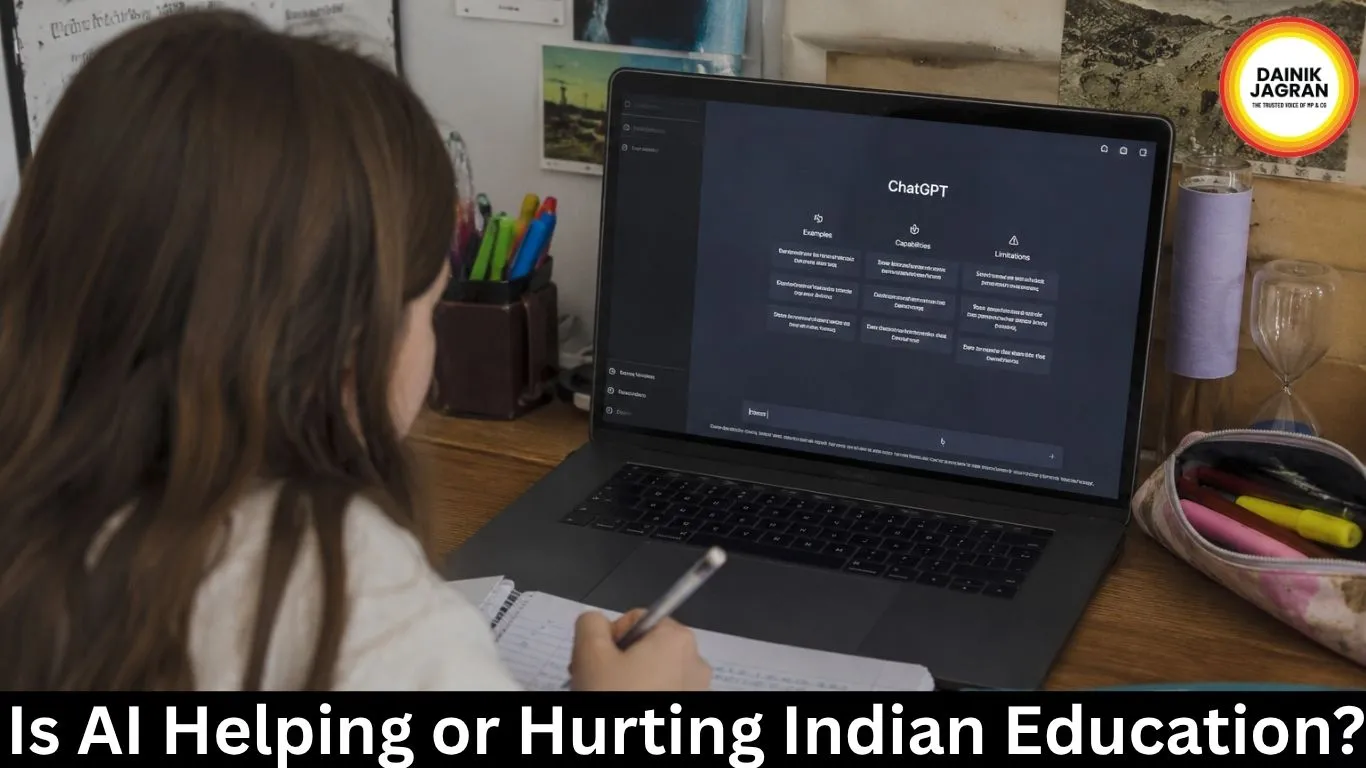
AI in Education — Are We Helping Students Learn or Just Helping Them Avoid It?
Digital Desk
AI is reshaping Indian classrooms — helping some students learn better and letting others skip the process entirely. The real problem may be education's outdated design.
The question has been sitting in classrooms, faculty meetings, and education ministry corridors for the past two years, and nobody seems to have a clean answer: is artificial intelligence making students smarter, or is it quietly doing the thinking for them?
The honest answer is both. And that might be the most uncomfortable truth in Indian education right now.
Walk into any urban school or college today and the evidence is everywhere. Students are submitting assignments that are grammatically flawless, structurally sound, and almost entirely written by AI tools. Teachers who have spent decades learning to read a student's voice in their writing are now looking at outputs that have no voice at all — smooth, competent, and hollow. The effort that once went into struggling through an essay, making mistakes, and slowly finding a way to express a thought? Gone.
This is not a hypothetical future concern. It is happening now, in classrooms in Mumbai, Bhopal, Bengaluru, and everywhere in between.
And yet it would be lazy thinking to stop there.
AI is also doing something genuinely useful for the first time in Indian education's history: it is beginning to address the gap that no government scheme, no mid-day meal programme, no teacher training initiative has ever fully closed — the gap between what a student needs to understand and what a single overworked teacher standing before sixty students can actually deliver. A first-generation learner in a tier-3 town who cannot afford coaching can now ask a question, get an explanation at exactly the right level, and ask it again in a different way until it clicks. That is not nothing. That is, in fact, enormous.
The problem is not the technology. The problem is that Indian education, almost entirely built around the memorise-reproduce-score model, has no framework to absorb a tool that makes memorisation and reproduction trivially easy. If your entire assessment system is based on asking students to recall and restate, you have not just an AI problem — you have a design problem that AI has simply made impossible to ignore any longer.
Teachers are not wrong to worry. When a Class 10 student cannot explain a paragraph they submitted, when a college thesis contains vocabulary its author does not recognise, the breakdown is real. But the solution is not to ban the tool any more than banning calculators would restore arithmetic understanding. The solution is to change what we are asking students to demonstrate.
What does a student think about this? What would they do differently? Can they argue against the AI's answer? Can they identify where it is wrong? These are the questions that no AI can answer on a student's behalf — not yet, and arguably not ever in the way genuine learning requires.
India's education system has an additional complication. AI tools of meaningful quality remain largely in English, which means they widen rather than narrow the gap between English-medium urban students and vernacular-medium rural ones. A student in Chhattisgarh whose first language is Chhattisgarhi and who studies in Hindi is working with tools built for someone else's context. The democratising promise of AI in Indian education is real, but it is unevenly distributed, and that unevenness runs along the same old fault lines of language, income, and geography.
Where does this leave us? AI in education is neither a revolution to celebrate nor a catastrophe to prevent. It is a pressure test — on curricula that prioritise recall over reasoning, on assessments that cannot distinguish understanding from output, on a system that has for too long confused the performance of learning with learning itself.
The students who will benefit most from AI are not the ones who use it to avoid thinking. They are the ones who use it to think harder, to go further, to check themselves. The job of educators — and of education policy — is to create conditions where that is what students are actually doing.
Whether they are, right now, is a fair question. And the answer, in most Indian classrooms today, is probably not yet.

--------
🚨 Beat the News Rush – Join Now!
Get breaking alerts, hot exclusives, and game-changing stories instantly on your phone. No delays, no fluff – just the edge you need. ⚡
Tap to join:
🟢 WhatsApp Channel: Dainik Jagran MP CG
Crave more?
🅕 Facebook: Dainik Jagran MP CG English
🅧 Twitter (X): Dainik Jagran MP CG
🅘 Instagram: Dainik Jagran MP CG
Share the fire – keep your crew ahead! 🗞️🔥
AI in Education — Are We Helping Students Learn or Just Helping Them Avoid It?
Digital Desk
The question has been sitting in classrooms, faculty meetings, and education ministry corridors for the past two years, and nobody seems to have a clean answer: is artificial intelligence making students smarter, or is it quietly doing the thinking for them?
The honest answer is both. And that might be the most uncomfortable truth in Indian education right now.
Walk into any urban school or college today and the evidence is everywhere. Students are submitting assignments that are grammatically flawless, structurally sound, and almost entirely written by AI tools. Teachers who have spent decades learning to read a student's voice in their writing are now looking at outputs that have no voice at all — smooth, competent, and hollow. The effort that once went into struggling through an essay, making mistakes, and slowly finding a way to express a thought? Gone.
This is not a hypothetical future concern. It is happening now, in classrooms in Mumbai, Bhopal, Bengaluru, and everywhere in between.
And yet it would be lazy thinking to stop there.
AI is also doing something genuinely useful for the first time in Indian education's history: it is beginning to address the gap that no government scheme, no mid-day meal programme, no teacher training initiative has ever fully closed — the gap between what a student needs to understand and what a single overworked teacher standing before sixty students can actually deliver. A first-generation learner in a tier-3 town who cannot afford coaching can now ask a question, get an explanation at exactly the right level, and ask it again in a different way until it clicks. That is not nothing. That is, in fact, enormous.
The problem is not the technology. The problem is that Indian education, almost entirely built around the memorise-reproduce-score model, has no framework to absorb a tool that makes memorisation and reproduction trivially easy. If your entire assessment system is based on asking students to recall and restate, you have not just an AI problem — you have a design problem that AI has simply made impossible to ignore any longer.
Teachers are not wrong to worry. When a Class 10 student cannot explain a paragraph they submitted, when a college thesis contains vocabulary its author does not recognise, the breakdown is real. But the solution is not to ban the tool any more than banning calculators would restore arithmetic understanding. The solution is to change what we are asking students to demonstrate.
What does a student think about this? What would they do differently? Can they argue against the AI's answer? Can they identify where it is wrong? These are the questions that no AI can answer on a student's behalf — not yet, and arguably not ever in the way genuine learning requires.
India's education system has an additional complication. AI tools of meaningful quality remain largely in English, which means they widen rather than narrow the gap between English-medium urban students and vernacular-medium rural ones. A student in Chhattisgarh whose first language is Chhattisgarhi and who studies in Hindi is working with tools built for someone else's context. The democratising promise of AI in Indian education is real, but it is unevenly distributed, and that unevenness runs along the same old fault lines of language, income, and geography.
Where does this leave us? AI in education is neither a revolution to celebrate nor a catastrophe to prevent. It is a pressure test — on curricula that prioritise recall over reasoning, on assessments that cannot distinguish understanding from output, on a system that has for too long confused the performance of learning with learning itself.
The students who will benefit most from AI are not the ones who use it to avoid thinking. They are the ones who use it to think harder, to go further, to check themselves. The job of educators — and of education policy — is to create conditions where that is what students are actually doing.
Whether they are, right now, is a fair question. And the answer, in most Indian classrooms today, is probably not yet.