


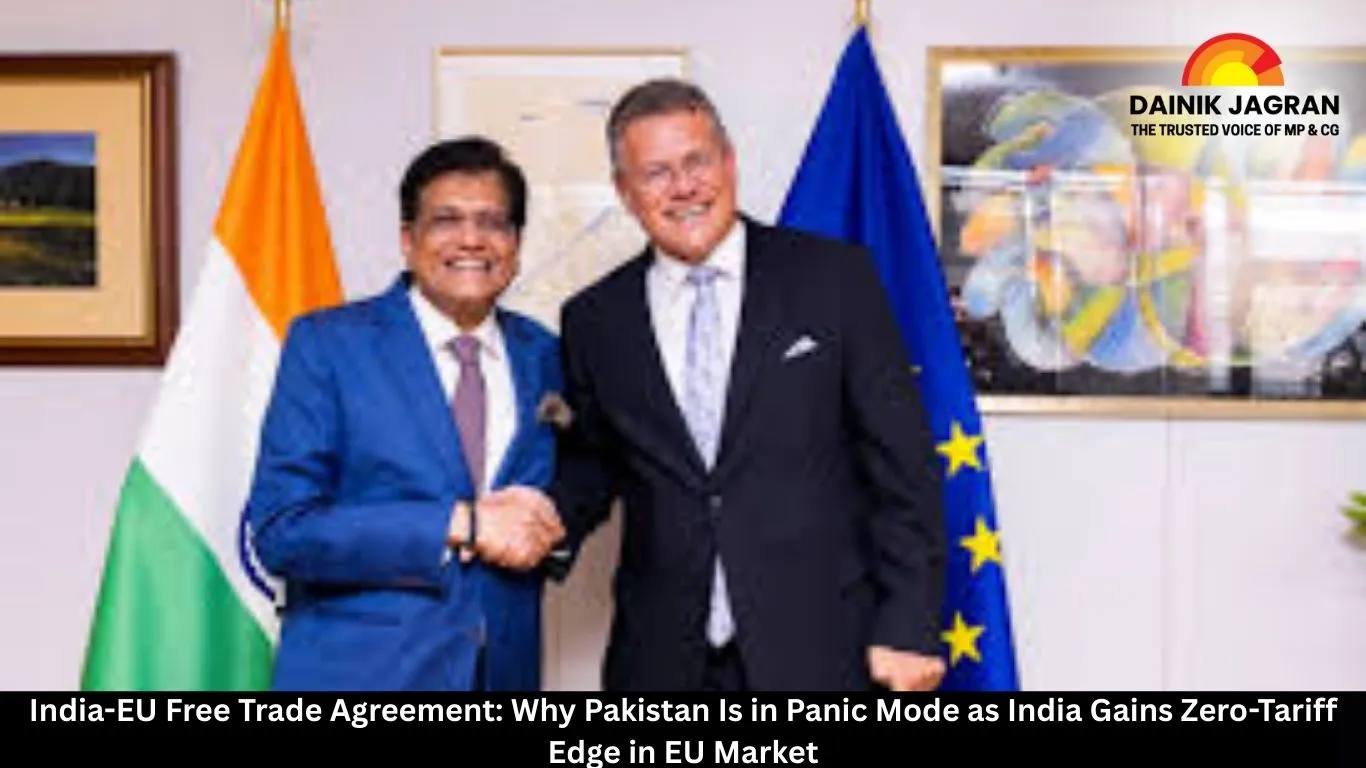
India-EU Free Trade Agreement: Why Pakistan Is in Panic Mode as India Gains Zero-Tariff Edge in EU Market
Digital Desk
India-EU Free Trade Agreement: A Game Changer in Global Trade
The recently concluded India-EU Free Trade Agreement has emerged as one of the most significant global trade developments in recent years. While trade deals are usually assessed only from the perspective of the two signatory partners, this agreement is different. Its impact is being felt far beyond India and the European Union—especially in neighboring countries like Pakistan and Bangladesh.
As the deal moves closer to implementation, Pakistan has entered panic mode, with exporters warning of massive losses and job cuts. Industry bodies are urging their government to act fast, fearing a collapse of exports to their biggest market—the European Union.
What Is the India-EU Free Trade Agreement?
After nearly 20 years of negotiations, India and the European Union finalized a landmark trade deal with unprecedented tariff reductions:
97% of EU goods entering India will face zero tariff
99% of Indian goods exported to the EU will also enjoy zero tariff access
This gives Indian exporters a level playing field in one of the world’s largest and richest consumer markets.
Why Pakistan Is Worried
Pakistan is not part of the EU India FTA, but the fallout directly affects its economy—especially the textile and garment sector.
Until now, Pakistan benefited from the EU’s GSP+ (Generalised Scheme of Preferences Plus) status, which allowed zero-duty textile exports to Europe. At the same time, Indian textile exports faced around 12% tariff, making Pakistani products cheaper in the EU market.
That advantage is now gone.
Key concerns for Pakistan:
Loss of price advantage in EU textile market
Indian goods now compete at zero tariff, same as Pakistan
Higher production costs in Pakistan due to:
Expensive electricity
Higher taxes
Costly raw materials
As a result, EU buyers are likely to prefer cheaper and higher-quality Indian products.
Massive Economic Stakes for Pakistan
The numbers explain the panic:
Pakistan exports around $8.8–9 billion worth of goods to the EU
Nearly 40% of Pakistan’s textile exports go to Europe
Industry leaders warn of:
Up to $9 billion export losses
Risk to nearly 10 million jobs
The All Pakistan Textile Mills Association has already warned that the India-EU Free Trade Agreement could wipe out Pakistan’s EU market share.
Why Europe Matters So Much
The European Union is the world’s largest textile importer, buying nearly $250 billion worth of textiles annually. More importantly, it is a high-value market:
Stable consumer demand
Willingness to pay premium prices
Strong focus on quality and compliance
India was unable to fully tap this market earlier due to high tariffs. Now, with zero-duty access, sectors like textiles, leather, and electronics stand to gain massively.
Bigger Than Pakistan: A Global Shift
This is not just Pakistan’s problem. Countries like Bangladesh, Vietnam, and Turkey, which earlier enjoyed preferential access, will also face tougher competition.
At a broader level, the deal reflects a strategic shift in global trade alliances, as the EU looks to diversify partners amid geopolitical uncertainties and reduced dependence on traditional allies.
The India-EU Free Trade Agreement is a turning point in global trade. For India, it opens the door to Europe’s most lucrative markets. For Pakistan, it signals the end of an era built on tariff advantages.
As competition intensifies, only countries with cost efficiency, quality production, and stable policies will survive. The message is clear: global trade rules are changing—and those who fail to adapt risk being left behind.
.jpg)




