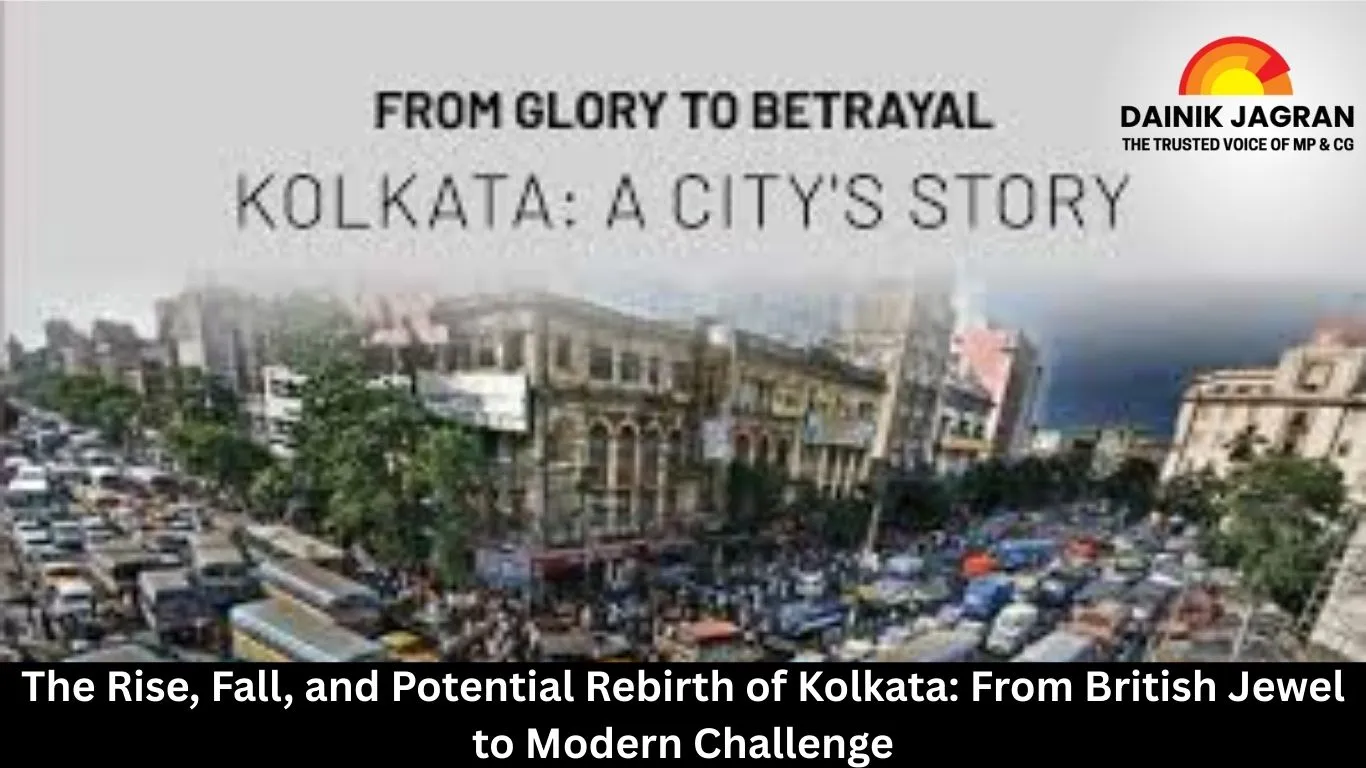
The Rise, Fall, and Potential Rebirth of Kolkata: From British Jewel to Modern Challenge
Digital Desk
For centuries, the city of Kolkata has been a land of contradictions. To the legendary poet Mirza Ghalib, who arrived in 1828, it was a breathtaking marvel of diversity and spirit. To former Prime Minister Rajiv Gandhi in 1985, it was a "dying city" plagued by urban decay. Today, as we navigate the complexities of the 21st century, Kolkata stands at a crossroads: a city steeped in a glorious intellectual past but struggling to find its footing in a hyper-competitive global economy.
The Foundation: More Than Just a British Trading Post
While history books often credit Job Charnock as the founder of Kolkata in 1690, a landmark 2003 High Court ruling corrected the record. The city’s roots trace back to the Maurya and Gupta periods, long before the East India Company consolidated the villages of Sutanuti, Gobindapur, and Kalikata.
By the 18th century, Kolkata—then Calcutta—was the "Jewel of the East." Historian William Dalrymple famously described it as the "Dubai of the 18th century"—a tax-free haven that attracted Armenian, Jewish, and Chinese traders. This economic prosperity birthed a sophisticated Indian merchant class (the Banias and Seths), setting the stage for India’s modern banking systems.
The Turning Point: Politics and the DNA of Conflict
The Battle of Plassey in 1757 was the ultimate catalyst. Following the defeat of Nawab Siraj-ud-Daulah, Kolkata became the administrative nerve center of British India. It saw the country’s first post office, first electric light, and first High Court.
However, this prosperity came at a cost. The city became the epicenter of the Bengal Renaissance, where luminaries like Raja Ram Mohan Roy and Swami Vivekananda challenged orthodox traditions. This intellectual awakening naturally transitioned into political defiance, making Kolkata the "hotbed" of the Indian freedom struggle.
The Long Shadow of Decline
The decline of Kolkata was not a single event but a series of historical shocks:
-
The Capital Shift (1911): The British moved the capital to Delhi to escape the revolutionary fervor of Bengal.
-
The Partition (1947): Unlike Punjab, migration in Bengal was largely one-way. Millions of refugees flooded the city, straining its infrastructure.
-
Industrial Crisis: Partition severed the jute mills in Kolkata from the jute-growing fields in East Pakistan, crippling the city's primary industry.
-
The Communist Era: From 1977 to 2011, the Left Front governed West Bengal. While land reforms were successful, a culture of strikes (bandhs) and the violent Naxalbari movement led to massive industrial flight.
Can Kolkata Reclaim the Crown?
Despite its struggles, Kolkata remains the gateway to Eastern India and Southeast Asia. For the city to witness a true revival, it must leverage India’s Act East Policy.
Actionable Insights for the Future:
-
Revitalizing the Port: Kolkata and Haldia ports are crucial for linking landlocked Himalayan nations and the BIMSTEC region.
-
IT and Infrastructure: While the city saw a 70% growth in IT between 2001 and 2005, it needs a massive infusion of domestic and foreign capital to compete with Bengaluru or Hyderabad.
-
Cultural Capital: Kolkata remains India’s intellectual soul. Transforming this "nostalgia" into a creative economy—focusing on arts, digital media, and education—could be its unique selling point.
Kolkata is a city that lives 100 years in the past and 100 years in the future simultaneously. Its challenge now is to finally master the present.