The World Did Not Vote for This War β€” And It Is Paying the Price Anyway

Digital Desk

The World Did Not Vote for This War β€” And It Is Paying the Price Anyway

The US-Israel war on Iran has shut the Strait of Hormuz & sent oil past $110. The world's ordinary people are paying for a war no one asked them about.

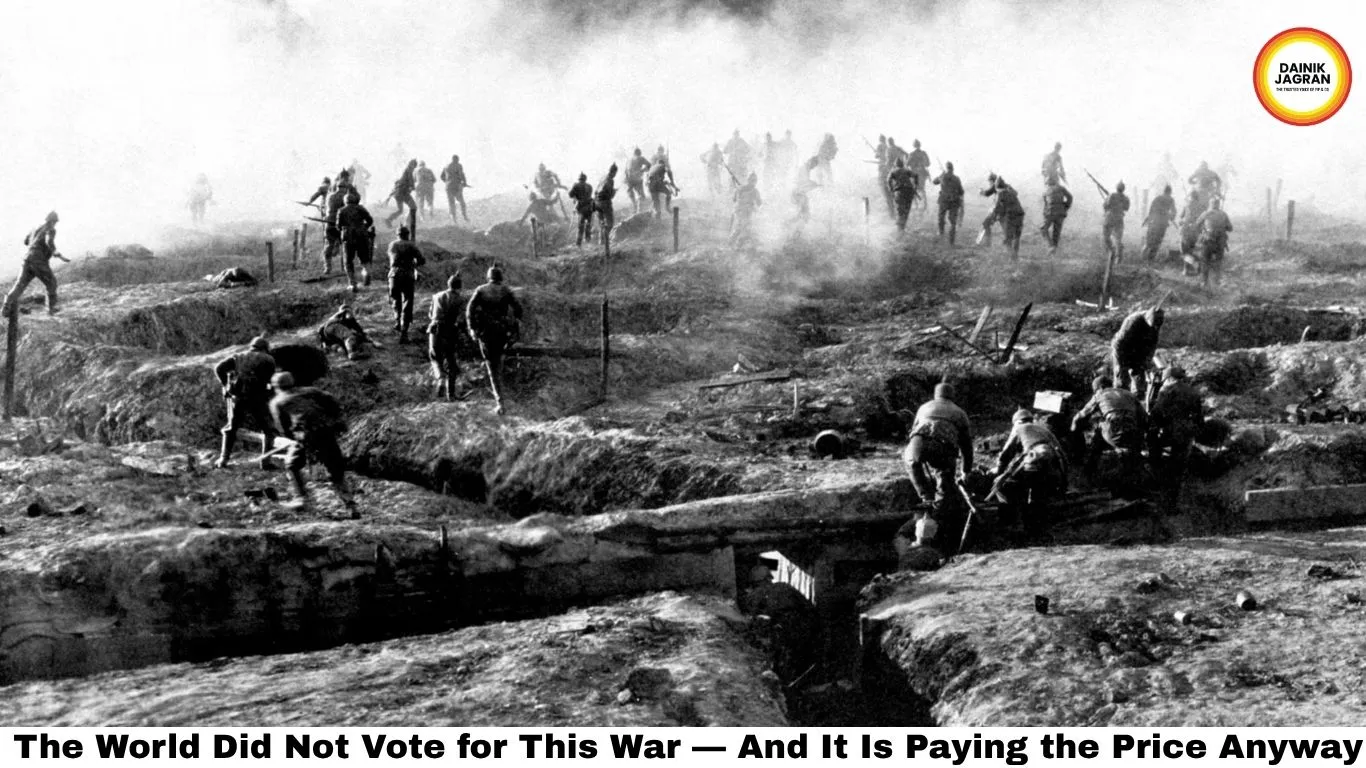
Here is a number worth sitting with: 3,000 people are dead in four weeks. Here is another: Brent crude oil is above $110 a barrel this morning, up again despite everything. And here is the one that will define the next decade: fewer than six ships a day are passing through a waterway that, just a month ago, carried twenty percent of the world's entire oil supply.

The Strait of Hormuz — 34 kilometres wide at its narrowest point, connecting the Persian Gulf to the open ocean — is effectively closed. And the global order that was built on the assumption of open sea lanes, predictable energy, and rules-based commerce is shaking in ways that no deadline, no Truth Social post, and no fifteen-point peace proposal is going to fix quickly.


A War That Bypassed Democracy

On February 28, 2026, the United States and Israel launched coordinated strikes on Iran under Operation Epic Fury. Iran's Supreme Leader Ali Khamenei was killed. Iran's military was decimated. And within days, the Islamic Revolutionary Guard Corps shut the Strait of Hormuz to US and Western-allied vessels — triggering the largest global energy disruption since the 1970s oil crisis, by the IMF's own assessment.

Not one ordinary citizen of the United States, India, Bangladesh, Pakistan, or any other country affected by this catastrophe was asked. Australia — a longstanding US ally — was not consulted before the strikes began. Its Prime Minister said so publicly. European nations learned about Operation Epic Fury the same way the rest of the world did.

This is what unilateral power looks like in 2026. It looks like a gas price spike. It looks like a four-day work week mandated in Pakistan and the Philippines because energy is no longer affordable. It looks like Bangladesh closing universities early for summer because running them has become too expensive.


Trump's Deadlines and Iran's Silence

President Trump has now extended his deadline for Iran to reopen the strait to April 6, 2026 — saying talks are "going very well." Iran's Foreign Minister says there are no negotiations. Iran's state television quotes officials saying the war ends only when Tehran's conditions are met — including a complete end to fighting on all fronts and guaranteed immunity from future attack.

Both cannot be simultaneously true. Someone is performing for their domestic audience. The tragedy is that while the two sides play this game of competing narratives, another tanker sits anchored outside the strait. Another barrel of oil gets priced a little higher. Another family somewhere fills up their petrol tank and quietly does the maths on what else they can no longer afford.

US special envoy Steve Witkoff presented Iran with a 15-point peace proposal delivered via Pakistan. Iran formally rejected it and issued five counter-conditions of its own — including recognition of Iranian sovereignty over the Strait of Hormuz itself. That is not a negotiating position. That is a statement of maximal defiance from a nation whose Supreme Leader has just been killed and whose naval commander, Rear Admiral Alireza Tangsiri, was killed in an Israeli strike on Thursday.


The Real Casualties Are Invisible

The death toll from direct strikes stands at over 3,000. That number, as grim as it is, does not capture the full human cost of this war.

Every ten percent increase in energy prices is expected to add almost half a percentage point to global inflation. Food security in Gulf nations — which import over 80% of their calories through the now-closed strait — is deteriorating rapidly. Shipping companies are rerouting around the Cape of Good Hope, adding weeks to delivery times and thousands of dollars to every consignment. The WTO has warned of a significant reduction in global trade volumes if high oil prices persist through 2026.

The poorest households in the most import-dependent economies — across South Asia, Sub-Saharan Africa, and Southeast Asia — will feel this the longest. They did not start this war. They have no leverage over how it ends. They are simply, quietly, absorbing the consequences.


India's Precarious Position

India deserves a special mention here. Importing 85% of its crude oil, India has navigated this crisis with remarkable diplomatic dexterity — five Indian-flagged LPG carriers were evacuated from the Hormuz region under Operation Sankalp, escorted by Indian Navy warships. Iran has explicitly permitted Indian vessels to transit the strait. India's Foreign Minister S. Jaishankar was at the G7 foreign ministers' meeting in Paris on March 27, sitting at a table where the US Secretary of State Marco Rubio was also present.

India is threading the needle between its historic ties with Iran, its deepening strategic partnership with the United States, and its absolute economic dependence on affordable energy. It is a needle that is getting narrower by the day. A prolonged war, a mining of the Persian Gulf sea lanes — which Iran has explicitly threatened if its coastal territory is attacked — would shatter India's energy arithmetic in ways no diplomatic relationship can easily repair.


What April 6 Actually Means

The April 6 deadline — Trump's extended window for Iran to reopen the strait before US strikes on Iranian power plants resume — is being watched by oil markets, shipping companies, defence planners, and governments from Tokyo to Nairobi.

The options are few and none are clean. A genuine diplomatic breakthrough could send oil prices tumbling and ease the worst of the global pressure — but would require Iran to accept terms that include missile limitations and nuclear rollback, which Tehran has publicly rejected. An escalation — strikes on power plants, followed by Iranian mine-laying across Gulf sea lanes — would push oil prices to territory not seen since 2008, and could draw in other powers in ways that are difficult to model and impossible to reverse.

The Pentagon is considering deploying 10,000 additional ground troops to the Middle East. Israel has said its strikes will "intensify and expand." The strait has been closed for twenty-seven days.


An Honest Question

History will ask a simple question of the decision-makers who launched Operation Epic Fury: did you plan for the morning after?

Killing a Supreme Leader is not a strategy. Destroying military infrastructure is not a peace plan. Issuing deadlines on social media is not diplomacy. And threatening to "unleash hell" on a country that is already absorbing some of the most intensive aerial bombardment in modern history is not pressure — it is noise.

The Strait of Hormuz will reopen. Wars end. The question is always the cost — measured not just in barrels of oil and stock market indices, but in the quiet, uncounted suffering of people who had no seat at the table when this was decided, and will have no voice in how it ends.

They deserve better than this. They always do.
--------

🚨 Beat the News Rush – Join Now!

Get breaking alerts, hot exclusives, and game-changing stories instantly on your phone. No delays, no fluff – just the edge you need. ⚑

Tap to join: 

🟒 WhatsApp Channel: Dainik Jagran MP CG

Crave more?

πŸ…• Facebook: Dainik Jagran MP CG English

πŸ…§ Twitter (X): Dainik Jagran MP CG

πŸ…˜ Instagram: Dainik Jagran MP CG

Share the fire – keep your crew ahead! πŸ—žοΈπŸ”₯

english.dainikjagranmpcg.com
27 Mar 2026 By Jiya.S

The World Did Not Vote for This War β€” And It Is Paying the Price Anyway

Digital Desk

Here is a number worth sitting with: 3,000 people are dead in four weeks. Here is another: Brent crude oil is above $110 a barrel this morning, up again despite everything. And here is the one that will define the next decade: fewer than six ships a day are passing through a waterway that, just a month ago, carried twenty percent of the world's entire oil supply.

The Strait of Hormuz — 34 kilometres wide at its narrowest point, connecting the Persian Gulf to the open ocean — is effectively closed. And the global order that was built on the assumption of open sea lanes, predictable energy, and rules-based commerce is shaking in ways that no deadline, no Truth Social post, and no fifteen-point peace proposal is going to fix quickly.


A War That Bypassed Democracy

On February 28, 2026, the United States and Israel launched coordinated strikes on Iran under Operation Epic Fury. Iran's Supreme Leader Ali Khamenei was killed. Iran's military was decimated. And within days, the Islamic Revolutionary Guard Corps shut the Strait of Hormuz to US and Western-allied vessels — triggering the largest global energy disruption since the 1970s oil crisis, by the IMF's own assessment.

Not one ordinary citizen of the United States, India, Bangladesh, Pakistan, or any other country affected by this catastrophe was asked. Australia — a longstanding US ally — was not consulted before the strikes began. Its Prime Minister said so publicly. European nations learned about Operation Epic Fury the same way the rest of the world did.

This is what unilateral power looks like in 2026. It looks like a gas price spike. It looks like a four-day work week mandated in Pakistan and the Philippines because energy is no longer affordable. It looks like Bangladesh closing universities early for summer because running them has become too expensive.


Trump's Deadlines and Iran's Silence

President Trump has now extended his deadline for Iran to reopen the strait to April 6, 2026 — saying talks are "going very well." Iran's Foreign Minister says there are no negotiations. Iran's state television quotes officials saying the war ends only when Tehran's conditions are met — including a complete end to fighting on all fronts and guaranteed immunity from future attack.

Both cannot be simultaneously true. Someone is performing for their domestic audience. The tragedy is that while the two sides play this game of competing narratives, another tanker sits anchored outside the strait. Another barrel of oil gets priced a little higher. Another family somewhere fills up their petrol tank and quietly does the maths on what else they can no longer afford.

US special envoy Steve Witkoff presented Iran with a 15-point peace proposal delivered via Pakistan. Iran formally rejected it and issued five counter-conditions of its own — including recognition of Iranian sovereignty over the Strait of Hormuz itself. That is not a negotiating position. That is a statement of maximal defiance from a nation whose Supreme Leader has just been killed and whose naval commander, Rear Admiral Alireza Tangsiri, was killed in an Israeli strike on Thursday.


The Real Casualties Are Invisible

The death toll from direct strikes stands at over 3,000. That number, as grim as it is, does not capture the full human cost of this war.

Every ten percent increase in energy prices is expected to add almost half a percentage point to global inflation. Food security in Gulf nations — which import over 80% of their calories through the now-closed strait — is deteriorating rapidly. Shipping companies are rerouting around the Cape of Good Hope, adding weeks to delivery times and thousands of dollars to every consignment. The WTO has warned of a significant reduction in global trade volumes if high oil prices persist through 2026.

The poorest households in the most import-dependent economies — across South Asia, Sub-Saharan Africa, and Southeast Asia — will feel this the longest. They did not start this war. They have no leverage over how it ends. They are simply, quietly, absorbing the consequences.


India's Precarious Position

India deserves a special mention here. Importing 85% of its crude oil, India has navigated this crisis with remarkable diplomatic dexterity — five Indian-flagged LPG carriers were evacuated from the Hormuz region under Operation Sankalp, escorted by Indian Navy warships. Iran has explicitly permitted Indian vessels to transit the strait. India's Foreign Minister S. Jaishankar was at the G7 foreign ministers' meeting in Paris on March 27, sitting at a table where the US Secretary of State Marco Rubio was also present.

India is threading the needle between its historic ties with Iran, its deepening strategic partnership with the United States, and its absolute economic dependence on affordable energy. It is a needle that is getting narrower by the day. A prolonged war, a mining of the Persian Gulf sea lanes — which Iran has explicitly threatened if its coastal territory is attacked — would shatter India's energy arithmetic in ways no diplomatic relationship can easily repair.


What April 6 Actually Means

The April 6 deadline — Trump's extended window for Iran to reopen the strait before US strikes on Iranian power plants resume — is being watched by oil markets, shipping companies, defence planners, and governments from Tokyo to Nairobi.

The options are few and none are clean. A genuine diplomatic breakthrough could send oil prices tumbling and ease the worst of the global pressure — but would require Iran to accept terms that include missile limitations and nuclear rollback, which Tehran has publicly rejected. An escalation — strikes on power plants, followed by Iranian mine-laying across Gulf sea lanes — would push oil prices to territory not seen since 2008, and could draw in other powers in ways that are difficult to model and impossible to reverse.

The Pentagon is considering deploying 10,000 additional ground troops to the Middle East. Israel has said its strikes will "intensify and expand." The strait has been closed for twenty-seven days.


An Honest Question

History will ask a simple question of the decision-makers who launched Operation Epic Fury: did you plan for the morning after?

Killing a Supreme Leader is not a strategy. Destroying military infrastructure is not a peace plan. Issuing deadlines on social media is not diplomacy. And threatening to "unleash hell" on a country that is already absorbing some of the most intensive aerial bombardment in modern history is not pressure — it is noise.

The Strait of Hormuz will reopen. Wars end. The question is always the cost — measured not just in barrels of oil and stock market indices, but in the quiet, uncounted suffering of people who had no seat at the table when this was decided, and will have no voice in how it ends.

They deserve better than this. They always do.

https://english.dainikjagranmpcg.com/opinion/the-world-did-not-vote-for-this-war-%E2%80%94-and/article-16122

Advertisement

Latest News