

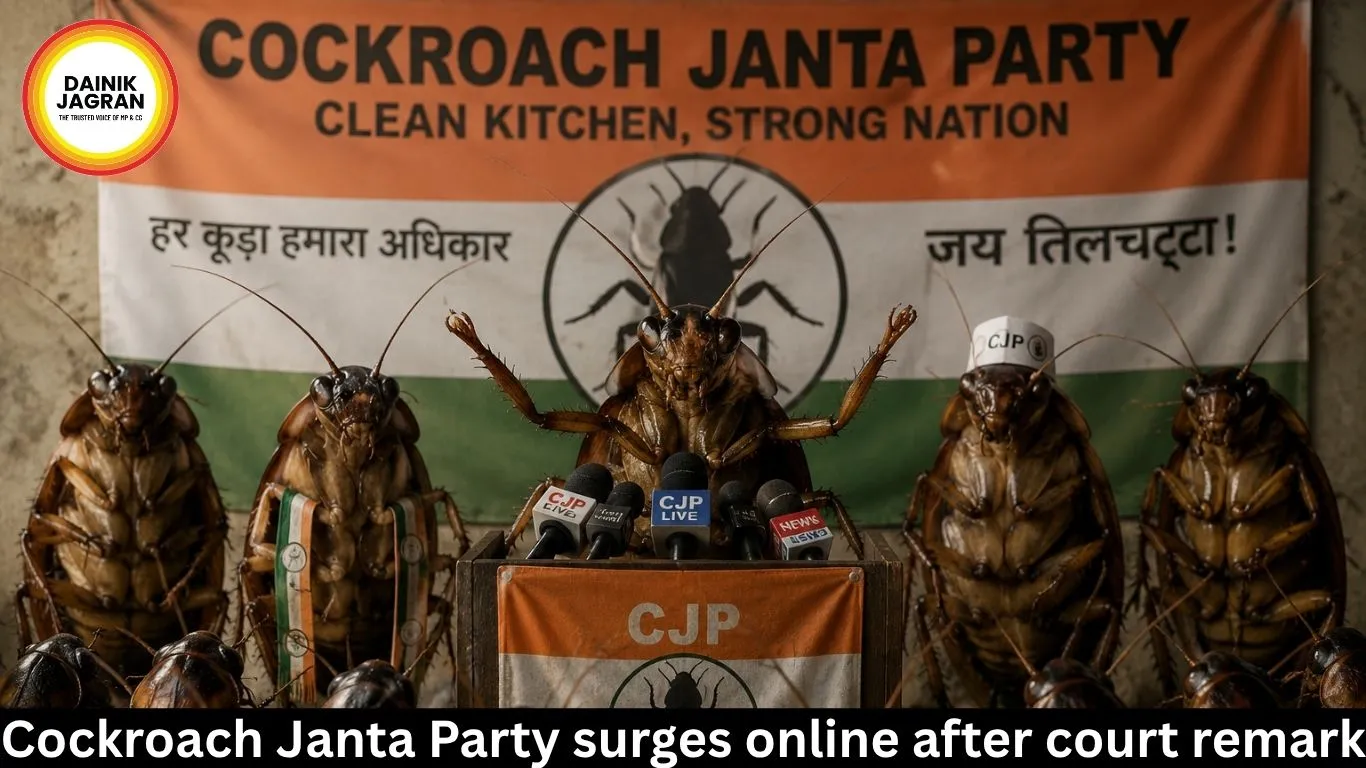
Cockroach Janta Party surges online after court remark
Digital Desk
Cockroach Janta Party gained millions after a Supreme Court ‘cockroaches’ remark. Viral energy contrasts with the long task of grassroots organisation.
Cockroach Janta Party surges online after ‘cockroaches’ remark; faces organisational test
Cockroach Janta Party gains millions on social media after Supreme Court comment, but experts say translating viral support into political force will be difficult
A viral insult from a top court and a rapid online mobilisation has given birth to the Cockroach Janta Party (CJP), a loose collective that accrued millions of followers within days — but political analysts and grassroots organisers say the group faces steep hurdles if it aims to become a genuine political force.
What happened
On 15 May, a remark by a senior Supreme Court judge referring to certain unemployed or fraudulent law graduates as “cockroaches” set off a fierce online reaction. Within 72 hours, a Google Form posted by Abhijeet Dipke, a 30-year-old former social media strategist, had gathered over 350,000 sign-ups and the movement’s Instagram account surpassed 11 million followers, according to screenshots and publicly visible metrics.
“The insult travelled faster than any policy rebuttal,” said a Delhi-based political communications consultant who asked not to be named. Initial reports indicate much of the mobilisation came from Gen Z users and college networks across Mumbai, Bengaluru and Delhi.
Online satire, real traction
The CJP’s branding — a deliberate inversion of the Bharatiya Janata Party name — blends satire with grievance. Its early posts frame the group as a home for the unemployed, the digitally native, and young people disillusioned by repeated exam scams and stagnant job prospects. The group has published a brief list of demands, including transparency in recruitment, reforms in higher education, and oversight of prosecutorial agencies.
According to officials at the platform hosting the Google Form, the rapid sign-ups were driven by organic reposting and a handful of influencer amplifications rather than paid campaigns. Local grassroots activists who spoke to this newsroom said the surge feels “performed” in parts — a mixture of earnest outrage, meme culture, and political theatre.
Institutional reality check
Experts say the next step — converting viral energy into organised political power — will be the hardest. “A Google Form is a good way to catalogue anger, not build local cadres,” said Dr. Meera Iyer, a political scientist at Jawaharlal Nehru University. She noted that contesting elections, sustaining campaigns and delivering services require money, local leadership, and institutional networks that take years to build.
Comparisons with recent student-led uprisings in Bangladesh and Nepal have circulated widely on social media. Dipke’s statement posted to the group’s channels emphasised peaceful, democratic channels and warned against violent confrontation. Analysts point out India’s federal scale, a functioning if beleaguered judiciary, and an often resilient electoral system make rapid regime collapse unlikely. Still, they caution that persistent institutional capture and erosion of public trust can push more activists from online protest to street mobilisation.
Ground-level signals
On the ground in college towns like Pune and Lucknow, students told reporters that the CJP has become shorthand for a kind of performative resistance — energising conversations but not yet producing sustained organising. “We repost, we rage, we sign forms. But who will run a booth in the municipal elections?” asked a university student in Pune who helped circulate the initial form.
CJP supporters argue the movement’s early success is evidence that mockery and satire can puncture the dominant political narrative. “It shows the cultural hegemony of certain parties can be challenged,” said one volunteer coordinating online outreach. Local civil society groups, however, remain sceptical about the group’s capacity to build unions, legal-aid networks, or trusted local leaders.
What’s next
The CJP’s immediate choices will shape its trajectory: build local chapters and invest in grassroots organisers, or remain a largely digital, symbolic critique. Observers say their rhetoric — focused on negation of perceived institutional failures — will need expansion into a positive policy platform to attract voters beyond a sympathetic online base.
Local election calendars in several states later this year and a series of university campus events could be early testing grounds. If organisers move to contest seats or field candidates in municipal polls, the national political class will likely take the experiment more seriously.
For now, the Cockroach Janta Party remains a potent online phenomenon that exposes genuine grievances, but whether it becomes a lasting political actor depends on long-term organisation rather than viral outrage alone.
--------
🚨 Beat the News Rush – Join Now!
Get breaking alerts, hot exclusives, and game-changing stories instantly on your phone. No delays, no fluff – just the edge you need. ⚡
Tap to join:
🟢 WhatsApp Channel: Dainik Jagran MP CG
Crave more?
🅕 Facebook: Dainik Jagran MP CG English
🅧 Twitter (X): Dainik Jagran MP CG
🅘 Instagram: Dainik Jagran MP CG
Share the fire – keep your crew ahead! 🗞️🔥
Cockroach Janta Party surges online after court remark
Digital Desk
Cockroach Janta Party surges online after ‘cockroaches’ remark; faces organisational test
Cockroach Janta Party gains millions on social media after Supreme Court comment, but experts say translating viral support into political force will be difficult
A viral insult from a top court and a rapid online mobilisation has given birth to the Cockroach Janta Party (CJP), a loose collective that accrued millions of followers within days — but political analysts and grassroots organisers say the group faces steep hurdles if it aims to become a genuine political force.
What happened
On 15 May, a remark by a senior Supreme Court judge referring to certain unemployed or fraudulent law graduates as “cockroaches” set off a fierce online reaction. Within 72 hours, a Google Form posted by Abhijeet Dipke, a 30-year-old former social media strategist, had gathered over 350,000 sign-ups and the movement’s Instagram account surpassed 11 million followers, according to screenshots and publicly visible metrics.
“The insult travelled faster than any policy rebuttal,” said a Delhi-based political communications consultant who asked not to be named. Initial reports indicate much of the mobilisation came from Gen Z users and college networks across Mumbai, Bengaluru and Delhi.
Online satire, real traction
The CJP’s branding — a deliberate inversion of the Bharatiya Janata Party name — blends satire with grievance. Its early posts frame the group as a home for the unemployed, the digitally native, and young people disillusioned by repeated exam scams and stagnant job prospects. The group has published a brief list of demands, including transparency in recruitment, reforms in higher education, and oversight of prosecutorial agencies.
According to officials at the platform hosting the Google Form, the rapid sign-ups were driven by organic reposting and a handful of influencer amplifications rather than paid campaigns. Local grassroots activists who spoke to this newsroom said the surge feels “performed” in parts — a mixture of earnest outrage, meme culture, and political theatre.
Institutional reality check
Experts say the next step — converting viral energy into organised political power — will be the hardest. “A Google Form is a good way to catalogue anger, not build local cadres,” said Dr. Meera Iyer, a political scientist at Jawaharlal Nehru University. She noted that contesting elections, sustaining campaigns and delivering services require money, local leadership, and institutional networks that take years to build.
Comparisons with recent student-led uprisings in Bangladesh and Nepal have circulated widely on social media. Dipke’s statement posted to the group’s channels emphasised peaceful, democratic channels and warned against violent confrontation. Analysts point out India’s federal scale, a functioning if beleaguered judiciary, and an often resilient electoral system make rapid regime collapse unlikely. Still, they caution that persistent institutional capture and erosion of public trust can push more activists from online protest to street mobilisation.
Ground-level signals
On the ground in college towns like Pune and Lucknow, students told reporters that the CJP has become shorthand for a kind of performative resistance — energising conversations but not yet producing sustained organising. “We repost, we rage, we sign forms. But who will run a booth in the municipal elections?” asked a university student in Pune who helped circulate the initial form.
CJP supporters argue the movement’s early success is evidence that mockery and satire can puncture the dominant political narrative. “It shows the cultural hegemony of certain parties can be challenged,” said one volunteer coordinating online outreach. Local civil society groups, however, remain sceptical about the group’s capacity to build unions, legal-aid networks, or trusted local leaders.
What’s next
The CJP’s immediate choices will shape its trajectory: build local chapters and invest in grassroots organisers, or remain a largely digital, symbolic critique. Observers say their rhetoric — focused on negation of perceived institutional failures — will need expansion into a positive policy platform to attract voters beyond a sympathetic online base.
Local election calendars in several states later this year and a series of university campus events could be early testing grounds. If organisers move to contest seats or field candidates in municipal polls, the national political class will likely take the experiment more seriously.
For now, the Cockroach Janta Party remains a potent online phenomenon that exposes genuine grievances, but whether it becomes a lasting political actor depends on long-term organisation rather than viral outrage alone.


