

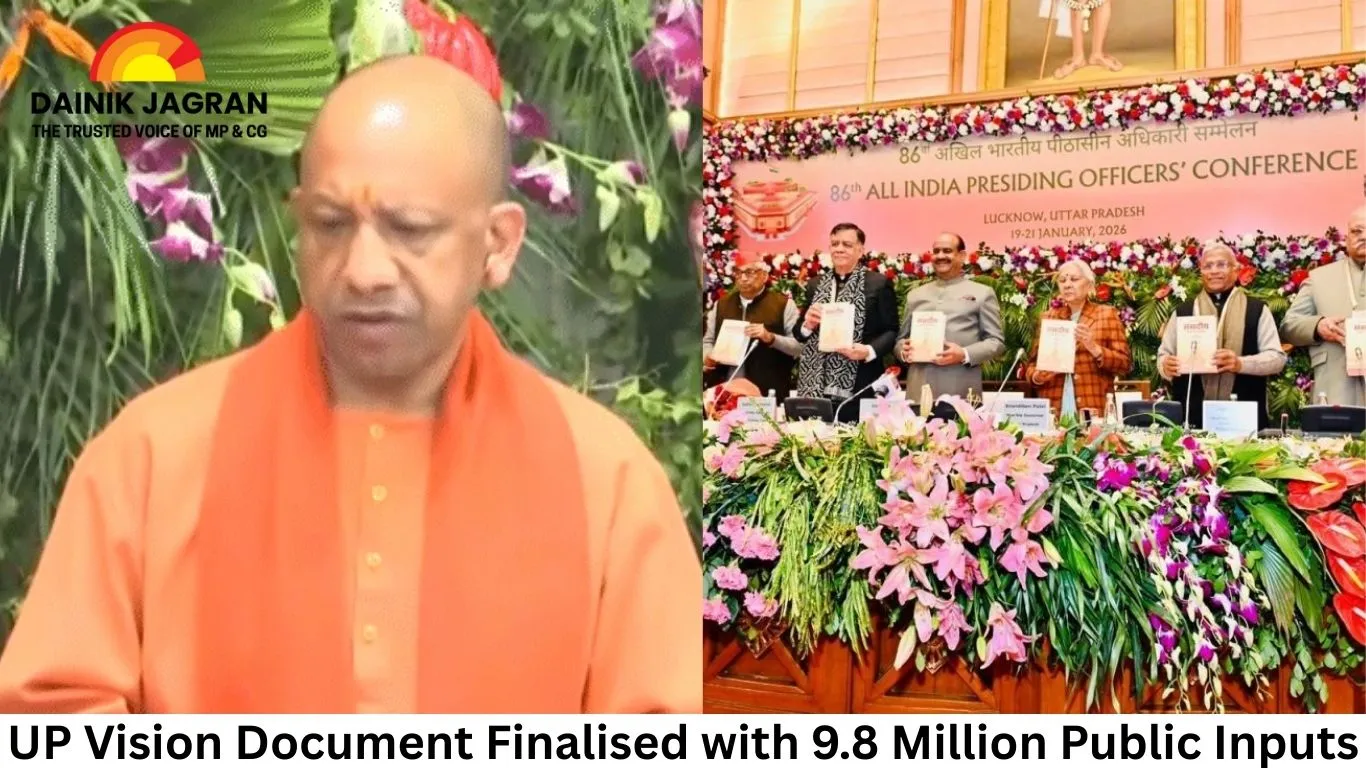
UP Vision Document Finalised with 9.8 Million Public Inputs; Presiding Officers’ Conference Adopts Six Resolutions
Digital Desk
Uttar Pradesh Chief Minister Yogi Adityanath on Tuesday announced that the state’s Vision Document for Developed India–Developed Uttar Pradesh has been finalised after an extensive participatory exercise that drew nearly 9.8 million public suggestions from across the state. The announcement was made at the closing session of the 86th All India Presiding Officers’ Conference, which concluded with the unanimous adoption of six resolutions aimed at strengthening democratic institutions.
Addressing the three-day conference, the Chief Minister said the vision document was prepared through consultations involving 500 public representatives and 500 intellectuals, followed by district-level outreach in all 75 districts. He said the process was designed to ensure that policy planning reflected grassroots aspirations rather than top-down assumptions.
The conference, attended by Lok Sabha Speaker Om Birla, Rajya Sabha Deputy Chairman Harivansh Singh, Uttar Pradesh Assembly Speaker Satish Mahana and presiding officers from legislatures across the country, focused on legislative reforms, accountability and public participation.
CM Yogi underlined that legislatures are the foundation of Indian democracy and must give voice to the last person in society. He said constructive debate, including disagreement, strengthens democratic functioning, while frequent disruptions undermine the purpose of legislative institutions. “House time is valuable. Deadlock and chaos cannot be equated with democracy,” he said.
Highlighting procedural reforms in the Uttar Pradesh Assembly, the Chief Minister said Question Hour had been strengthened by adopting parliamentary practices, allowing more members to raise questions and improving executive accountability. He also stressed the importance of training, discipline and adherence to legislative procedures.
A key theme of the address was the need for minimum sittings. CM Yogi reiterated that legislatures should function for at least 30 days annually, adding that this principle should extend to municipal bodies, gram panchayats, district panchayats and area panchayats to reinforce accountability at the grassroots.
Lok Sabha Speaker Om Birla said democratic values in Uttar Pradesh had deepened alongside improvements in governance, infrastructure and law and order. He noted that the conference deliberations emphasised transparency and closer engagement between institutions and citizens. Rajya Sabha Deputy Chairman Harivansh Singh said Uttar Pradesh had emerged as a revenue surplus state and was now being viewed by NITI Aayog as a “frontier state” shaping a new development narrative.
The six resolutions adopted included a collective commitment to the goal of Developed India by 2047, a consensus-driven minimum of 30 legislative sittings annually, greater use of technology to enhance public-legislature interaction, leadership by presiding officers to strengthen democratic traditions, capacity-building of MPs and MLAs, and the creation of a National Legislative Index to benchmark performance.
--------
🚨 Beat the News Rush – Join Now!
Get breaking alerts, hot exclusives, and game-changing stories instantly on your phone. No delays, no fluff – just the edge you need. ⚡
Tap to join:
🟢 WhatsApp Channel: Dainik Jagran MP CG
Crave more?
🅕 Facebook: Dainik Jagran MP CG English
🅧 Twitter (X): Dainik Jagran MP CG
🅘 Instagram: Dainik Jagran MP CG
Share the fire – keep your crew ahead! 🗞️🔥
UP Vision Document Finalised with 9.8 Million Public Inputs; Presiding Officers’ Conference Adopts Six Resolutions
Digital Desk
Addressing the three-day conference, the Chief Minister said the vision document was prepared through consultations involving 500 public representatives and 500 intellectuals, followed by district-level outreach in all 75 districts. He said the process was designed to ensure that policy planning reflected grassroots aspirations rather than top-down assumptions.
The conference, attended by Lok Sabha Speaker Om Birla, Rajya Sabha Deputy Chairman Harivansh Singh, Uttar Pradesh Assembly Speaker Satish Mahana and presiding officers from legislatures across the country, focused on legislative reforms, accountability and public participation.
CM Yogi underlined that legislatures are the foundation of Indian democracy and must give voice to the last person in society. He said constructive debate, including disagreement, strengthens democratic functioning, while frequent disruptions undermine the purpose of legislative institutions. “House time is valuable. Deadlock and chaos cannot be equated with democracy,” he said.
Highlighting procedural reforms in the Uttar Pradesh Assembly, the Chief Minister said Question Hour had been strengthened by adopting parliamentary practices, allowing more members to raise questions and improving executive accountability. He also stressed the importance of training, discipline and adherence to legislative procedures.
A key theme of the address was the need for minimum sittings. CM Yogi reiterated that legislatures should function for at least 30 days annually, adding that this principle should extend to municipal bodies, gram panchayats, district panchayats and area panchayats to reinforce accountability at the grassroots.
Lok Sabha Speaker Om Birla said democratic values in Uttar Pradesh had deepened alongside improvements in governance, infrastructure and law and order. He noted that the conference deliberations emphasised transparency and closer engagement between institutions and citizens. Rajya Sabha Deputy Chairman Harivansh Singh said Uttar Pradesh had emerged as a revenue surplus state and was now being viewed by NITI Aayog as a “frontier state” shaping a new development narrative.
The six resolutions adopted included a collective commitment to the goal of Developed India by 2047, a consensus-driven minimum of 30 legislative sittings annually, greater use of technology to enhance public-legislature interaction, leadership by presiding officers to strengthen democratic traditions, capacity-building of MPs and MLAs, and the creation of a National Legislative Index to benchmark performance.


