


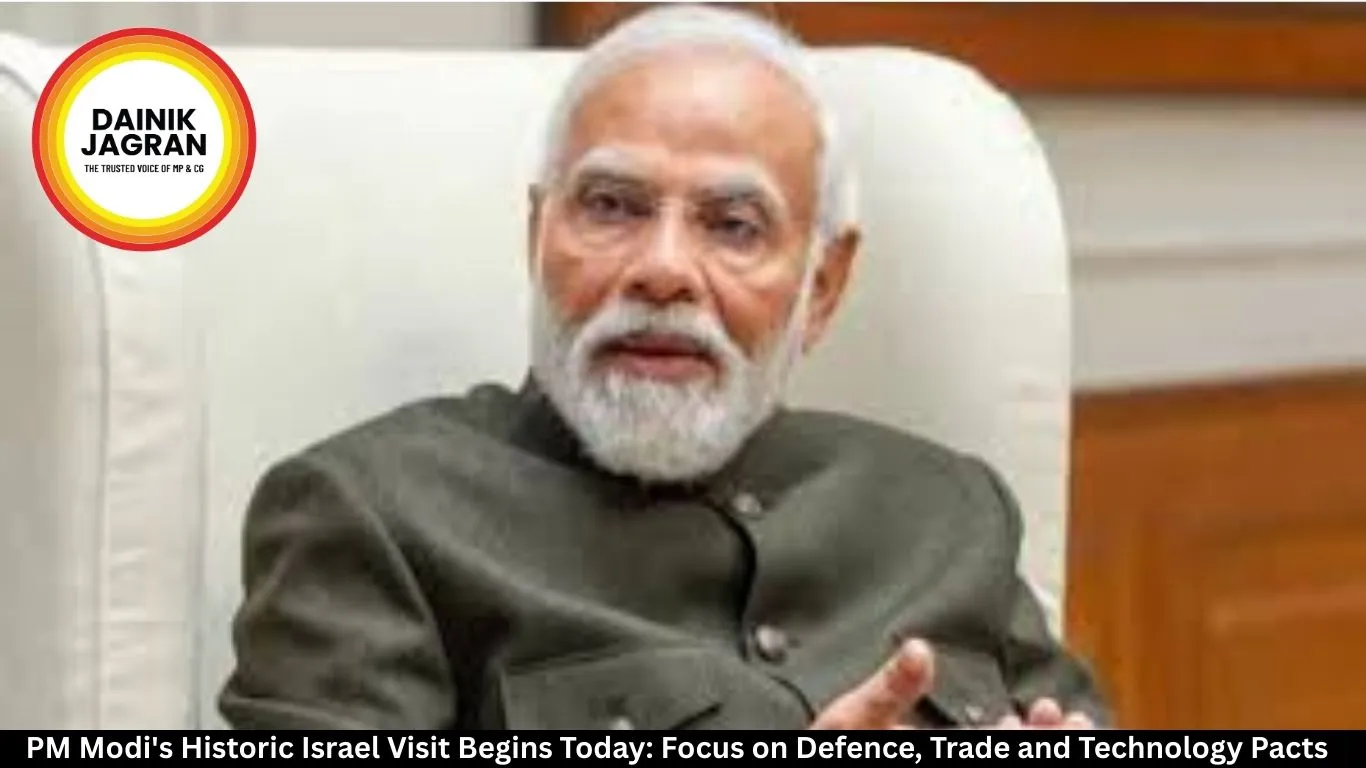
PM Modi's Historic Israel Visit Begins Today: Focus on Defence, Trade and Technology Pacts
Digital Desk
Prime Minister Narendra Modi's two-day historic visit to Israel commenced on Wednesday, February 25, 2026, marking his second trip to the country since 2017. The visit comes at a crucial juncture when bilateral trade has witnessed a significant downturn, making the anticipated agreements in defence, artificial intelligence, and cyber security even more critical for resetting the economic partnership .
Why This Visit Matters Now
The timing of PM Modi's Israel visit is particularly significant as India and Israel navigate a complex trade landscape. Aggregate trade between the two nations tumbled over 43% year-on-year in FY25 to ₹30,711.33 crore, compared to ₹54,081.05 crore in FY24 . Israel's share in India's total global trade has now shrunk to just 0.31%, declining consecutively over the last two years.
Despite this downturn, India maintains a positive trade balance with Israel, with exports exceeding imports. However, Indian exports to Israel halved in FY25 to ₹18,169.79 crore, while imports fell 24% to ₹12,541.54 crore during the same period .
Defence Cooperation Takes Center Stage
Ahead of the visit, India and Israel inked a new Memorandum of Understanding institutionalizing deeper collaboration between their defence industries. The partnership has steadily transitioned from buyer-seller transactions to joint development and structured technology collaboration .
The MoU follows a strategic industry engagement led by Israel's International Defence Cooperation Directorate (SIBAT) in partnership with the Society of Indian Defence Manufacturers and India's Defence Ministry. Both sides expressed commitment to advancing bilateral dialogue, emphasizing continued cooperation between industries that have "stood shoulder to shoulder in times of crisis" .
The Barak-8 surface-to-air missile system, co-developed by India's DRDO and Israel Aerospace Industries, stands as a shining example of successful technology sharing. Similarly, the Army's recent induction of the Suryastra Universal long-range rocket launcher, developed through collaboration between Israel's Elbit Systems and Pune-based Nibe Ltd, demonstrates the deepening defence manufacturing partnership .
Free Trade Agreement Negotiations Progress
Simultaneously, the first round of negotiations for the proposed India-Israel Free Trade Agreement began in New Delhi on Monday and will continue until February 26, coinciding with PM Modi's visit . The timing provides fresh momentum to deepen economic ties between the two nations.
Commerce Secretary Rajesh Agrawal underscored that the FTA negotiations began at an opportune moment, highlighting significant opportunities in innovation, science and technology, artificial intelligence, cybersecurity, high-tech manufacturing, agriculture, and services .
Former Israeli Ambassador to India, Daniel Carmon, expressed confidence in the negotiations, noting a significant shift in India's approach to FTAs under Minister Piyush Goyal's leadership. "The Israeli market is so small compared to others that things will not be influenced by movements of trade that have to do with Israel. People don't have to be scared to sign an FTA as soon as possible," Carmon observed .
What India Exports and Imports
India's primary exports to Israel include polished diamonds, precious stones, refined petroleum, electronics, machinery, organic chemicals, textiles, agricultural products like spices and tea, and defence equipment .
Conversely, India imports high-tech electronics, defence equipment, agricultural fertilizers, rough diamonds, advanced defence systems, communication devices, medical apparatus, and chemicals from Israel, which serves as a critical supplier of military hardware and technology .
Building on Recent Milestones
Last September, India and Israel signed a Bilateral Investment Agreement designed to provide greater certainty and protection for investors, including arbitration-based dispute resolution . The total investment between the two countries stood at approximately $800 million (₹7,200 crore) at that time .
The agreement aims to foster cooperation in fintech innovation, infrastructure development, financial regulation, and digital payment connectivity. Both nations have identified cybersecurity and defence as primary areas for fresh agreements during this visit .
Strategic Outlook
PM Modi will address Israel's parliament, the Knesset, and hold delegation-level talks with his counterpart Benjamin Netanyahu. The leaders will review progress in the India-Israel Strategic Partnership and discuss opportunities across science and technology, innovation, agriculture, water management, and people-to-people exchanges .
As Israel's largest arms importer, accounting for 34% of Israeli defence exports between 2020-24 according to SIPRI, India's strategic calculus with Israel extends beyond commerce into geopolitical alignment . The visit reaffirms the deep partnership between two resilient democracies facing persistent security challenges.
With several memoranda of understanding expected to be signed, PM Modi's Israel visit represents a pivotal moment to transform bilateral trust into tangible economic and strategic outcomes for both nations.



.jpg)




