


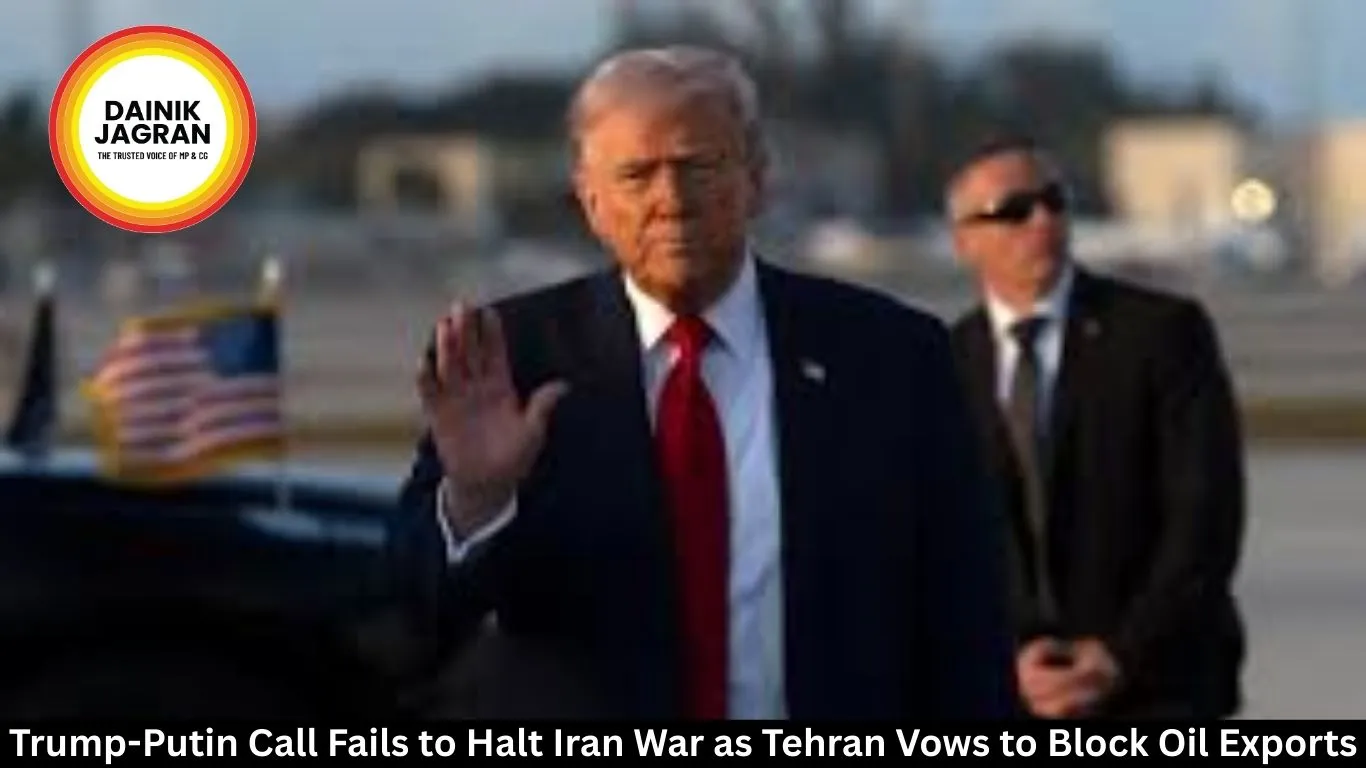
Trump-Putin Call Fails to Halt Iran War as Tehran Vows to Block Oil Exports
Digital Desk
Diplomatic efforts to quell the raging conflict in the Middle East took a dramatic turn on Tuesday as US President Donald Trump spoke with Russian President Vladimir Putin. However, any hope for an immediate de-escalation was swiftly dashed by Tehran, which issued a stark warning to the global economy: not a single liter of oil will pass through the region unless the attacks stop .
As the conflict enters its second week, the rhetoric has intensified on all sides, with Iran's leadership closing the door on negotiations and the United States vowing to secure global energy supplies "by whatever means necessary."
Putin Offers Mediation, Trump Points to Ukraine
In a highly anticipated hour-long phone call on Monday evening, President Trump and President Putin discussed the escalating situation in Iran and the ongoing war in Ukraine. Kremlin aide Yuri Ushakov described the conversation as "businesslike, frank and constructive" .
According to reports, Putin expressed a willingness to help mediate an end to the Iran conflict, suggesting multilateral talks involving Gulf nations. However, Trump reportedly steered the conversation toward Russia's involvement in Ukraine, suggesting that Moscow's focus should be on resolving that conflict first .
Despite the superpower dialogue, the situation on the ground remains volatile. Shortly after the call, Trump stated that the war with Iran would be over "very soon," though he stopped short of providing a specific timeline .
Tehran Hardens Stance: "No Talks, No Oil"
On the heels of Trump's cautious optimism, Iran delivered a defiant message. Foreign Minister Abbas Araghchi confirmed that negotiations with the United States are "no longer on the agenda," adding that Tehran is prepared to continue its missile and drone campaigns for "as long as necessary" .
The most significant escalation came from the Islamic Revolutionary Guard Corps (IRGC), which issued a direct threat to the global energy market. "The Iranian armed forces… will not allow the export of a single litre of oil from the region to the hostile side and its partners until further notice," an IRGC spokesman declared .
This threat explicitly targets the Strait of Hormuz, a narrow waterway through which nearly 20% of the world's crude oil passes. The warning sent immediate shockwaves through the market, though prices later stabilized after Trump's "end soon" comments .
President Trump responded with a fiery warning on Truth Social, stating that if Iran attempts to block the strait, the US will hit them "twenty times harder than before," promising "Death, Fire, and Fury" .
Regional Fallout: Gulf States Under Fire
The conflict continues to ripple across the Middle East, drawing in nations beyond Iran's borders.
- UAE Under Attack: The United Arab Emirates confirmed it was intercepting drone and missile attacks from Iran on Tuesday. This comes after debris from interceptions recently killed civilians in the UAE .
- Kuwait on High Alert: Kuwait's National Guard intercepted six drones, following the destruction of ballistic missiles just a day prior .
- Lebanon Displaced: The humanitarian toll is rising sharply. UNICEF reported that at least 83 children have been killed in Lebanon amid the exchanges between Israel and Hezbollah, with nearly 700,000 people now displaced in the country .
Australia Joins the Coalition
In a sign of the widening international involvement, Australian Prime Minister Anthony Albanese announced the deployment of a long-range E-7A Wedgetail surveillance aircraft and air-to-air missiles to the UAE. The move is designed to help Gulf nations defend against Iranian attacks and protect airspace over the Gulf for the next month .
The Nuclear Dimension
Overnight, tensions escalated further as Israeli TV Channel 12 reported that Israeli airstrikes targeted nuclear laboratories in Tehran. While Iran has not officially commented, the strikes suggest a broadening of military objectives beyond military installations to include Iran's nuclear infrastructure .
As the world watches the Strait of Hormuz, the next 24 hours will be critical. With Iran blocking diplomacy and threatening the world's oil supply, and the US vowing an overwhelming response, the Middle East teeters on the edge of a wider conflagration.


.jpg)




