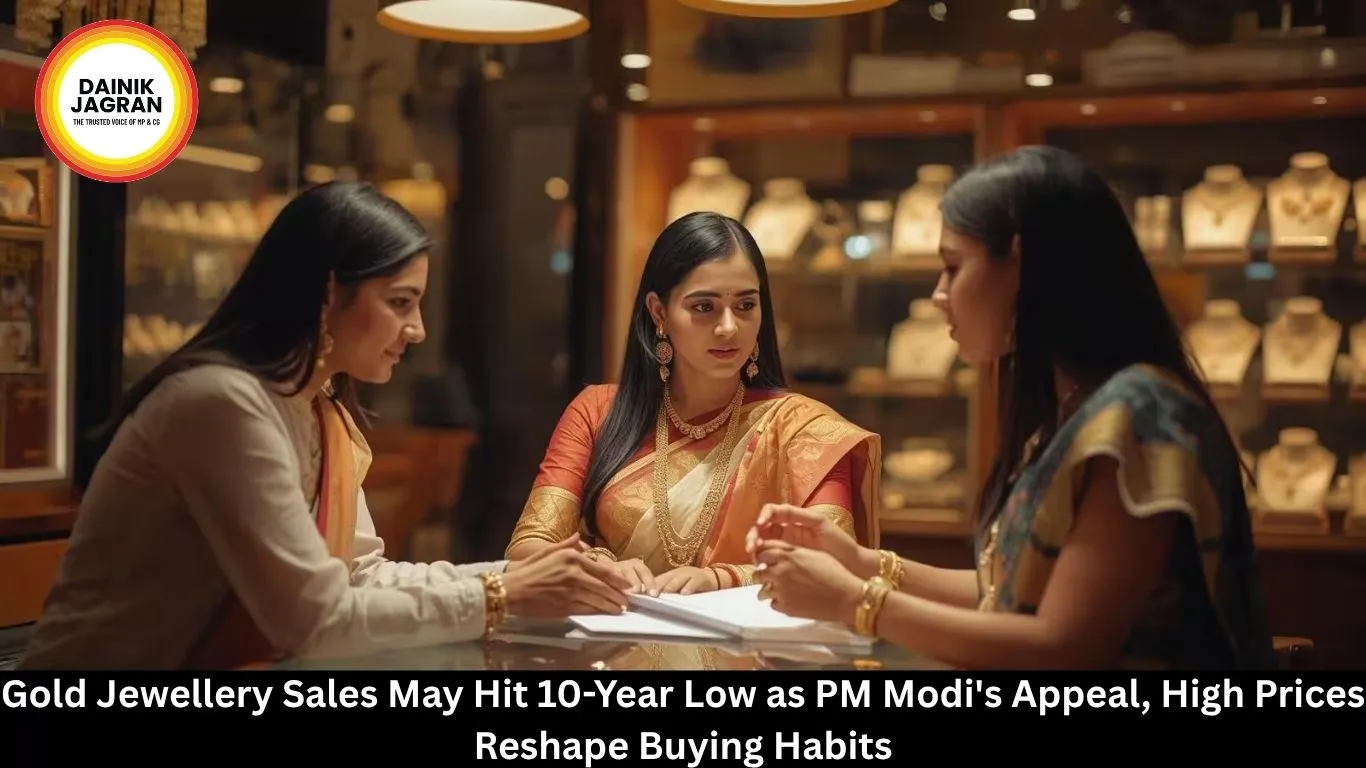
Gold Jewellery Sales May Hit 10-Year Low Amid PM Modi's Appeal
Digital Desk
PM Modi's appeal to avoid buying gold and record-high prices are pushing India's jewellery sales toward a 10-year low in FY27. Here's what the industry is doing.
India's gold jewellery market is staring at what could be its worst sales year in a decade. A combination of Prime Minister Narendra Modi's public appeal to avoid buying gold and record-high bullion prices has hammered consumer demand, pushing jewellery associations to seek government intervention and retailers to rethink how they do business entirely.
A Call That Echoed Across Counters
The shift traces back to May 10, when Prime Minister Modi made an unusual public appeal. "We must decide that, for one year, whatever function takes place at home, we will not buy gold jewellery," he said, urging citizens to step back from one of the country's oldest purchasing habits. The appeal landed hard. Industry estimates now suggest gold jewellery sales could fall to a 10-year low in FY27 — a scenario that, even a few months ago, would have seemed far-fetched.
Prices That Price People Out
The PM's appeal didn't land in a vacuum. Gold was already becoming unaffordable for large sections of buyers. According to the India Bullion and Jewellers Association, 10 grams of 24-carat gold is currently quoted at โน1.56 lakh, while silver has hit โน2.66 lakh per kilogram. Over the past year alone, gold prices have risen nearly 40%. Silver has returned an astonishing 188%. At these levels, even traditional wedding purchases — long considered non-negotiable — are being reconsidered.
Industry Looks to Government for a Lifeline
With demand contracting fast, jewellery bodies have moved beyond waiting. The IBJA has formally backed the government's push to reduce gold imports and has floated a proposal to monetise nearly 1,000 tonnes of idle temple gold held by religious trusts across the country. The logic is straightforward: if a portion of that idle stock enters the supply chain, it could ease import pressure and protect livelihoods across the artisan and small jeweller ecosystem.
"Many trusts currently hold large quantities of idle gold — nearly 1,000 tonnes in total. If even a portion of that gold can be utilised, it would help significantly," IBJA's Gujarat State president Nainesh Pachchigar told PTI.
Exchange Schemes Fill the Gap
On the retail floor, jewellers aren't waiting for policy to arrive. Gold exchange schemes are becoming the dominant pitch — customers bring in old, inherited jewellery and walk out with new designs, without fresh cash purchases. Pune-based PNG Jewellers launched its 'Swarna Swaraj' scheme with exactly this spirit. "India's gold should circulate within India. That is the simplest and most powerful thing we can do together," said chairman and MD Saurabh Gadgil.
Other retailers are noticing the same shift. "Rising prices could also increase exchange and upgrade purchases, as customers monetise existing gold holdings to manage budgets more efficiently," said Raghav Dhir, Director at Dhirsons Jewellers.
Market analyst Ajay Kedia of Kedia Advisory put numbers to the trend: nearly 50% of India's jewellery demand is now being supported through old gold exchange and recycling. The industry, he added, is also pivoting toward lower-weight and lower-carat products to hold on to buyers priced out of heavier pieces.
India's Gold Wealth Puts the Crisis in Perspective
Even as current sales slump, India remains the world's largest private holder of gold. Indian households collectively own over 34,600 tonnes — valued at more than $5 trillion or roughly โน475 lakh crore, according to the World Gold Council. Temples add another estimated 8,000 tonnes to that figure. The crisis, in other words, isn't a lack of gold — it's a question of how that stock is mobilised.
It isn't the first time gold has played a defining role in India's economic story. In 1991, the RBI pledged gold as collateral to raise $600 million and prevent a sovereign default, buying time for the landmark economic reforms that followed.
What Comes Next
The industry is navigating a structural inflection point — not just a seasonal dip. With exchange schemes gaining ground and reform proposals on the table, the coming months will test whether domestic recycling and policy support can offset the twin pressure of political restraint and sky-high prices. The gold counter, for now, looks very different from what it did a year ago.
--------
๐จ Beat the News Rush โ Join Now!
Get breaking alerts, hot exclusives, and game-changing stories instantly on your phone. No delays, no fluff โ just the edge you need. โก
Tap to join:ย
๐ข WhatsApp Channel: Dainik Jagran MP CG
Crave more?
๐ Facebook: Dainik Jagran MP CG English
๐ ง Twitter (X): Dainik Jagran MP CG
๐ Instagram: Dainik Jagran MP CG
Share the fire โ keep your crew ahead! ๐๏ธ๐ฅ
Gold Jewellery Sales May Hit 10-Year Low Amid PM Modi's Appeal
Digital Desk
India's gold jewellery market is staring at what could be its worst sales year in a decade. A combination of Prime Minister Narendra Modi's public appeal to avoid buying gold and record-high bullion prices has hammered consumer demand, pushing jewellery associations to seek government intervention and retailers to rethink how they do business entirely.
A Call That Echoed Across Counters
The shift traces back to May 10, when Prime Minister Modi made an unusual public appeal. "We must decide that, for one year, whatever function takes place at home, we will not buy gold jewellery," he said, urging citizens to step back from one of the country's oldest purchasing habits. The appeal landed hard. Industry estimates now suggest gold jewellery sales could fall to a 10-year low in FY27 — a scenario that, even a few months ago, would have seemed far-fetched.
Prices That Price People Out
The PM's appeal didn't land in a vacuum. Gold was already becoming unaffordable for large sections of buyers. According to the India Bullion and Jewellers Association, 10 grams of 24-carat gold is currently quoted at โน1.56 lakh, while silver has hit โน2.66 lakh per kilogram. Over the past year alone, gold prices have risen nearly 40%. Silver has returned an astonishing 188%. At these levels, even traditional wedding purchases — long considered non-negotiable — are being reconsidered.
Industry Looks to Government for a Lifeline
With demand contracting fast, jewellery bodies have moved beyond waiting. The IBJA has formally backed the government's push to reduce gold imports and has floated a proposal to monetise nearly 1,000 tonnes of idle temple gold held by religious trusts across the country. The logic is straightforward: if a portion of that idle stock enters the supply chain, it could ease import pressure and protect livelihoods across the artisan and small jeweller ecosystem.
"Many trusts currently hold large quantities of idle gold — nearly 1,000 tonnes in total. If even a portion of that gold can be utilised, it would help significantly," IBJA's Gujarat State president Nainesh Pachchigar told PTI.
Exchange Schemes Fill the Gap
On the retail floor, jewellers aren't waiting for policy to arrive. Gold exchange schemes are becoming the dominant pitch — customers bring in old, inherited jewellery and walk out with new designs, without fresh cash purchases. Pune-based PNG Jewellers launched its 'Swarna Swaraj' scheme with exactly this spirit. "India's gold should circulate within India. That is the simplest and most powerful thing we can do together," said chairman and MD Saurabh Gadgil.
Other retailers are noticing the same shift. "Rising prices could also increase exchange and upgrade purchases, as customers monetise existing gold holdings to manage budgets more efficiently," said Raghav Dhir, Director at Dhirsons Jewellers.
Market analyst Ajay Kedia of Kedia Advisory put numbers to the trend: nearly 50% of India's jewellery demand is now being supported through old gold exchange and recycling. The industry, he added, is also pivoting toward lower-weight and lower-carat products to hold on to buyers priced out of heavier pieces.
India's Gold Wealth Puts the Crisis in Perspective
Even as current sales slump, India remains the world's largest private holder of gold. Indian households collectively own over 34,600 tonnes — valued at more than $5 trillion or roughly โน475 lakh crore, according to the World Gold Council. Temples add another estimated 8,000 tonnes to that figure. The crisis, in other words, isn't a lack of gold — it's a question of how that stock is mobilised.
It isn't the first time gold has played a defining role in India's economic story. In 1991, the RBI pledged gold as collateral to raise $600 million and prevent a sovereign default, buying time for the landmark economic reforms that followed.
What Comes Next
The industry is navigating a structural inflection point — not just a seasonal dip. With exchange schemes gaining ground and reform proposals on the table, the coming months will test whether domestic recycling and policy support can offset the twin pressure of political restraint and sky-high prices. The gold counter, for now, looks very different from what it did a year ago.