

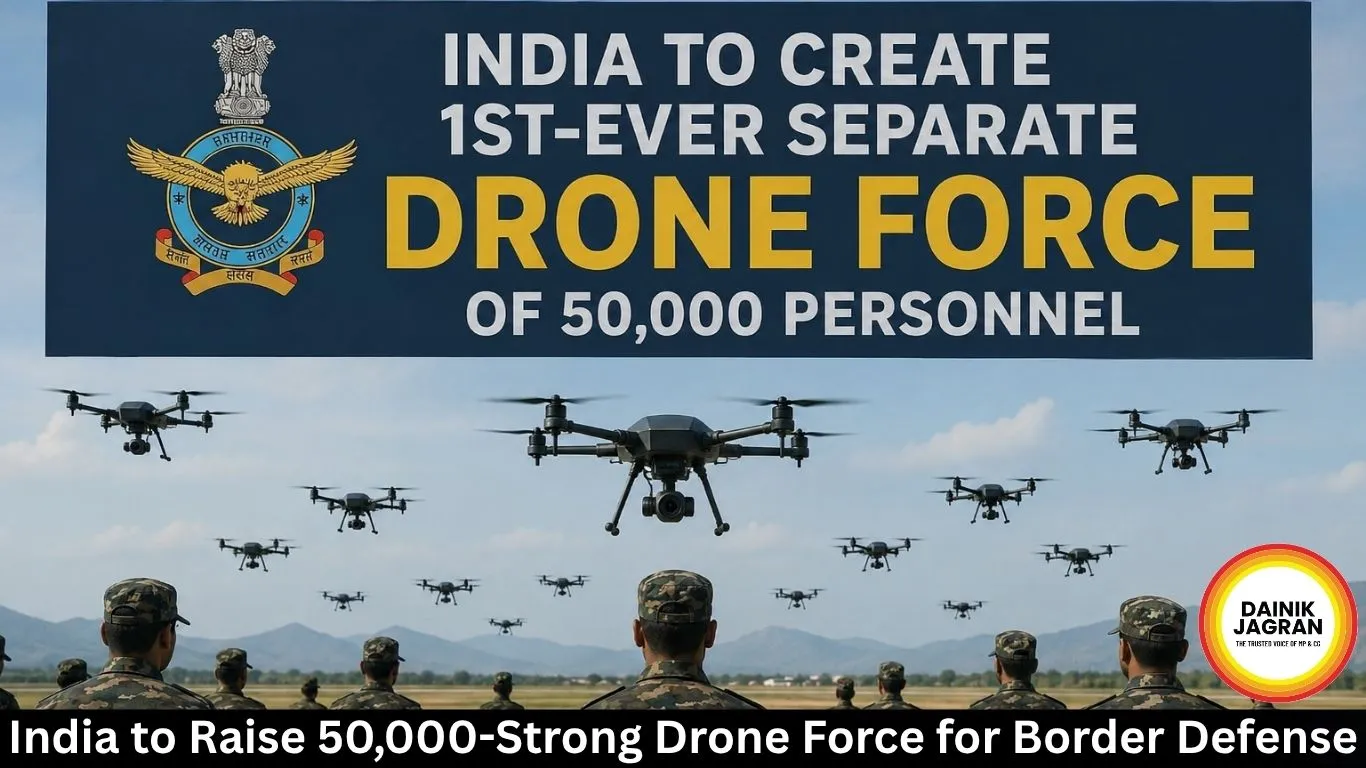
India to Raise 50,000-Strong Drone Force for Border Defense

Digital Desk

India to Raise 50,000-Strong Drone Force for Border Defense

India is creating a dedicated 50,000-personnel Drone Force including BSF and ITBP units to serve as first responders against modern military and swarm attacks.


India to Raise Dedicated 50,000-Strong Drone Force to Bolster Border Defense

In a significant shift toward modernizing its combat doctrine, India has initiated the creation of a first-of-its-kind dedicated Drone Force comprising 50,000 personnel. The specialized cadre is designed to serve as the "first responder" in military contingencies, marking a departure from traditional border management to a high-tech, proactive defense posture.

The decision, confirmed by officials within the Integrated Defence Headquarters, stems from critical tactical lessons learned during Operation Sindoor and contemporary global conflicts in Ukraine and West Asia. The force will not be limited to the tri-services; key paramilitary organizations like the Border Security Force (BSF) and the Indo-Tibetan Border Police (ITBP) are slated for integration to secure sensitive sectors along the Line of Control (LoC) and the Line of Actual Control (LAC).

Training and Technological Backbone

Currently, approximately 50,000 military personnel are undergoing specialized training to man this new wing. Over the next three years, the government plans to establish 15 'Centres of Excellence.' These hubs will move away from conventional drills, focusing instead on real-time battle scenarios utilizing high-fidelity simulators and Virtual Reality (VR) environments.

The force will operate under a sophisticated technological umbrella, supported by a dedicated data and cognitive warfare unit. Sources familiar with the project indicated that the system will be seamlessly linked with the Indian Air Force’s Integrated Air Command and Control System (IACCS) and the Army’s ‘Akashteer’ air defense network to ensure a synchronized response to aerial threats.

Countering Asymmetric Warfare

The move is largely a response to the evolving nature of cross-border threats. Last year, a massive coordinated attempt involving nearly 1,000 drones from the western border highlighted vulnerabilities in traditional air defense. The primary objective of such "swarms" is often to deplete expensive missile stockpiles against low-cost targets—an economic drain that the new Drone Force aims to mitigate.

To counter these tactics, the Indian armed forces are increasingly deploying a mix of "soft kill" methods, such as jamming and spoofing, alongside "hard kill" systems. The latter includes indigenous laser-based directed energy weapons designed to neutralize hostile UAVs at a fraction of the cost of a surface-to-air missile.

Empowerment at the Infantry Level

In what could be a game-changer for ground troops, the Army plans to decentralize drone usage. The roadmap suggests that basic drone training will eventually be imparted to every soldier within the force, with the long-term goal of providing personal drones to personnel on the battlefield. Each Army corps is expected to be equipped with nearly 8,000 units, cumulatively creating a massive domestic fleet of over one lakh drones for surveillance and precision strikes.

Boom in Defense Ecosystem

This strategic pivot is backed by a surging domestic defense industry, now valued at ₹1.54 lakh crore. The shift toward self-reliance is evident: nearly 75% of the ₹7.85 lakh crore defense budget is now being funneled into the domestic market.

This year alone has seen the birth of 120 defense startups, with at least 20 focusing exclusively on Artificial Intelligence (AI) and electronic warfare. Local firms like PTC Industries and Data Patterns have begun producing critical components, such as missile seekers and engines, which were previously imported from Russia.

Missile Maintenance and MRO

Parallel to the drone initiative, the Indian Air Force has secured a deal with European defense major MBDA. Under this agreement, the maintenance and mid-life overhaul of MICA air-to-air missiles—used by the Rafale fleet—will now happen on Indian soil. This domestic MRO (Maintenance, Repair, and Overhaul) capability is seen as a prerequisite for the upcoming acquisition of 114 multirole fighter aircraft.

Navigating Future Multi-Domain Wars

Military experts suggest that future warfare will no longer be linear but multi-domain. Retired Air Commodore Gaurav M Tripathi noted that the threat landscape is shifting toward "hardened" drones that are resistant to jamming and capable of GPS-independent navigation.

"The next phase of theater commands will require an integrated network—a web of communication rather than a chain," an official stated. By establishing this Drone Force, India aims to close existing gaps in its electronic and cyber warfare defenses, ensuring that its critical installations are shielded from the increasingly sophisticated swarm attacks seen in modern theaters of war.


--------

🚨 Beat the News Rush – Join Now!

Get breaking alerts, hot exclusives, and game-changing stories instantly on your phone. No delays, no fluff – just the edge you need. ⚡

Tap to join: 

🟢 WhatsApp Channel: Dainik Jagran MP CG

Crave more?

🅕 Facebook: Dainik Jagran MP CG English

🅧 Twitter (X): Dainik Jagran MP CG

🅘 Instagram: Dainik Jagran MP CG

Share the fire – keep your crew ahead! 🗞️🔥

english.dainikjagranmpcg.com
07 May 2026 By Abhishek Joshi

India to Raise 50,000-Strong Drone Force for Border Defense

Digital Desk

India to Raise Dedicated 50,000-Strong Drone Force to Bolster Border Defense

In a significant shift toward modernizing its combat doctrine, India has initiated the creation of a first-of-its-kind dedicated Drone Force comprising 50,000 personnel. The specialized cadre is designed to serve as the "first responder" in military contingencies, marking a departure from traditional border management to a high-tech, proactive defense posture.

The decision, confirmed by officials within the Integrated Defence Headquarters, stems from critical tactical lessons learned during Operation Sindoor and contemporary global conflicts in Ukraine and West Asia. The force will not be limited to the tri-services; key paramilitary organizations like the Border Security Force (BSF) and the Indo-Tibetan Border Police (ITBP) are slated for integration to secure sensitive sectors along the Line of Control (LoC) and the Line of Actual Control (LAC).

Training and Technological Backbone

Currently, approximately 50,000 military personnel are undergoing specialized training to man this new wing. Over the next three years, the government plans to establish 15 'Centres of Excellence.' These hubs will move away from conventional drills, focusing instead on real-time battle scenarios utilizing high-fidelity simulators and Virtual Reality (VR) environments.

The force will operate under a sophisticated technological umbrella, supported by a dedicated data and cognitive warfare unit. Sources familiar with the project indicated that the system will be seamlessly linked with the Indian Air Force’s Integrated Air Command and Control System (IACCS) and the Army’s ‘Akashteer’ air defense network to ensure a synchronized response to aerial threats.

Countering Asymmetric Warfare

The move is largely a response to the evolving nature of cross-border threats. Last year, a massive coordinated attempt involving nearly 1,000 drones from the western border highlighted vulnerabilities in traditional air defense. The primary objective of such "swarms" is often to deplete expensive missile stockpiles against low-cost targets—an economic drain that the new Drone Force aims to mitigate.

To counter these tactics, the Indian armed forces are increasingly deploying a mix of "soft kill" methods, such as jamming and spoofing, alongside "hard kill" systems. The latter includes indigenous laser-based directed energy weapons designed to neutralize hostile UAVs at a fraction of the cost of a surface-to-air missile.

Empowerment at the Infantry Level

In what could be a game-changer for ground troops, the Army plans to decentralize drone usage. The roadmap suggests that basic drone training will eventually be imparted to every soldier within the force, with the long-term goal of providing personal drones to personnel on the battlefield. Each Army corps is expected to be equipped with nearly 8,000 units, cumulatively creating a massive domestic fleet of over one lakh drones for surveillance and precision strikes.

Boom in Defense Ecosystem

This strategic pivot is backed by a surging domestic defense industry, now valued at ₹1.54 lakh crore. The shift toward self-reliance is evident: nearly 75% of the ₹7.85 lakh crore defense budget is now being funneled into the domestic market.

This year alone has seen the birth of 120 defense startups, with at least 20 focusing exclusively on Artificial Intelligence (AI) and electronic warfare. Local firms like PTC Industries and Data Patterns have begun producing critical components, such as missile seekers and engines, which were previously imported from Russia.

Missile Maintenance and MRO

Parallel to the drone initiative, the Indian Air Force has secured a deal with European defense major MBDA. Under this agreement, the maintenance and mid-life overhaul of MICA air-to-air missiles—used by the Rafale fleet—will now happen on Indian soil. This domestic MRO (Maintenance, Repair, and Overhaul) capability is seen as a prerequisite for the upcoming acquisition of 114 multirole fighter aircraft.

Navigating Future Multi-Domain Wars

Military experts suggest that future warfare will no longer be linear but multi-domain. Retired Air Commodore Gaurav M Tripathi noted that the threat landscape is shifting toward "hardened" drones that are resistant to jamming and capable of GPS-independent navigation.

"The next phase of theater commands will require an integrated network—a web of communication rather than a chain," an official stated. By establishing this Drone Force, India aims to close existing gaps in its electronic and cyber warfare defenses, ensuring that its critical installations are shielded from the increasingly sophisticated swarm attacks seen in modern theaters of war.


https://english.dainikjagranmpcg.com/special-news/india-to-raise-50000-strong-drone-force-for-border-defense/article-17877

Related Posts

Latest News

Suvendu Adhikari’s PA Murdered in West Bengal | Police Recover Bike Suvendu Adhikari’s PA Murdered in West Bengal | Police Recover Bike
Chandranath Rath, personal assistant to BJP leader Suvendu Adhikari, was killed in a suspected professional hit in West Bengal. Police...
Rain, Hail in North India; Rajkot Hottest at 42.9°C
Govt Schools Overhaul: Parents to Manage 15 Lakh Schools
J&K Bolsters Security with 1,500 New Village Defence Guards
Indian Railways AI Reservation System From August
Social Laws Need Public Buy-In, Says RSS Chief Bhagwat
Congress-DMK Clash in Mayiladuthurai as TN Govt Crisis Deepens


