

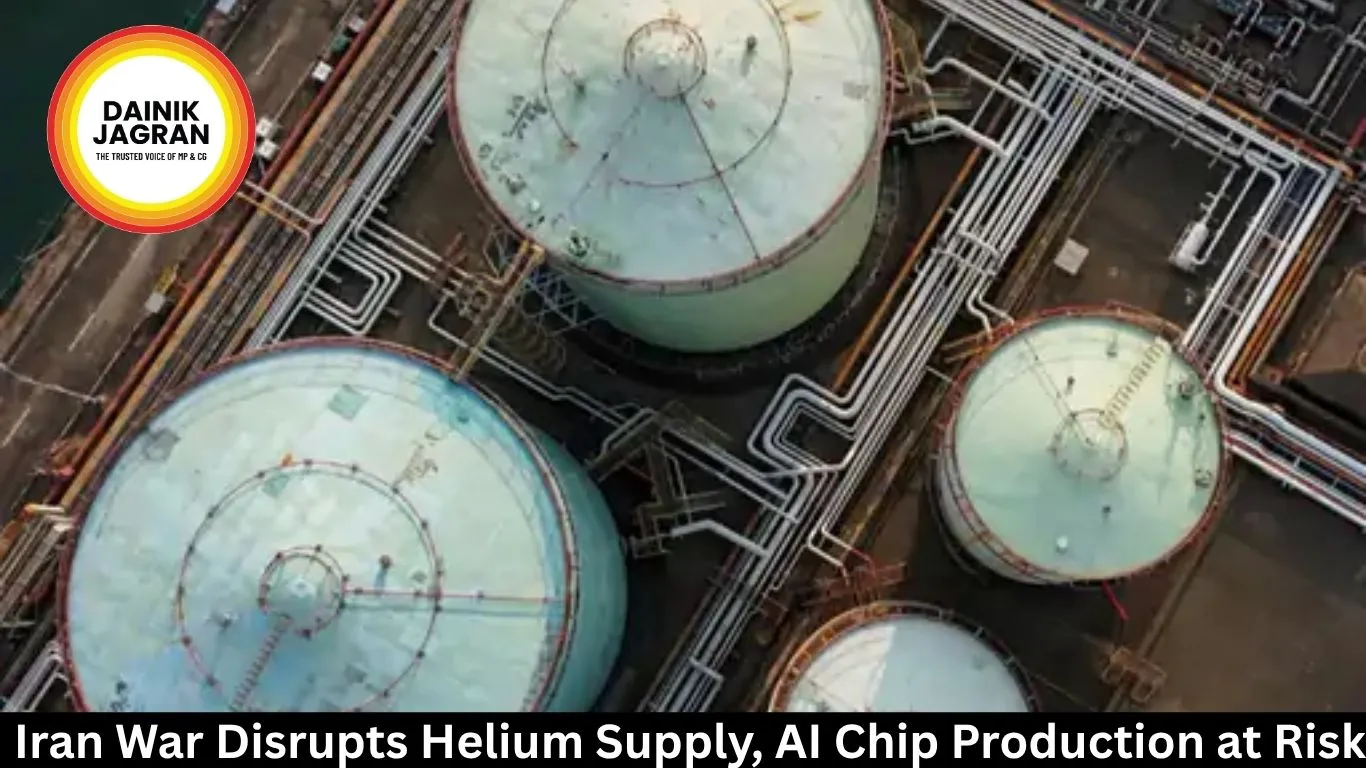
Iran War Disrupts Helium Supply, AI Chip Production at Risk

Digital Desk

Iran War Disrupts Helium Supply, AI Chip Production at Risk

 Iran's war on Qatar's gas facilities has halted helium exports, threatening global AI chip production. Spot prices have doubled as South Korea and Taiwan face supply shortages.

Iran War Chokes Helium Supply, Putting Global AI Chip Production on Alert

Qatar's Ras Laffan plant sustains extensive damage; spot helium prices have doubled in weeks, threatening chipmakers in South Korea, Taiwan, and beyond

From Balloons to Billion-Dollar Chips

When most people think of helium, party balloons come to mind. But inside the world's most advanced semiconductor factories, this colourless gas is as essential as electricity. The ongoing Iran war has now placed that supply under serious threat, triggering concern across the global technology industry over its potential impact on AI chip production.

Qatar's state-owned energy company QatarGas was forced to halt production of LNG and associated products after Iranian drone attacks, later declaring force majeure as it became unable to supply contracted customers. The disruption is now cascading far beyond energy markets.

Why Helium Powers AI Hardware

In chipmaking, fabricators rely on helium most critically during etching — the selective removal of material that gives a chip its features. An advanced AI chip can pack tens of billions of transistors, requiring extreme precision in temperature control. To maintain stability, fabs blow helium gas across the backs of wafers to draw away heat, and helium's exceptional thermal conductivity makes it uniquely effective for this purpose.

Crucially, there is no readily available substitute. The Semiconductor Industry Association warned in 2023 that if helium supplies were disrupted, there would likely be significant shocks to the global semiconductor manufacturing industry.

Qatar's Output Crippled

After Ras Laffan — the world's largest liquefied natural gas plant — was struck again by further Iranian missile attacks, QatarGas reported extensive damage that could take years to fully repair, and announced a 14% cut to annual helium exports.

Since mid-March, disruptions tied to halted gas processing in Qatar removed an estimated 5.2 million cubic metres of helium per month from the global market, triggering force majeure declarations and doubling spot prices.

Phil Kornbluth, president of Kornbluth Helium Consulting, told media that even an optimistic recovery scenario — partial production resuming within six weeks — now appears "highly unlikely."

South Korea and Taiwan Most Vulnerable

South Korea's semiconductor sector is particularly exposed, with the country importing around 65% of its helium from Qatar. Samsung Electronics and SK Hynix, the world's largest memory chip producers, likely hold several months of inventory but must accelerate efforts to secure alternative sources as the conflict continues.

Taiwan bought 69% of its helium from the Gulf Cooperation Council in 2024, according to analysts at Barclays, making it equally vulnerable to prolonged Middle East supply disruptions.

TSMC, for its part, said it does not anticipate a significant impact at this time but is continuing to monitor the situation closely.

Prices Spike Sharply

Bank of America estimated that spot helium prices have surged by as much as 40%, while Kornbluth put the figure at 70% to 100% in some markets within barely more than a week of the crisis erupting.

Wall Street banks including JPMorgan, Deutsche Bank, and Wells Fargo have flagged the tightening helium market as a positive trigger for industrial gas suppliers like Linde and Air Products, both of which have seen significant stock gains this year.

Strait of Hormuz Compounds the Crisis

Beyond production damage, the transportation of helium faces its own complications. With the effective closure of the Strait of Hormuz shipping route, more than 25% of the world's helium supply would be taken off the global market during an extended shutdown, further straining chipmakers dependent on Gulf exports.

Data centres in the Middle East have also come under direct attack from missile strikes. The region had been attracting massive investment in AI infrastructure from the U.S. and Gulf nations, but the energy security advantage those locations once offered can no longer be taken for granted.

Industry Watches, But Has Not Paused

Despite the alarm, industry analysts say the immediate damage remains contained. The Korea Semiconductor Industry Association indicated that short-term supplies are sufficient and that companies have been diversifying their sourcing routes. Experts note that chipmakers and medical imaging providers tend to receive priority allocations during shortages, while less critical industrial uses — including party balloons — are likely to see steep cuts.

AI companies themselves remain in strong financial shape, with Anthropic recently doubling its projected revenue run rate compared to late last year. Analysts say the war's energy impact may slow data centre expansion in the near term but could also accelerate the shift toward renewable energy sources and more efficient cooling technologies.

The broader message from the Iran conflict is hard to miss: the AI economy runs not just on data and code, but on physical supply chains that remain deeply exposed to geopolitical shocks — and helium is now squarely at the centre of that vulnerability.


--------

🚨 Beat the News Rush – Join Now!

Get breaking alerts, hot exclusives, and game-changing stories instantly on your phone. No delays, no fluff – just the edge you need. ⚡

Tap to join: 

🟢 WhatsApp Channel: Dainik Jagran MP CG

Crave more?

🅕 Facebook: Dainik Jagran MP CG English

🅧 Twitter (X): Dainik Jagran MP CG

🅘 Instagram: Dainik Jagran MP CG

Share the fire – keep your crew ahead! 🗞️🔥

english.dainikjagranmpcg.com
25 Mar 2026 By Abhishek Joshi

Iran War Disrupts Helium Supply, AI Chip Production at Risk

Digital Desk

Iran War Chokes Helium Supply, Putting Global AI Chip Production on Alert

Qatar's Ras Laffan plant sustains extensive damage; spot helium prices have doubled in weeks, threatening chipmakers in South Korea, Taiwan, and beyond

From Balloons to Billion-Dollar Chips

When most people think of helium, party balloons come to mind. But inside the world's most advanced semiconductor factories, this colourless gas is as essential as electricity. The ongoing Iran war has now placed that supply under serious threat, triggering concern across the global technology industry over its potential impact on AI chip production.

Qatar's state-owned energy company QatarGas was forced to halt production of LNG and associated products after Iranian drone attacks, later declaring force majeure as it became unable to supply contracted customers. The disruption is now cascading far beyond energy markets.

Why Helium Powers AI Hardware

In chipmaking, fabricators rely on helium most critically during etching — the selective removal of material that gives a chip its features. An advanced AI chip can pack tens of billions of transistors, requiring extreme precision in temperature control. To maintain stability, fabs blow helium gas across the backs of wafers to draw away heat, and helium's exceptional thermal conductivity makes it uniquely effective for this purpose.

Crucially, there is no readily available substitute. The Semiconductor Industry Association warned in 2023 that if helium supplies were disrupted, there would likely be significant shocks to the global semiconductor manufacturing industry.

Qatar's Output Crippled

After Ras Laffan — the world's largest liquefied natural gas plant — was struck again by further Iranian missile attacks, QatarGas reported extensive damage that could take years to fully repair, and announced a 14% cut to annual helium exports.

Since mid-March, disruptions tied to halted gas processing in Qatar removed an estimated 5.2 million cubic metres of helium per month from the global market, triggering force majeure declarations and doubling spot prices.

Phil Kornbluth, president of Kornbluth Helium Consulting, told media that even an optimistic recovery scenario — partial production resuming within six weeks — now appears "highly unlikely."

South Korea and Taiwan Most Vulnerable

South Korea's semiconductor sector is particularly exposed, with the country importing around 65% of its helium from Qatar. Samsung Electronics and SK Hynix, the world's largest memory chip producers, likely hold several months of inventory but must accelerate efforts to secure alternative sources as the conflict continues.

Taiwan bought 69% of its helium from the Gulf Cooperation Council in 2024, according to analysts at Barclays, making it equally vulnerable to prolonged Middle East supply disruptions.

TSMC, for its part, said it does not anticipate a significant impact at this time but is continuing to monitor the situation closely.

Prices Spike Sharply

Bank of America estimated that spot helium prices have surged by as much as 40%, while Kornbluth put the figure at 70% to 100% in some markets within barely more than a week of the crisis erupting.

Wall Street banks including JPMorgan, Deutsche Bank, and Wells Fargo have flagged the tightening helium market as a positive trigger for industrial gas suppliers like Linde and Air Products, both of which have seen significant stock gains this year.

Strait of Hormuz Compounds the Crisis

Beyond production damage, the transportation of helium faces its own complications. With the effective closure of the Strait of Hormuz shipping route, more than 25% of the world's helium supply would be taken off the global market during an extended shutdown, further straining chipmakers dependent on Gulf exports.

Data centres in the Middle East have also come under direct attack from missile strikes. The region had been attracting massive investment in AI infrastructure from the U.S. and Gulf nations, but the energy security advantage those locations once offered can no longer be taken for granted.

Industry Watches, But Has Not Paused

Despite the alarm, industry analysts say the immediate damage remains contained. The Korea Semiconductor Industry Association indicated that short-term supplies are sufficient and that companies have been diversifying their sourcing routes. Experts note that chipmakers and medical imaging providers tend to receive priority allocations during shortages, while less critical industrial uses — including party balloons — are likely to see steep cuts.

AI companies themselves remain in strong financial shape, with Anthropic recently doubling its projected revenue run rate compared to late last year. Analysts say the war's energy impact may slow data centre expansion in the near term but could also accelerate the shift toward renewable energy sources and more efficient cooling technologies.

The broader message from the Iran conflict is hard to miss: the AI economy runs not just on data and code, but on physical supply chains that remain deeply exposed to geopolitical shocks — and helium is now squarely at the centre of that vulnerability.


https://english.dainikjagranmpcg.com/special-news/iran-war-disrupts-helium-supply-ai-chip-production-at-risk/article-15953

Advertisement

Latest News


