

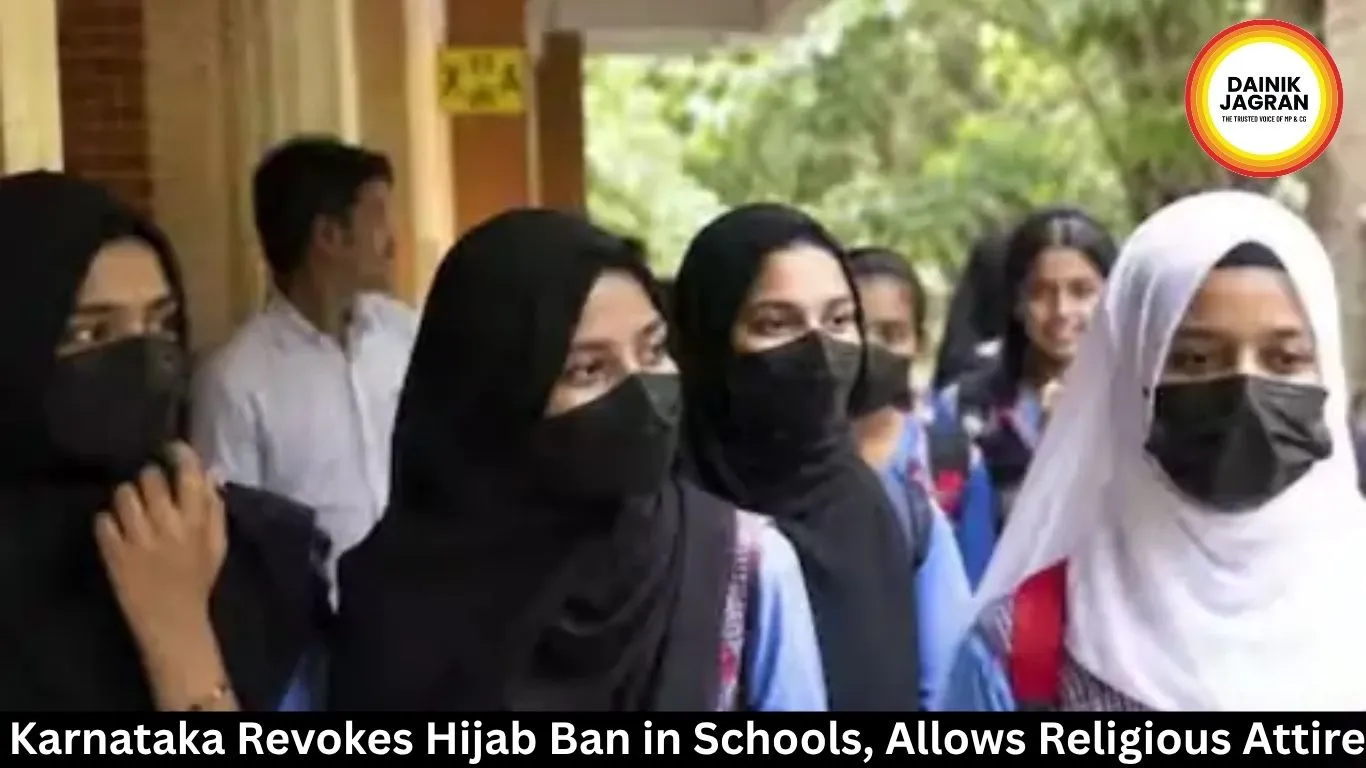
Karnataka Revokes Hijab Ban in Schools, Allows Religious Attire
Digital Desk
Karnataka government withdraws 2022 hijab ban in schools and colleges. New order permits hijab, kalava, rudraksha and janeu in classrooms under disciplinary rules.
New order permits hijab, kalava, rudraksha and janeu in classrooms under disciplinary guidelines
The Karnataka government has moved to reverse one of the state's most contentious education policies by formally withdrawing the 2022 hijab ban in schools and colleges. The new directive clears the way for students to wear hijab alongside other religious symbols including kalava, rudraksha and janeu, provided they adhere to institutional discipline and rules.
The decision marks a significant administrative shift nearly four years after the original prohibition sparked widespread unrest across the state's educational institutions.
The controversy erupted in late December 2021 when six Muslim girls at a college in Karnataka's Udupi district were prevented from attending classes in hijab. Their protest quickly snowballed into a statewide flashpoint. Within weeks, Hindu students began appearing in colleges wearing saffron shawls, turning educational spaces into flashpoints for religious tension.
By early 2022, sporadic violence had pushed the state government to intervene with what officials framed as a neutrality measure.
In February 2022, the then-BJP administration issued a sweeping order mandating uniform compliance across government pre-university colleges. The notification barred any clothing deemed to affect "equality, unity and public order" — language broad enough to encompass religious attire.
The effect was immediate and visible. Across government institutions, management began enforcing the directive, turning away hijab-wearing students from classrooms and enforcing what became known as the hijab ban.
The row reached Karnataka High Court by March 2022, where judges upheld the ban, ruling that hijab had not been established as an "essential religious practice" in Islam. The verdict appeared final, but Muslim organisations challenged it in the Supreme Court.
Nearly eight months later, in October 2022, a two-judge Supreme Court bench delivered what effectively became a stalemate. Justice Hemant Gupta sided with the state, supporting the ban. Justice Sudhanshu Dhulia disagreed sharply, arguing that student education and personal choice superseded uniform requirements and calling the ban misguided.
Because the judges split, constitutional precedent required referral to a larger bench for final determination. That larger bench has not delivered a ruling.
The legal limbo persisted for four years. While the larger Supreme Court bench remained seized of the matter, regular hearings stalled. The Karnataka High Court's 2022 order remained the operative legal position — technically still in force since the apex court had not completely overturned it.
Facing mounting pressure and an indefinite wait for judicial closure, the Congress government chose administrative action. Rather than wait further for the Supreme Court's larger bench, state authorities formally withdrew the ban order at the administrative level.
Students can now wear hijab in classrooms, reversing what had become a flashpoint in state education policy. The new framework also legitimises other religious symbols — kalava, rudraksha and janeu among them — provided students remain within school discipline and uniform norms where applicable.
The move effectively acknowledges that restricting religious expression had created more social friction than institutional order.
For students and families who endured the ban, the reversal offers relief after years of navigating school corridors with uncertainty. For some institutional administrators, it may require recalibrating dress code enforcement to balance inclusivity with school discipline.
The decision will likely close a chapter on one of Karnataka's most visible social policy disputes, though questions about implementation and institutional consistency may emerge as the new order settles into practice.
The larger Supreme Court bench, if and when it delivers its verdict, may offer constitutional finality — but administratively, the ban is now history.
--------
šØ Beat the News Rush ā Join Now!
Get breaking alerts, hot exclusives, and game-changing stories instantly on your phone. No delays, no fluff ā just the edge you need. ā”
Tap to join:Ā
š¢ WhatsApp Channel: Dainik Jagran MP CG
Crave more?
š Facebook: Dainik Jagran MP CG English
š § Twitter (X): Dainik Jagran MP CG
š Instagram: Dainik Jagran MP CG
Share the fire ā keep your crew ahead! šļøš„
Karnataka Revokes Hijab Ban in Schools, Allows Religious Attire
Digital Desk
New order permits hijab, kalava, rudraksha and janeu in classrooms under disciplinary guidelines
The Karnataka government has moved to reverse one of the state's most contentious education policies by formally withdrawing the 2022 hijab ban in schools and colleges. The new directive clears the way for students to wear hijab alongside other religious symbols including kalava, rudraksha and janeu, provided they adhere to institutional discipline and rules.
The decision marks a significant administrative shift nearly four years after the original prohibition sparked widespread unrest across the state's educational institutions.
The controversy erupted in late December 2021 when six Muslim girls at a college in Karnataka's Udupi district were prevented from attending classes in hijab. Their protest quickly snowballed into a statewide flashpoint. Within weeks, Hindu students began appearing in colleges wearing saffron shawls, turning educational spaces into flashpoints for religious tension.
By early 2022, sporadic violence had pushed the state government to intervene with what officials framed as a neutrality measure.
In February 2022, the then-BJP administration issued a sweeping order mandating uniform compliance across government pre-university colleges. The notification barred any clothing deemed to affect "equality, unity and public order" — language broad enough to encompass religious attire.
The effect was immediate and visible. Across government institutions, management began enforcing the directive, turning away hijab-wearing students from classrooms and enforcing what became known as the hijab ban.
The row reached Karnataka High Court by March 2022, where judges upheld the ban, ruling that hijab had not been established as an "essential religious practice" in Islam. The verdict appeared final, but Muslim organisations challenged it in the Supreme Court.
Nearly eight months later, in October 2022, a two-judge Supreme Court bench delivered what effectively became a stalemate. Justice Hemant Gupta sided with the state, supporting the ban. Justice Sudhanshu Dhulia disagreed sharply, arguing that student education and personal choice superseded uniform requirements and calling the ban misguided.
Because the judges split, constitutional precedent required referral to a larger bench for final determination. That larger bench has not delivered a ruling.
The legal limbo persisted for four years. While the larger Supreme Court bench remained seized of the matter, regular hearings stalled. The Karnataka High Court's 2022 order remained the operative legal position — technically still in force since the apex court had not completely overturned it.
Facing mounting pressure and an indefinite wait for judicial closure, the Congress government chose administrative action. Rather than wait further for the Supreme Court's larger bench, state authorities formally withdrew the ban order at the administrative level.
Students can now wear hijab in classrooms, reversing what had become a flashpoint in state education policy. The new framework also legitimises other religious symbols — kalava, rudraksha and janeu among them — provided students remain within school discipline and uniform norms where applicable.
The move effectively acknowledges that restricting religious expression had created more social friction than institutional order.
For students and families who endured the ban, the reversal offers relief after years of navigating school corridors with uncertainty. For some institutional administrators, it may require recalibrating dress code enforcement to balance inclusivity with school discipline.
The decision will likely close a chapter on one of Karnataka's most visible social policy disputes, though questions about implementation and institutional consistency may emerge as the new order settles into practice.
The larger Supreme Court bench, if and when it delivers its verdict, may offer constitutional finality — but administratively, the ban is now history.


