

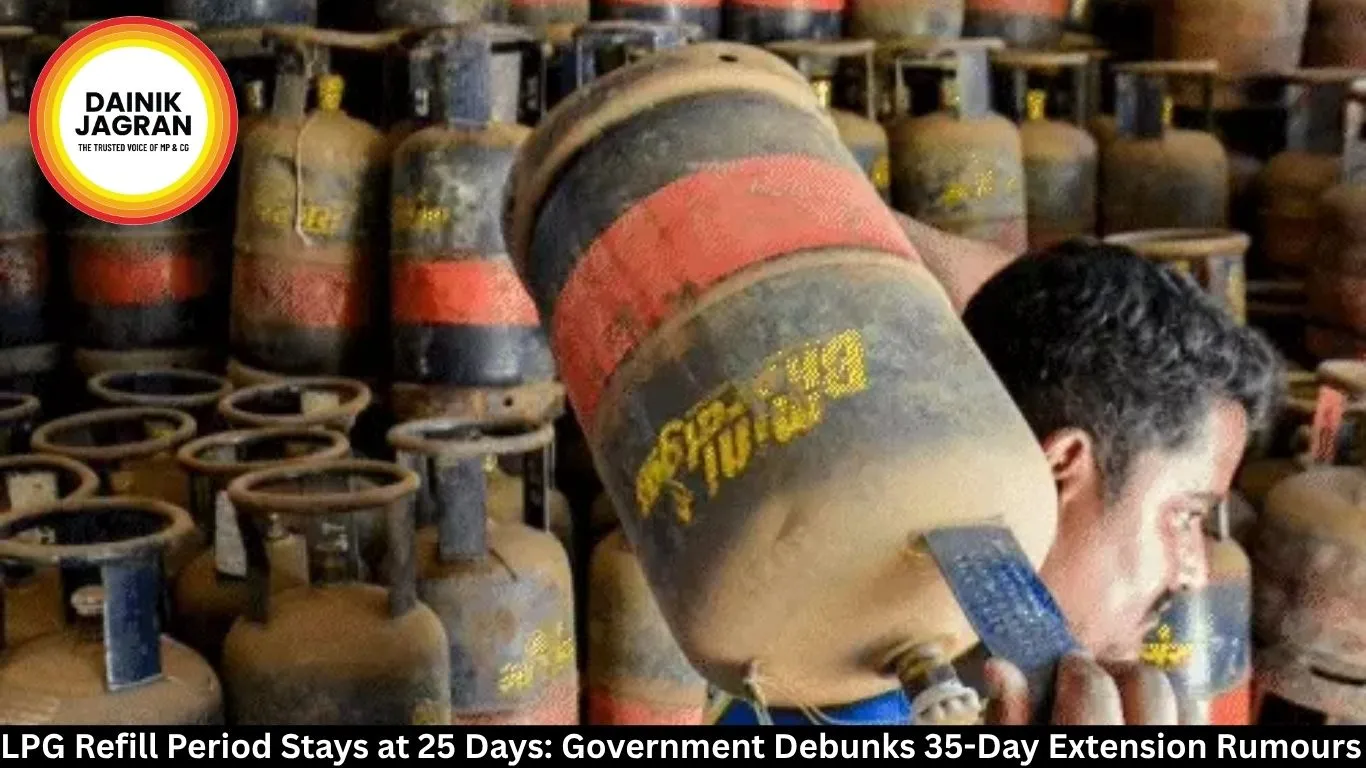
LPG Refill Period Stays at 25 Days: Government Debunks 35-Day Extension Rumours
Digital Desk
The Ministry of Petroleum and Natural Gas has clarified that the minimum LPG cylinder refill period stays at 25 days, debunking 35-day extension rumours. New Natural Gas and Petroleum Products Distribution Order 2026 pushes PNG adoption with strict timelines and penalties for delays. Latest India news update on government measures amid supply concerns.
The Ministry of Petroleum and Natural Gas on Wednesday clarified that the minimum refill period for 14.2 kg domestic LPG cylinders remains 25 days, firmly dismissing social media claims of an extension to 35 days as fake news. The clarification comes amid growing concerns over supply pressures triggered by the ongoing conflict in West Asia.
Officials stressed that no such change to 35 days has been made for double-cylinder connections or any other category. The government continues to monitor the situation closely to ensure equitable distribution of cooking gas across the country.
LPG Booking Rules Tightened
In recent weeks, the Centre has introduced several demand-side measures to manage LPG supplies. On March 9, authorities raised the minimum booking gap from 21 to 25 days in urban areas to curb panic buying and hoarding. For rural and difficult terrains, the gap was later set at 45 days. These steps aim to prevent misuse while maintaining steady availability for genuine households.
As of now, India has around 33.2 crore LPG connections, far outnumbering the 1.65 crore PNG connections. The ministry has urged consumers not to indulge in panic booking, assuring that normal deliveries continue without disruption.
New Order to Accelerate PNG Adoption
On Tuesday, the government notified the Natural Gas and Petroleum Products Distribution Order, 2026 under the Essential Commodities Act. The move seeks to fast-track piped natural gas infrastructure and reduce dependence on LPG cylinders amid global supply uncertainties.
The order introduces strict timelines for approvals and penal provisions for delays. Housing societies and resident welfare associations must grant permission for pipeline passage within three days of a request. Failure to do so could lead to suspension of LPG supply to the entire area after due process.
Key Provisions of the Distribution Order
Swift Approvals for Pipeline Projects
Government departments now face mandatory clearance deadlines — 10 days for small networks and 60 days for larger ones. Non-response within the stipulated time will be treated as deemed approval, allowing work to proceed without further delay.
Easing Land and Compensation Issues
To prevent prolonged litigation, the order provides a fixed compensation formula based on circle rates for private land used in pipeline laying. In case of disputes, the District Collector can intervene to ensure projects move forward without stalling supply chains.
Mandatory Shift Where PNG is Feasible
Households where PNG infrastructure is available or can be extended will receive a notice. They must take the piped gas connection, failing which LPG supply could be discontinued after 90 days. PNG users are already barred from retaining or refilling domestic LPG cylinders under a March 14 amendment.
Background and Policy Context
The measures follow earlier interventions this month. On March 6, a 21-day lock-in was introduced, which was quickly adjusted to 25 days in cities and extended further in rural areas. The March 14 notification made dual PNG-LPG connections illegal, requiring immediate surrender of LPG by those with piped gas.
These steps reflect the government’s strategy to promote cleaner, more efficient PNG while safeguarding subsidised LPG for households without access to pipelines. Global energy disruptions, particularly linked to West Asia, have prompted this calibrated response to avoid any domestic shortage.
Impact on Consumers and Industry
For millions of urban and rural families, the 25-day urban refill rule means slightly longer gaps between bookings compared to earlier norms. However, officials point out that average household consumption aligns well with this cycle, typically requiring 7-8 cylinders annually.
PNG, billed on actual usage, is generally considered more convenient and economical in the long run. It also eliminates the hassle of cylinder booking and delivery. Safety benefits are another plus, as piped gas reduces risks associated with cylinder handling.
Housing societies can no longer block pipeline projects arbitrarily, a frequent bottleneck in the past. This is expected to speed up city gas distribution networks significantly.
Exceptions and Relief Measures
The rules do not apply where technical constraints make PNG connection impossible. In such cases, LPG supply will continue uninterrupted. Consumers facing genuine difficulties can approach their distributors or local authorities for clarification.
What Lies Ahead
The government aims to expand PNG coverage rapidly through time-bound infrastructure rollout. Industry observers expect accelerated investment in city gas projects, supported by the investor-friendly provisions in the new order.
As implementation begins, officials have appealed for public cooperation. Consumers are advised to check official notifications from oil marketing companies and avoid unverified social media claims that could cause unnecessary panic.
In the final analysis, these government updates on LPG and PNG seek to balance immediate supply management with long-term transition to a cleaner fuel ecosystem. Households are encouraged to stay informed through authorised channels for smooth adaptation.
LPG Refill Period Stays at 25 Days: Government Debunks 35-Day Extension Rumours
Digital Desk
The Ministry of Petroleum and Natural Gas on Wednesday clarified that the minimum refill period for 14.2 kg domestic LPG cylinders remains 25 days, firmly dismissing social media claims of an extension to 35 days as fake news. The clarification comes amid growing concerns over supply pressures triggered by the ongoing conflict in West Asia.
Officials stressed that no such change to 35 days has been made for double-cylinder connections or any other category. The government continues to monitor the situation closely to ensure equitable distribution of cooking gas across the country.
LPG Booking Rules Tightened
In recent weeks, the Centre has introduced several demand-side measures to manage LPG supplies. On March 9, authorities raised the minimum booking gap from 21 to 25 days in urban areas to curb panic buying and hoarding. For rural and difficult terrains, the gap was later set at 45 days. These steps aim to prevent misuse while maintaining steady availability for genuine households.
As of now, India has around 33.2 crore LPG connections, far outnumbering the 1.65 crore PNG connections. The ministry has urged consumers not to indulge in panic booking, assuring that normal deliveries continue without disruption.
New Order to Accelerate PNG Adoption
On Tuesday, the government notified the Natural Gas and Petroleum Products Distribution Order, 2026 under the Essential Commodities Act. The move seeks to fast-track piped natural gas infrastructure and reduce dependence on LPG cylinders amid global supply uncertainties.
The order introduces strict timelines for approvals and penal provisions for delays. Housing societies and resident welfare associations must grant permission for pipeline passage within three days of a request. Failure to do so could lead to suspension of LPG supply to the entire area after due process.
Key Provisions of the Distribution Order
Swift Approvals for Pipeline Projects
Government departments now face mandatory clearance deadlines — 10 days for small networks and 60 days for larger ones. Non-response within the stipulated time will be treated as deemed approval, allowing work to proceed without further delay.
Easing Land and Compensation Issues
To prevent prolonged litigation, the order provides a fixed compensation formula based on circle rates for private land used in pipeline laying. In case of disputes, the District Collector can intervene to ensure projects move forward without stalling supply chains.
Mandatory Shift Where PNG is Feasible
Households where PNG infrastructure is available or can be extended will receive a notice. They must take the piped gas connection, failing which LPG supply could be discontinued after 90 days. PNG users are already barred from retaining or refilling domestic LPG cylinders under a March 14 amendment.
Background and Policy Context
The measures follow earlier interventions this month. On March 6, a 21-day lock-in was introduced, which was quickly adjusted to 25 days in cities and extended further in rural areas. The March 14 notification made dual PNG-LPG connections illegal, requiring immediate surrender of LPG by those with piped gas.
These steps reflect the government’s strategy to promote cleaner, more efficient PNG while safeguarding subsidised LPG for households without access to pipelines. Global energy disruptions, particularly linked to West Asia, have prompted this calibrated response to avoid any domestic shortage.
Impact on Consumers and Industry
For millions of urban and rural families, the 25-day urban refill rule means slightly longer gaps between bookings compared to earlier norms. However, officials point out that average household consumption aligns well with this cycle, typically requiring 7-8 cylinders annually.
PNG, billed on actual usage, is generally considered more convenient and economical in the long run. It also eliminates the hassle of cylinder booking and delivery. Safety benefits are another plus, as piped gas reduces risks associated with cylinder handling.
Housing societies can no longer block pipeline projects arbitrarily, a frequent bottleneck in the past. This is expected to speed up city gas distribution networks significantly.
Exceptions and Relief Measures
The rules do not apply where technical constraints make PNG connection impossible. In such cases, LPG supply will continue uninterrupted. Consumers facing genuine difficulties can approach their distributors or local authorities for clarification.
What Lies Ahead
The government aims to expand PNG coverage rapidly through time-bound infrastructure rollout. Industry observers expect accelerated investment in city gas projects, supported by the investor-friendly provisions in the new order.
As implementation begins, officials have appealed for public cooperation. Consumers are advised to check official notifications from oil marketing companies and avoid unverified social media claims that could cause unnecessary panic.
In the final analysis, these government updates on LPG and PNG seek to balance immediate supply management with long-term transition to a cleaner fuel ecosystem. Households are encouraged to stay informed through authorised channels for smooth adaptation.


