

Nita Ambani's ₹11 Lakh Jamdani Saree Highlights India's Saree Industry Value

Digital Desk

Nita Ambani's ₹11 Lakh Jamdani Saree Highlights India's Saree Industry Value

 Nita Ambani wore a ₹11 lakh Jamdani saree at TIME100 Summit. Discover how India's saree industry employs 4.5 crore people and generates ₹57,000 crore annually—a heritage textile legacy.


Nita Ambani's ₹11 Lakh Jamdani Saree Shines at US Summit, Spotlights India's Thriving Textile Legacy

Masterpiece took two years to weave; saree industry employs 4.5 crore people across India

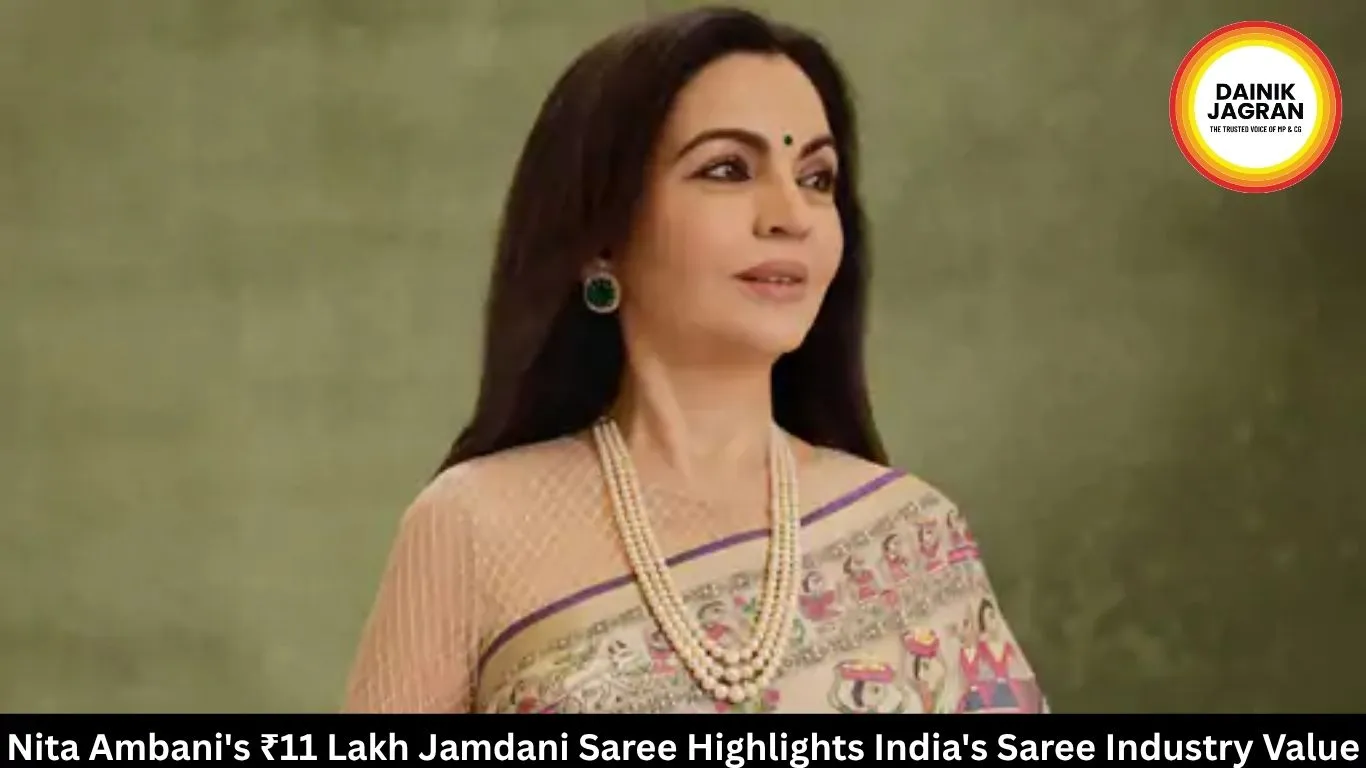
Nita Ambani's appearance at the TIME100 Summit in New York this week sparked considerable interest, not just for her presence but for the exquisite cream-coloured Jamdani saree she wore—a piece valued at approximately ₹11 lakh. The handwoven marvel, crafted over two years by West Bengal-based Padma Shri awardee Biren Kumar Basak, has once again brought international attention to India's heritage textile industry, a sector that continues to employ millions and generate over ₹57,000 crore annually.

The Masterpiece Behind the Moment

The saree that caught global attention is far more than fabric. It represents meticulous artisanship—a Meenakari Jamdani creation handwoven in Phulia, West Bengal, featuring intricate depictions of Bengal's textile legacy with animal and tree motifs embedded throughout. The piece was sourced through Swadesh, a Reliance Foundation initiative dedicated to promoting Indian heritage crafts.

Biren Kumar Basak, whose enterprise clocks over ₹50 crore in annual business, has become one of the country's most sought-after saree weavers. His clientele spans from Prime Minister Narendra Modi to West Bengal Chief Minister Mamata Banerjee. According to Basak, such bespoke creations reflect the painstaking labour involved—handwork that can span months or even years.

Understanding Jamdani: Tradition Meets Craft

Jamdani represents one of India's most celebrated weaving traditions. The technique involves intricate hand-weaving that produces remarkably thin, delicate fabric adorned with elaborate floral patterns. Predominantly woven in West Bengal, with significant production also occurring in Hyderabad, Jamdani sarees have remained synonymous with cultural sophistication and refined taste across generations.

Celebrities and dignitaries have long favoured the style. Late renowned singers Asha Bhosle and Lata Mangeshkar were notable patrons, as are members of prominent political families. West Bengal Chief Minister Mamata Banerjee, known for her signature white sarees, predominantly wears Jamdani pieces—typically selecting lower-range variants priced around ₹3,000, according to Basak.

The Price Range and Accessibility

Jamdani sarees span a wide pricing spectrum, determined largely by the complexity and extent of handwork involved. According to Basak, prices range from a few thousand rupees to well over one lakh. Premium pieces like Ambani's represent the zenith of craftsmanship—years of labour concentrated into a single garment.

"We also craft Jamdani kurtas and have presented handcrafted Jamdani-style sheets to dignitaries," noted Basak in remarks highlighting the versatility of the traditional technique beyond conventional saree-making.

A ₹57,000 Crore Industry Sustaining Millions

India's saree market, valued at over ₹57,000 crore in 2025 according to IMARC Group data, continues expanding annually. Despite the popularity of contemporary clothing, the saree remains the undisputed centrepiece of Indian fashion, transcending regional and generational boundaries.

The scale of employment within this sector is staggering. The Ministry of Textiles indicates that more than 4.5 crore individuals work directly in the textile sector nationally. Within handloom weaving specifically—the domain producing traditional sarees like Jamdani, Banarasi, and Kanchipuram varieties—over 43 lakh weavers operate across India.

Rural Lifeline and Economic Backbone

The saree industry functions as a crucial economic lifeline in rural India. While factory-based manufacturing contributes to overall production, millions of families in small villages sustain themselves through home-based saree weaving. This distributed model has allowed the sector to remain resilient and inclusive, providing dignified livelihoods across countless communities.

Each saree purchase extends beyond acquiring a garment. It represents direct economic support to an industry generating ₹57,000 crore annually and providing sustenance to over 4.5 crore workers—a chain of value that connects international runways with village looms.

India's Heritage Textiles Gain Global Recognition

Nita Ambani's appearance at a prestigious international summit wearing an Indian heritage saree signals renewed global appreciation for the country's textile craftsmanship. As modern fashion trends evolve, India's traditional weaving techniques continue demonstrating their relevance and value on the world stage.

The saree industry represents more than commerce—it embodies cultural continuity, artisanal excellence, and economic opportunity intertwined. Each handwoven piece carries the skill of generations, the investment of countless hours, and the aspirations of entire rural communities dependent on this ancient craft.

What Lies Ahead

As the Indian saree market expands and international interest grows, the focus remains on sustaining traditional weaving practices while supporting the livelihoods of millions. Initiatives like Swadesh demonstrate how heritage craft promotion can merge cultural preservation with economic empowerment, ensuring that India's textile legacy continues thriving for generations to come.


--------

🚨 Beat the News Rush – Join Now!

Get breaking alerts, hot exclusives, and game-changing stories instantly on your phone. No delays, no fluff – just the edge you need. ⚡

Tap to join: 

🟢 WhatsApp Channel: Dainik Jagran MP CG

Crave more?

🅕 Facebook: Dainik Jagran MP CG English

🅧 Twitter (X): Dainik Jagran MP CG

🅘 Instagram: Dainik Jagran MP CG

Share the fire – keep your crew ahead! 🗞️🔥

english.dainikjagranmpcg.com
25 Apr 2026 By Abhishek Joshi

Nita Ambani's ₹11 Lakh Jamdani Saree Highlights India's Saree Industry Value

Digital Desk

Nita Ambani's ₹11 Lakh Jamdani Saree Shines at US Summit, Spotlights India's Thriving Textile Legacy

Masterpiece took two years to weave; saree industry employs 4.5 crore people across India

Nita Ambani's appearance at the TIME100 Summit in New York this week sparked considerable interest, not just for her presence but for the exquisite cream-coloured Jamdani saree she wore—a piece valued at approximately ₹11 lakh. The handwoven marvel, crafted over two years by West Bengal-based Padma Shri awardee Biren Kumar Basak, has once again brought international attention to India's heritage textile industry, a sector that continues to employ millions and generate over ₹57,000 crore annually.

The Masterpiece Behind the Moment

The saree that caught global attention is far more than fabric. It represents meticulous artisanship—a Meenakari Jamdani creation handwoven in Phulia, West Bengal, featuring intricate depictions of Bengal's textile legacy with animal and tree motifs embedded throughout. The piece was sourced through Swadesh, a Reliance Foundation initiative dedicated to promoting Indian heritage crafts.

Biren Kumar Basak, whose enterprise clocks over ₹50 crore in annual business, has become one of the country's most sought-after saree weavers. His clientele spans from Prime Minister Narendra Modi to West Bengal Chief Minister Mamata Banerjee. According to Basak, such bespoke creations reflect the painstaking labour involved—handwork that can span months or even years.

Understanding Jamdani: Tradition Meets Craft

Jamdani represents one of India's most celebrated weaving traditions. The technique involves intricate hand-weaving that produces remarkably thin, delicate fabric adorned with elaborate floral patterns. Predominantly woven in West Bengal, with significant production also occurring in Hyderabad, Jamdani sarees have remained synonymous with cultural sophistication and refined taste across generations.

Celebrities and dignitaries have long favoured the style. Late renowned singers Asha Bhosle and Lata Mangeshkar were notable patrons, as are members of prominent political families. West Bengal Chief Minister Mamata Banerjee, known for her signature white sarees, predominantly wears Jamdani pieces—typically selecting lower-range variants priced around ₹3,000, according to Basak.

The Price Range and Accessibility

Jamdani sarees span a wide pricing spectrum, determined largely by the complexity and extent of handwork involved. According to Basak, prices range from a few thousand rupees to well over one lakh. Premium pieces like Ambani's represent the zenith of craftsmanship—years of labour concentrated into a single garment.

"We also craft Jamdani kurtas and have presented handcrafted Jamdani-style sheets to dignitaries," noted Basak in remarks highlighting the versatility of the traditional technique beyond conventional saree-making.

A ₹57,000 Crore Industry Sustaining Millions

India's saree market, valued at over ₹57,000 crore in 2025 according to IMARC Group data, continues expanding annually. Despite the popularity of contemporary clothing, the saree remains the undisputed centrepiece of Indian fashion, transcending regional and generational boundaries.

The scale of employment within this sector is staggering. The Ministry of Textiles indicates that more than 4.5 crore individuals work directly in the textile sector nationally. Within handloom weaving specifically—the domain producing traditional sarees like Jamdani, Banarasi, and Kanchipuram varieties—over 43 lakh weavers operate across India.

Rural Lifeline and Economic Backbone

The saree industry functions as a crucial economic lifeline in rural India. While factory-based manufacturing contributes to overall production, millions of families in small villages sustain themselves through home-based saree weaving. This distributed model has allowed the sector to remain resilient and inclusive, providing dignified livelihoods across countless communities.

Each saree purchase extends beyond acquiring a garment. It represents direct economic support to an industry generating ₹57,000 crore annually and providing sustenance to over 4.5 crore workers—a chain of value that connects international runways with village looms.

India's Heritage Textiles Gain Global Recognition

Nita Ambani's appearance at a prestigious international summit wearing an Indian heritage saree signals renewed global appreciation for the country's textile craftsmanship. As modern fashion trends evolve, India's traditional weaving techniques continue demonstrating their relevance and value on the world stage.

The saree industry represents more than commerce—it embodies cultural continuity, artisanal excellence, and economic opportunity intertwined. Each handwoven piece carries the skill of generations, the investment of countless hours, and the aspirations of entire rural communities dependent on this ancient craft.

What Lies Ahead

As the Indian saree market expands and international interest grows, the focus remains on sustaining traditional weaving practices while supporting the livelihoods of millions. Initiatives like Swadesh demonstrate how heritage craft promotion can merge cultural preservation with economic empowerment, ensuring that India's textile legacy continues thriving for generations to come.


https://english.dainikjagranmpcg.com/special-news/nita-ambanis-%E2%82%B911-lakh-jamdani-saree-highlights-indias-saree-industry/article-17345

Related Posts

Latest News


