Rubio Hints Major US-Iran Deal Announcement Today
Digital Desk
US Secretary of State Marco Rubio signals major announcement on US-Iran conflict likely today as Tehran eyes final agreement in 30-60 days. Trump says deal largely negotiated including Strait of Hormuz reopening. India monitors fuel price impact.
US Secretary of State Marco Rubio has indicated that a significant announcement regarding the ongoing US-Iran conflict could come within hours, sparking cautious optimism about a possible diplomatic resolution. Speaking in New Delhi, Rubio described recent developments as “good news on that front,” raising expectations of progress in talks that have drawn global attention.
Iranian officials, meanwhile, struck a more measured tone. Foreign Ministry spokesman Esmaeil Baqaei acknowledged a “trend towards rapprochement” but clarified that it did not guarantee agreement on core issues. He said both sides were working on a framework memorandum of understanding with 14 clauses, hoping a final deal could be hammered out within 30 to 60 days after that.
Trump Claims Deal Largely Negotiated
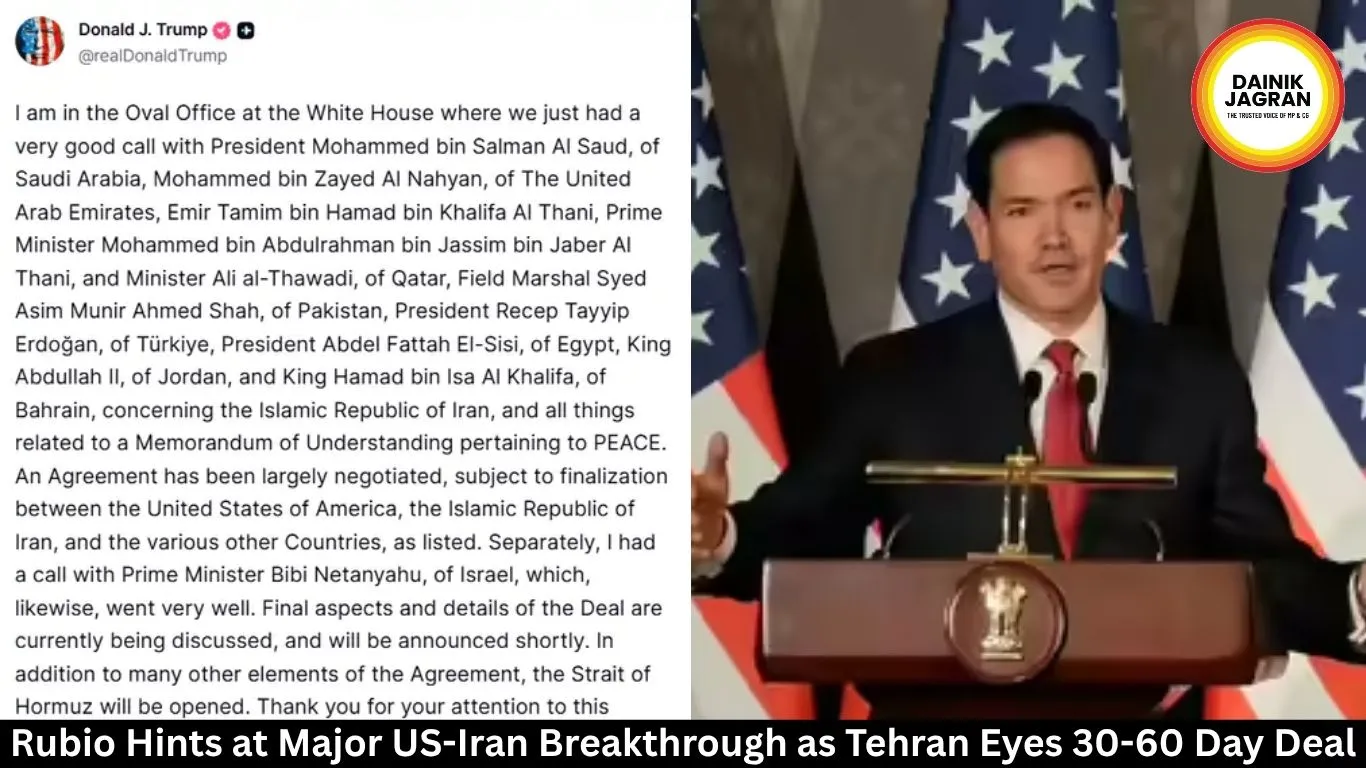
US President Donald Trump added to the momentum, posting on Truth Social that an agreement had been “largely negotiated,” subject to finalisation. The proposed deal reportedly includes reopening the Strait of Hormuz for normal shipping, a critical chokepoint for global oil trade. Trump mentioned involvement of several regional countries, including Pakistan as a key mediator.
Sources familiar with the discussions say the understanding involves a 60-day ceasefire extension, gradual reopening of the Strait, and steps on Iran’s nuclear programme, including potential removal of highly enriched uranium stockpiles. In return, the US may ease some sanctions and restrictions on Iranian ports and oil sales.
India’s Cautious Stand Amid Rising Fuel Prices
India’s External Affairs Minister S. Jaishankar, who appeared alongside Rubio, emphasised the need for market stability. He said India would continue diversifying its energy sources at reasonable prices, reflecting concerns over the West Asia crisis. Petrol and diesel prices in Delhi have climbed again to ₹99.51 and ₹92.49 per litre respectively, adding pressure on households and the economy.
International Reactions and Regional Concerns
The potential deal has elicited mixed responses. UK Prime Minister Keir Starmer welcomed progress but insisted the Strait of Hormuz must reopen with unconditional freedom of navigation and that Iran must never develop nuclear weapons. Turkish President Recep Tayyip Erdogan offered Ankara’s support for implementation, while Pakistan described the latest diplomatic efforts as a major step towards regional peace.
However, divisions have surfaced within the US Republican Party. Senator Ted Cruz expressed deep concerns, while former CIA Director Mike Pompeo criticised the emerging framework. Trump’s communications team pushed back strongly against internal critics.
Israel has also voiced reservations. Former Defence Minister Benny Gantz warned against linking any Lebanon ceasefire to the Iran deal, saying it could embolden Hezbollah. Israeli strikes continued in southern Lebanon on Sunday, with reports of casualties in Tyre and Nabatieh areas.
Ground Realities in Iran and Beyond
Inside Iran, challenges persist. The country’s internet blackout entered its 86th day, severely limiting external communication. The digital hardware market continues to suffer from shortages and volatile prices due to disrupted imports. Iranian officials, including President Masoud Pezeshkian, have stressed that any final decision requires approval from Supreme Leader Mojtaba Khamenei.
Tehran has rejected claims of fully ceding control over the Strait of Hormuz, insisting it would only allow pre-war levels of shipping while retaining management authority. Revolutionary Guards commanders warned of a strong response to any new attacks.
What Lies Ahead
With mediators working overtime, the coming hours could prove decisive. While a major announcement appears imminent, bridging remaining differences on one or two clauses in the framework agreement remains crucial. For India and the world, any breakthrough that stabilises energy routes and eases tensions in West Asia would bring much-needed relief.
The situation continues to evolve rapidly. Diplomatic circles in New Delhi and other capitals are watching closely as the day unfolds.
--------
🚨 Beat the News Rush – Join Now!
Get breaking alerts, hot exclusives, and game-changing stories instantly on your phone. No delays, no fluff – just the edge you need. ⚡
Tap to join:
🟢 WhatsApp Channel: Dainik Jagran MP CG
Crave more?
🅕 Facebook: Dainik Jagran MP CG English
🅧 Twitter (X): Dainik Jagran MP CG
🅘 Instagram: Dainik Jagran MP CG
Share the fire – keep your crew ahead! 🗞️🔥
Rubio Hints Major US-Iran Deal Announcement Today
Digital Desk
US Secretary of State Marco Rubio has indicated that a significant announcement regarding the ongoing US-Iran conflict could come within hours, sparking cautious optimism about a possible diplomatic resolution. Speaking in New Delhi, Rubio described recent developments as “good news on that front,” raising expectations of progress in talks that have drawn global attention.
Iranian officials, meanwhile, struck a more measured tone. Foreign Ministry spokesman Esmaeil Baqaei acknowledged a “trend towards rapprochement” but clarified that it did not guarantee agreement on core issues. He said both sides were working on a framework memorandum of understanding with 14 clauses, hoping a final deal could be hammered out within 30 to 60 days after that.
Trump Claims Deal Largely Negotiated
US President Donald Trump added to the momentum, posting on Truth Social that an agreement had been “largely negotiated,” subject to finalisation. The proposed deal reportedly includes reopening the Strait of Hormuz for normal shipping, a critical chokepoint for global oil trade. Trump mentioned involvement of several regional countries, including Pakistan as a key mediator.
Sources familiar with the discussions say the understanding involves a 60-day ceasefire extension, gradual reopening of the Strait, and steps on Iran’s nuclear programme, including potential removal of highly enriched uranium stockpiles. In return, the US may ease some sanctions and restrictions on Iranian ports and oil sales.
India’s Cautious Stand Amid Rising Fuel Prices
India’s External Affairs Minister S. Jaishankar, who appeared alongside Rubio, emphasised the need for market stability. He said India would continue diversifying its energy sources at reasonable prices, reflecting concerns over the West Asia crisis. Petrol and diesel prices in Delhi have climbed again to ₹99.51 and ₹92.49 per litre respectively, adding pressure on households and the economy.
International Reactions and Regional Concerns
The potential deal has elicited mixed responses. UK Prime Minister Keir Starmer welcomed progress but insisted the Strait of Hormuz must reopen with unconditional freedom of navigation and that Iran must never develop nuclear weapons. Turkish President Recep Tayyip Erdogan offered Ankara’s support for implementation, while Pakistan described the latest diplomatic efforts as a major step towards regional peace.
However, divisions have surfaced within the US Republican Party. Senator Ted Cruz expressed deep concerns, while former CIA Director Mike Pompeo criticised the emerging framework. Trump’s communications team pushed back strongly against internal critics.
Israel has also voiced reservations. Former Defence Minister Benny Gantz warned against linking any Lebanon ceasefire to the Iran deal, saying it could embolden Hezbollah. Israeli strikes continued in southern Lebanon on Sunday, with reports of casualties in Tyre and Nabatieh areas.
Ground Realities in Iran and Beyond
Inside Iran, challenges persist. The country’s internet blackout entered its 86th day, severely limiting external communication. The digital hardware market continues to suffer from shortages and volatile prices due to disrupted imports. Iranian officials, including President Masoud Pezeshkian, have stressed that any final decision requires approval from Supreme Leader Mojtaba Khamenei.
Tehran has rejected claims of fully ceding control over the Strait of Hormuz, insisting it would only allow pre-war levels of shipping while retaining management authority. Revolutionary Guards commanders warned of a strong response to any new attacks.
What Lies Ahead
With mediators working overtime, the coming hours could prove decisive. While a major announcement appears imminent, bridging remaining differences on one or two clauses in the framework agreement remains crucial. For India and the world, any breakthrough that stabilises energy routes and eases tensions in West Asia would bring much-needed relief.
The situation continues to evolve rapidly. Diplomatic circles in New Delhi and other capitals are watching closely as the day unfolds.