

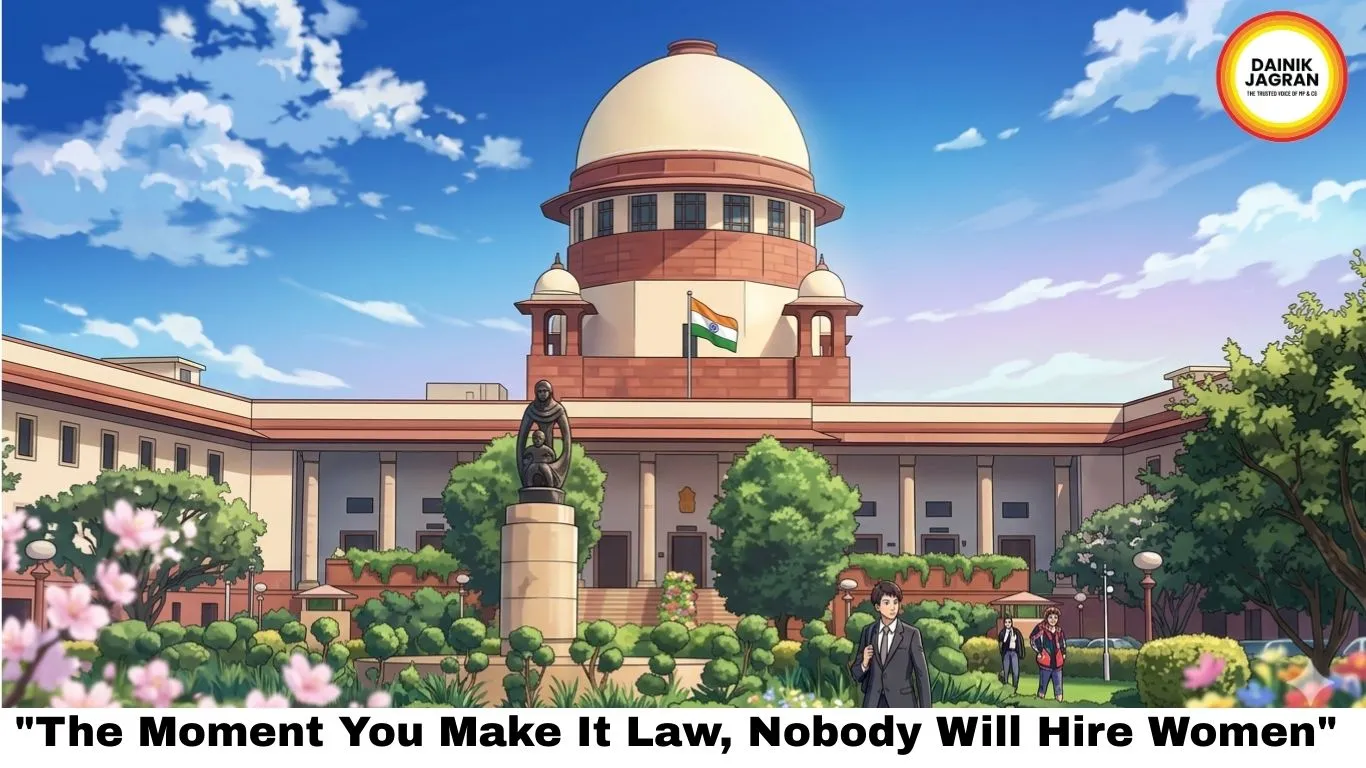
Supreme Court on Menstrual Leave: "The Moment You Make It Law, Nobody Will Hire Women" — CJI Surya Kant Declines PIL, Warns of Career Damage and Gender Stereotype Reinforcement

Digital Desk

Supreme Court on Menstrual Leave:

Supreme Court declines PIL for nationwide compulsory menstrual leave. CJI Surya Kant warns mandatory law will stop employers hiring women. Voluntary policies "excellent." Full ruling explained.

India's Highest Court Just Declined to Make Menstrual Leave the Law — Here Is Exactly Why

Today, March 13, 2026, a bench of the Supreme Court of India comprising Chief Justice Surya Kant and Justice Joymalya Bagchi declined to entertain a public interest litigation seeking a nationwide compulsory menstrual leave policy for women students and workers across India. The PIL was filed by advocate Shailendra Mani Tripathi.

The court's reasoning was precise, pointed — and immediately controversial. Its core argument: making menstrual leave compulsory by law would cause employers to stop hiring women altogether, doing far more harm to women's professional lives than the biological reality it was trying to address.


What the Court Actually Said: Key Observations

"Voluntarily given is excellent. The moment you say it is compulsory in law, nobody will give them jobs. Nobody will take them in the judiciary or government jobs; their career will be over," CJI Surya Kant said during the hearing. News9live

"Creating awareness and sensitisation is different… but the moment you bring in a law mandating menstrual leave, nobody will hire them," the CJI added. "You don't know the mindset of employers. They will not hire women if we make such a law." Asianet Newsable

The bench went further, questioning the very framing of the PIL itself: "These pleas are made to create fear, to call women inferior, that menstruation is something bad happening to them. This is an affirmative right. But think about the employer who needs to give paid leave." LatestLY

The CJI warned of the most damaging possible outcome: employers telling women to "sit at home after informing everyone" — effectively using the mandated leave as a justification for discrimination in hiring. Deccan Chronicle

The bench also warned that a compulsory legal mandate could generate a psychological impression among working women themselves that they are seen as "less than" their male counterparts — reinforcing the very inferiority narrative the PIL was ostensibly fighting against. ThePrint


What the Petitioner Argued: The Case for Menstrual Leave

Senior advocate M.R. Shamshad, appearing for petitioner Tripathi, made a substantive case that the court's concerns, while valid, should not foreclose the conversation entirely.

He pointed out that while women are granted leave during pregnancy, there is no similar provision addressing the physical discomfort and health issues associated with menstruation — a disparity that affects women across all sectors of employment every single month of their working lives. The petition sought directions to the Centre and state governments to introduce at least two days of menstrual leave per month. Dainikjagranmpcg

Shamshad also cited the Government of Kerala's 2013 initiative granting menstrual leave to women students in state-run universities — introduced by Chief Minister Pinarayi Vijayan as part of efforts to promote a more gender-just society — as evidence that the policy is workable in practice. He added that several private companies have voluntarily provided such leave without apparent damage to their hiring of women. ThePrint


How the Court Disposed of the Case

The bench disposed of the petition while noting that the petitioner had already made a representation to the competent authority — the Union Ministry of Women and Child Development. It directed the competent authority to examine the request and decide whether a policy framework on menstrual leave could be considered after consulting relevant stakeholders. Amar Ujala

The bench clarified that the issue involves policy decisions that fall within the government's domain rather than the judiciary's — meaning it is not for courts to mandate through judicial directions what Parliament and the executive should decide through legislation and policy. Wikipedia

This is not the first time the court has taken this position. In July 2024, a bench headed by then CJI D.Y. Chandrachud had also asked the Centre to examine the feasibility of a menstrual leave policy after consulting states and stakeholders — and similarly disposed of that petition by observing that mandating such leave through judicial directions could discourage employers from hiring women. The Free Press Journal


The Tension at the Heart of This Debate

Today's Supreme Court ruling captures a genuine dilemma that women's rights advocates, employers, and policymakers have wrestled with for years — not just in India but globally.

The case for compulsory menstrual leave rests on a simple, biological fact: menstruation causes real, often debilitating pain for a significant proportion of the women who experience it every month. Conditions like dysmenorrhea, endometriosis and PCOS — which remain dramatically underdiagnosed in India — can make working through the pain genuinely harmful. Refusing to acknowledge this in law means forcing women to choose between their health and their income every month.

The case against compulsory menstrual leave — as the Supreme Court articulated today — rests on an equally real social fact: India's employment market has not yet evolved to the point where employers will absorb an additional gendered cost without making hiring decisions that disadvantage women. The law would be well-intentioned but its consequences could structurally harm the very people it was designed to help.

The Supreme Court's separate January 2026 ruling recognised menstrual hygiene as an essential component of a girl child's right to life, dignity, health and education under Article 21 — directing governments to ensure free sanitary napkins, functional gender-segregated toilets in schools, and awareness campaigns. That ruling shows the court is not dismissive of menstrual health as a rights issue. Today's decision draws a careful line between recognising the right and choosing the mechanism through which it is enforced. ThePrint


What Should India Actually Do?

Today's ruling does not close the debate — it redirects it to where the court says it belongs: the government. Several constructive paths forward exist:

Voluntary industry frameworks — the court explicitly called voluntary menstrual leave policies "excellent." Industry bodies and corporate India can lead here without waiting for legislation, building a track record that demonstrates it does not harm hiring of women.

Awareness and medical support — subsidised access to gynaecological diagnosis and treatment for menstrual disorders, particularly in government and organised sector workplaces, would address the underlying health issue without creating a hiring disincentive.

Paid sick leave parity — strengthening existing paid sick leave entitlements and ensuring women can use them for menstrual health without stigma or documentation barriers may be a more employment-neutral path than a dedicated menstrual leave category.

State-level experimentation — Kerala's 2013 model and similar state-level voluntary frameworks provide evidence that can inform a national policy decision without imposing a top-down legislative mandate before that evidence is fully evaluated.


Bottom Line

The Supreme Court's ruling today is legally sound and practically grounded in the realities of India's employment market. But it is also a ruling that asks women to continue absorbing a biological cost — alone, silently, every month — because the society around them has not yet evolved enough to share it fairly.

The court is right that compulsory legislation carries unintended risks in an imperfect employer environment. But that environment will not improve on its own. Today's ruling makes the government's response — and the timeline of that response — the most important question left unanswered.

--------

🚨 Beat the News Rush – Join Now!

Get breaking alerts, hot exclusives, and game-changing stories instantly on your phone. No delays, no fluff – just the edge you need. ⚡

Tap to join: 

🟢 WhatsApp Channel: Dainik Jagran MP CG

Crave more?

🅕 Facebook: Dainik Jagran MP CG English

🅧 Twitter (X): Dainik Jagran MP CG

🅘 Instagram: Dainik Jagran MP CG

Share the fire – keep your crew ahead! 🗞️🔥

english.dainikjagranmpcg.com
13 Mar 2026 By Nitin Trivedi

Supreme Court on Menstrual Leave: "The Moment You Make It Law, Nobody Will Hire Women" — CJI Surya Kant Declines PIL, Warns of Career Damage and Gender Stereotype Reinforcement

Digital Desk

India's Highest Court Just Declined to Make Menstrual Leave the Law — Here Is Exactly Why

Today, March 13, 2026, a bench of the Supreme Court of India comprising Chief Justice Surya Kant and Justice Joymalya Bagchi declined to entertain a public interest litigation seeking a nationwide compulsory menstrual leave policy for women students and workers across India. The PIL was filed by advocate Shailendra Mani Tripathi.

The court's reasoning was precise, pointed — and immediately controversial. Its core argument: making menstrual leave compulsory by law would cause employers to stop hiring women altogether, doing far more harm to women's professional lives than the biological reality it was trying to address.


What the Court Actually Said: Key Observations

"Voluntarily given is excellent. The moment you say it is compulsory in law, nobody will give them jobs. Nobody will take them in the judiciary or government jobs; their career will be over," CJI Surya Kant said during the hearing. News9live

"Creating awareness and sensitisation is different… but the moment you bring in a law mandating menstrual leave, nobody will hire them," the CJI added. "You don't know the mindset of employers. They will not hire women if we make such a law." Asianet Newsable

The bench went further, questioning the very framing of the PIL itself: "These pleas are made to create fear, to call women inferior, that menstruation is something bad happening to them. This is an affirmative right. But think about the employer who needs to give paid leave." LatestLY

The CJI warned of the most damaging possible outcome: employers telling women to "sit at home after informing everyone" — effectively using the mandated leave as a justification for discrimination in hiring. Deccan Chronicle

The bench also warned that a compulsory legal mandate could generate a psychological impression among working women themselves that they are seen as "less than" their male counterparts — reinforcing the very inferiority narrative the PIL was ostensibly fighting against. ThePrint


What the Petitioner Argued: The Case for Menstrual Leave

Senior advocate M.R. Shamshad, appearing for petitioner Tripathi, made a substantive case that the court's concerns, while valid, should not foreclose the conversation entirely.

He pointed out that while women are granted leave during pregnancy, there is no similar provision addressing the physical discomfort and health issues associated with menstruation — a disparity that affects women across all sectors of employment every single month of their working lives. The petition sought directions to the Centre and state governments to introduce at least two days of menstrual leave per month. Dainikjagranmpcg

Shamshad also cited the Government of Kerala's 2013 initiative granting menstrual leave to women students in state-run universities — introduced by Chief Minister Pinarayi Vijayan as part of efforts to promote a more gender-just society — as evidence that the policy is workable in practice. He added that several private companies have voluntarily provided such leave without apparent damage to their hiring of women. ThePrint


How the Court Disposed of the Case

The bench disposed of the petition while noting that the petitioner had already made a representation to the competent authority — the Union Ministry of Women and Child Development. It directed the competent authority to examine the request and decide whether a policy framework on menstrual leave could be considered after consulting relevant stakeholders. Amar Ujala

The bench clarified that the issue involves policy decisions that fall within the government's domain rather than the judiciary's — meaning it is not for courts to mandate through judicial directions what Parliament and the executive should decide through legislation and policy. Wikipedia

This is not the first time the court has taken this position. In July 2024, a bench headed by then CJI D.Y. Chandrachud had also asked the Centre to examine the feasibility of a menstrual leave policy after consulting states and stakeholders — and similarly disposed of that petition by observing that mandating such leave through judicial directions could discourage employers from hiring women. The Free Press Journal


The Tension at the Heart of This Debate

Today's Supreme Court ruling captures a genuine dilemma that women's rights advocates, employers, and policymakers have wrestled with for years — not just in India but globally.

The case for compulsory menstrual leave rests on a simple, biological fact: menstruation causes real, often debilitating pain for a significant proportion of the women who experience it every month. Conditions like dysmenorrhea, endometriosis and PCOS — which remain dramatically underdiagnosed in India — can make working through the pain genuinely harmful. Refusing to acknowledge this in law means forcing women to choose between their health and their income every month.

The case against compulsory menstrual leave — as the Supreme Court articulated today — rests on an equally real social fact: India's employment market has not yet evolved to the point where employers will absorb an additional gendered cost without making hiring decisions that disadvantage women. The law would be well-intentioned but its consequences could structurally harm the very people it was designed to help.

The Supreme Court's separate January 2026 ruling recognised menstrual hygiene as an essential component of a girl child's right to life, dignity, health and education under Article 21 — directing governments to ensure free sanitary napkins, functional gender-segregated toilets in schools, and awareness campaigns. That ruling shows the court is not dismissive of menstrual health as a rights issue. Today's decision draws a careful line between recognising the right and choosing the mechanism through which it is enforced. ThePrint


What Should India Actually Do?

Today's ruling does not close the debate — it redirects it to where the court says it belongs: the government. Several constructive paths forward exist:

Voluntary industry frameworks — the court explicitly called voluntary menstrual leave policies "excellent." Industry bodies and corporate India can lead here without waiting for legislation, building a track record that demonstrates it does not harm hiring of women.

Awareness and medical support — subsidised access to gynaecological diagnosis and treatment for menstrual disorders, particularly in government and organised sector workplaces, would address the underlying health issue without creating a hiring disincentive.

Paid sick leave parity — strengthening existing paid sick leave entitlements and ensuring women can use them for menstrual health without stigma or documentation barriers may be a more employment-neutral path than a dedicated menstrual leave category.

State-level experimentation — Kerala's 2013 model and similar state-level voluntary frameworks provide evidence that can inform a national policy decision without imposing a top-down legislative mandate before that evidence is fully evaluated.


Bottom Line

The Supreme Court's ruling today is legally sound and practically grounded in the realities of India's employment market. But it is also a ruling that asks women to continue absorbing a biological cost — alone, silently, every month — because the society around them has not yet evolved enough to share it fairly.

The court is right that compulsory legislation carries unintended risks in an imperfect employer environment. But that environment will not improve on its own. Today's ruling makes the government's response — and the timeline of that response — the most important question left unanswered.

https://english.dainikjagranmpcg.com/special-news/supreme-court-on-menstrual-leave-the-moment-you-make-it/article-15297

Related Posts

Trending News


