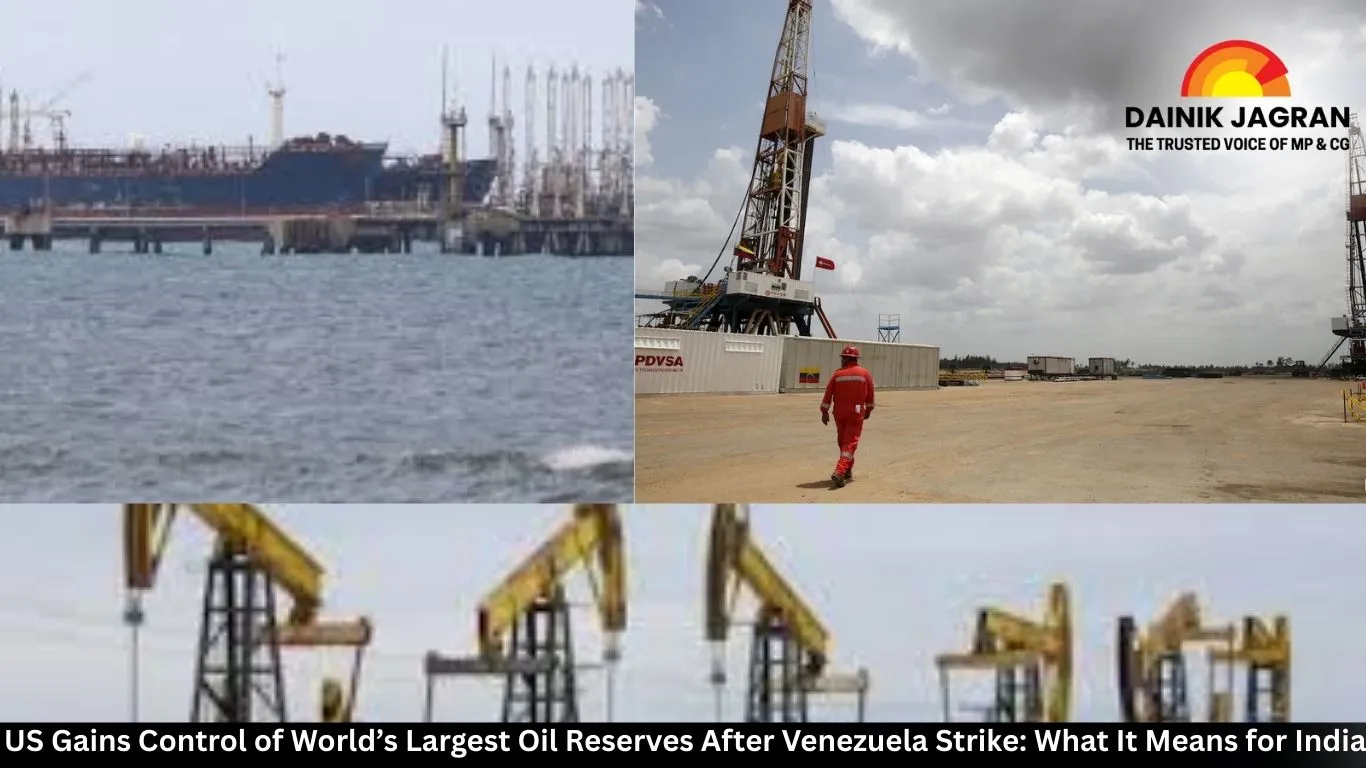
US Gains Control of World’s Largest Oil Reserves After Venezuela Strike: What It Means for India
Digital Desk
US controls Venezuela's 303 billion barrel oil reserves after capturing Maduro. Discover how this impacts global energy and the status of India’s oil reserves.
In a move that has sent shockwaves through the global energy market, US President Donald Trump announced on January 3, 2026, that the United States has effectively taken temporary control of Venezuela’s governance and its massive energy assets.
Following a large-scale military strike, Venezuelan President Nicolás Maduro was captured and flown to the US to face charges.
This development marks a historic shift in global power dynamics, as the US now controls the world’s largest oil reserves, potentially rewriting the rules of the international energy trade.
The $17 Trillion Asset: Why Venezuela Matters
According to the latest data, Venezuela sits on approximately 303 billion barrels of proven oil reserves. To put that in perspective, that is nearly 20% of the global total—surpassing the reserves of even Saudi Arabia or Iraq.
At current market prices, these reserves are valued at an astronomical $17.3 trillion. President Trump justified the intervention under the umbrella of counter-terrorism and regional stability, stating that US oil companies would be deployed to fix Venezuela's "broken infrastructure" and "get the oil flowing" again.
Why Can’t Venezuela Extract Its Own Oil?
Despite having the most oil on the planet, Venezuela has struggled with a "resource curse." Most of its reserves consist of extra-heavy crude, which is:
-
Viscous and Sticky: It requires specialized technology to pump.
-
Costly to Refine: It must be diluted with lighter oils or processed in complex refineries.
-
Dependent on Tech: Decades of underinvestment and sanctions have left local infrastructure in ruins.
By bringing in American engineering and capital, the US administration aims to transform these "stranded assets" into active global supply.
Does India Have Its Own Oil Reserves?
The sudden shift in the Americas has sparked urgent questions regarding India’s oil reserves and its energy independence. As the world's third-largest oil consumer, India remains in a delicate position.
Current Holdings
India currently holds approximately 4.8 billion barrels of proven oil reserves. While this places India among the top 25 nations globally, it is a fraction of what Venezuela or the US holds. Currently, India imports over 85% of its crude oil, making the domestic economy highly sensitive to global price fluctuations.
Strategic Petroleum Reserves (SPR)
To protect against supply shocks, the Indian government has been aggressively expanding its Strategic Petroleum Reserves (SPR)—massive underground salt caverns and rock bunkers designed for emergencies.
-
Existing Sites: Visakhapatnam, Mangaluru, and Padur.
-
Planned Expansion: New facilities are being fast-tracked in Chandikhole (Odisha) and Bikaner (Rajasthan).
-
The Goal: India aims to increase its emergency storage to cover at least 90 days of imports, aligning with international energy standards.
Conclusion: A New Energy Era
The US intervention in Venezuela is more than a political story; it is a total recalibration of the "black gold" map. For India, the priority remains clear: diversifying import sources and accelerating the build-out of domestic strategic reserves to ensure that a crisis in Caracas or a policy shift in Washington doesn't bring the Indian economy to a standstill.

--------
🚨 Beat the News Rush – Join Now!
Get breaking alerts, hot exclusives, and game-changing stories instantly on your phone. No delays, no fluff – just the edge you need. ⚡
Tap to join:
🟢 WhatsApp Channel: Dainik Jagran MP CG
Crave more?
🅕 Facebook: Dainik Jagran MP CG English
🅧 Twitter (X): Dainik Jagran MP CG
🅘 Instagram: Dainik Jagran MP CG
Share the fire – keep your crew ahead! 🗞️🔥
US Gains Control of World’s Largest Oil Reserves After Venezuela Strike: What It Means for India
Digital Desk
In a move that has sent shockwaves through the global energy market, US President Donald Trump announced on January 3, 2026, that the United States has effectively taken temporary control of Venezuela’s governance and its massive energy assets.
Following a large-scale military strike, Venezuelan President Nicolás Maduro was captured and flown to the US to face charges.
This development marks a historic shift in global power dynamics, as the US now controls the world’s largest oil reserves, potentially rewriting the rules of the international energy trade.
The $17 Trillion Asset: Why Venezuela Matters
According to the latest data, Venezuela sits on approximately 303 billion barrels of proven oil reserves. To put that in perspective, that is nearly 20% of the global total—surpassing the reserves of even Saudi Arabia or Iraq.
At current market prices, these reserves are valued at an astronomical $17.3 trillion. President Trump justified the intervention under the umbrella of counter-terrorism and regional stability, stating that US oil companies would be deployed to fix Venezuela's "broken infrastructure" and "get the oil flowing" again.
Why Can’t Venezuela Extract Its Own Oil?
Despite having the most oil on the planet, Venezuela has struggled with a "resource curse." Most of its reserves consist of extra-heavy crude, which is:
-
Viscous and Sticky: It requires specialized technology to pump.
-
Costly to Refine: It must be diluted with lighter oils or processed in complex refineries.
-
Dependent on Tech: Decades of underinvestment and sanctions have left local infrastructure in ruins.
By bringing in American engineering and capital, the US administration aims to transform these "stranded assets" into active global supply.
Does India Have Its Own Oil Reserves?
The sudden shift in the Americas has sparked urgent questions regarding India’s oil reserves and its energy independence. As the world's third-largest oil consumer, India remains in a delicate position.
Current Holdings
India currently holds approximately 4.8 billion barrels of proven oil reserves. While this places India among the top 25 nations globally, it is a fraction of what Venezuela or the US holds. Currently, India imports over 85% of its crude oil, making the domestic economy highly sensitive to global price fluctuations.
Strategic Petroleum Reserves (SPR)
To protect against supply shocks, the Indian government has been aggressively expanding its Strategic Petroleum Reserves (SPR)—massive underground salt caverns and rock bunkers designed for emergencies.
-
Existing Sites: Visakhapatnam, Mangaluru, and Padur.
-
Planned Expansion: New facilities are being fast-tracked in Chandikhole (Odisha) and Bikaner (Rajasthan).
-
The Goal: India aims to increase its emergency storage to cover at least 90 days of imports, aligning with international energy standards.
Conclusion: A New Energy Era
The US intervention in Venezuela is more than a political story; it is a total recalibration of the "black gold" map. For India, the priority remains clear: diversifying import sources and accelerating the build-out of domestic strategic reserves to ensure that a crisis in Caracas or a policy shift in Washington doesn't bring the Indian economy to a standstill.