

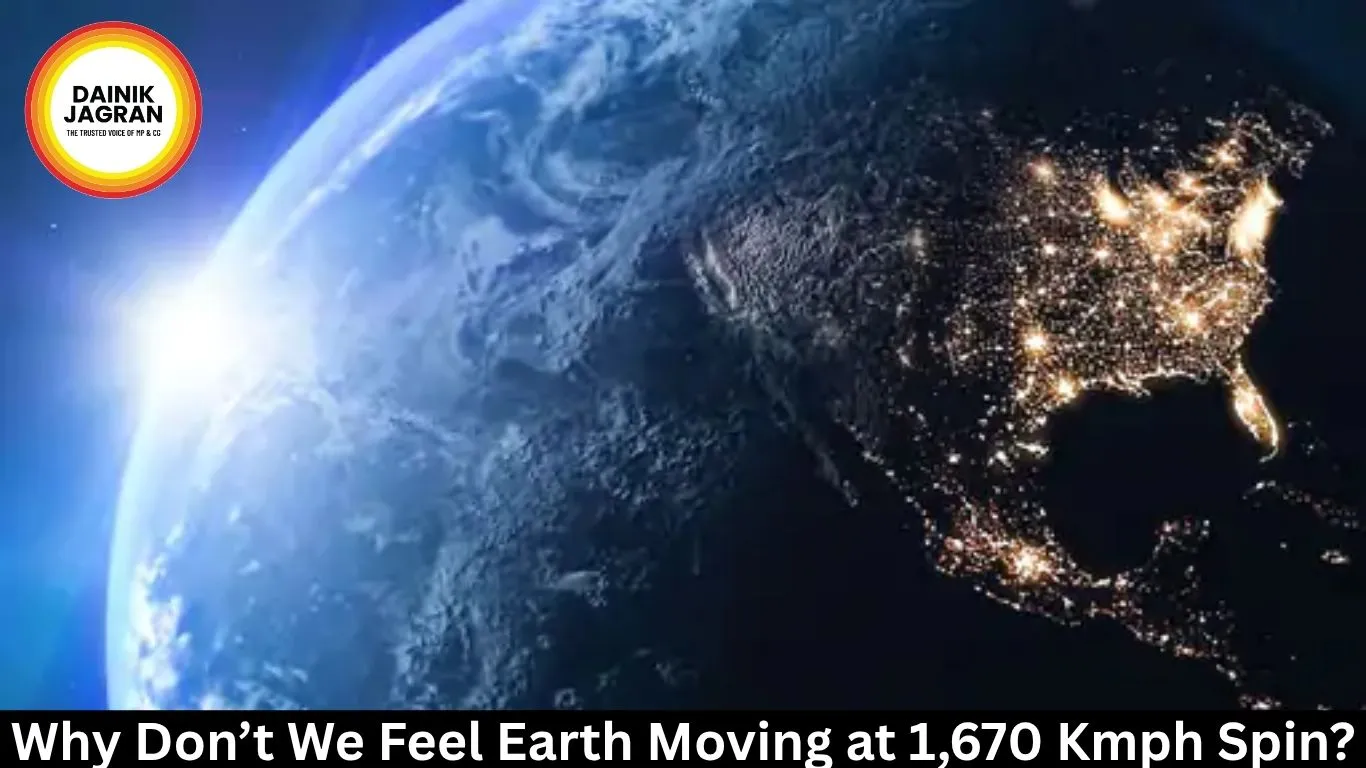
Why Don’t We Feel Earth Moving at 1,670 Kmph Spin?

Digital Desk

Why Don’t We Feel Earth Moving at 1,670 Kmph Spin?

Earth rotates at 1,670 kilometres per hour at the equator, yet we don’t feel Earth moving. Simple physics explains this everyday mystery that puzzles millions.

Earth's Incredible Speed  

Our planet completes one full rotation every 24 hours. At the equator, that translates to a blistering 1,670 km per hour. Yet life on the surface feels utterly still. This speed drops closer to the poles, reaching zero at the exact axis points, but the principle remains the same everywhere.

Motion Shared Equally  

Everything around us travels at exactly the same velocity as the ground beneath our feet. The air, buildings, oceans and even our own bodies move in perfect sync with the planet. There is no relative motion to trigger the sensation of speed. It is the same reason passengers inside a cruising jet feel no turbulence once at constant altitude.

Scale Defies Sensation  

Earth’s vast size plays a crucial role. With a diameter of nearly 13,000 kilometres, the curve is so gentle that our senses register nothing unusual. Humans are like tiny ants crawling across an enormous beach ball. The ball turns smoothly, but the ant notices no dramatic shift because the surface feels flat and steady on its tiny scale.

Stars Too Far Away  

Unlike a car journey where trees and buildings whip past, space offers no close reference points. The nearest stars lie trillions of kilometres away. They appear fixed in the sky even as Earth races beneath them. Our brains, wired to detect motion through nearby objects, simply register stillness.

Gravity's Invisible Hold  

Gravity anchors every object firmly to the surface. This constant pull towards Earth’s centre keeps us grounded despite the rapid spin. Without it, we might feel the effects of centrifugal force, but the planet’s mass creates a grip strong enough to counteract any outward push at normal rotational speeds.

Daily Proof All Around  

Clear evidence of Earth’s movement surrounds us. Day turns to night because the planet rotates. Seasons change as the tilted axis orbits the Sun. Constellations drift across the sky over months. Satellites and telescopes have measured these motions with pinpoint accuracy for decades, confirming what ancient astronomers first suspected.

Cosmos in Constant Flux  

Earth is not alone in its journey. The planet orbits the Sun at 107,000 km per hour while the entire solar system hurtles through the Milky Way. Nothing in the universe stands still. Yet because all motion remains smooth and uniform, we experience none of it directly.

This fundamental truth about why we don’t feel Earth moving continues to spark curiosity in classrooms and public discussions across India. It reminds us that some of the most profound scientific realities hide in plain sight. As space agencies push deeper into exploration, fresh observations from orbit only sharpen our understanding of these invisible forces shaping daily life on the blue planet.


--------

🚨 Beat the News Rush – Join Now!

Get breaking alerts, hot exclusives, and game-changing stories instantly on your phone. No delays, no fluff – just the edge you need. ⚡

Tap to join: 

🟢 WhatsApp Channel: Dainik Jagran MP CG

Crave more?

🅕 Facebook: Dainik Jagran MP CG English

🅧 Twitter (X): Dainik Jagran MP CG

🅘 Instagram: Dainik Jagran MP CG

Share the fire – keep your crew ahead! 🗞️🔥

english.dainikjagranmpcg.com
05 Apr 2026 By Abhishek Joshi

Why Don’t We Feel Earth Moving at 1,670 Kmph Spin?

Digital Desk

Earth's Incredible Speed  

Our planet completes one full rotation every 24 hours. At the equator, that translates to a blistering 1,670 km per hour. Yet life on the surface feels utterly still. This speed drops closer to the poles, reaching zero at the exact axis points, but the principle remains the same everywhere.

Motion Shared Equally  

Everything around us travels at exactly the same velocity as the ground beneath our feet. The air, buildings, oceans and even our own bodies move in perfect sync with the planet. There is no relative motion to trigger the sensation of speed. It is the same reason passengers inside a cruising jet feel no turbulence once at constant altitude.

Scale Defies Sensation  

Earth’s vast size plays a crucial role. With a diameter of nearly 13,000 kilometres, the curve is so gentle that our senses register nothing unusual. Humans are like tiny ants crawling across an enormous beach ball. The ball turns smoothly, but the ant notices no dramatic shift because the surface feels flat and steady on its tiny scale.

Stars Too Far Away  

Unlike a car journey where trees and buildings whip past, space offers no close reference points. The nearest stars lie trillions of kilometres away. They appear fixed in the sky even as Earth races beneath them. Our brains, wired to detect motion through nearby objects, simply register stillness.

Gravity's Invisible Hold  

Gravity anchors every object firmly to the surface. This constant pull towards Earth’s centre keeps us grounded despite the rapid spin. Without it, we might feel the effects of centrifugal force, but the planet’s mass creates a grip strong enough to counteract any outward push at normal rotational speeds.

Daily Proof All Around  

Clear evidence of Earth’s movement surrounds us. Day turns to night because the planet rotates. Seasons change as the tilted axis orbits the Sun. Constellations drift across the sky over months. Satellites and telescopes have measured these motions with pinpoint accuracy for decades, confirming what ancient astronomers first suspected.

Cosmos in Constant Flux  

Earth is not alone in its journey. The planet orbits the Sun at 107,000 km per hour while the entire solar system hurtles through the Milky Way. Nothing in the universe stands still. Yet because all motion remains smooth and uniform, we experience none of it directly.

This fundamental truth about why we don’t feel Earth moving continues to spark curiosity in classrooms and public discussions across India. It reminds us that some of the most profound scientific realities hide in plain sight. As space agencies push deeper into exploration, fresh observations from orbit only sharpen our understanding of these invisible forces shaping daily life on the blue planet.


https://english.dainikjagranmpcg.com/special-news/why-don%E2%80%99t-we-feel-earth-moving-at-1670-kmph-spin/article-16541
Tags: Earth

Related Posts

Latest News


