

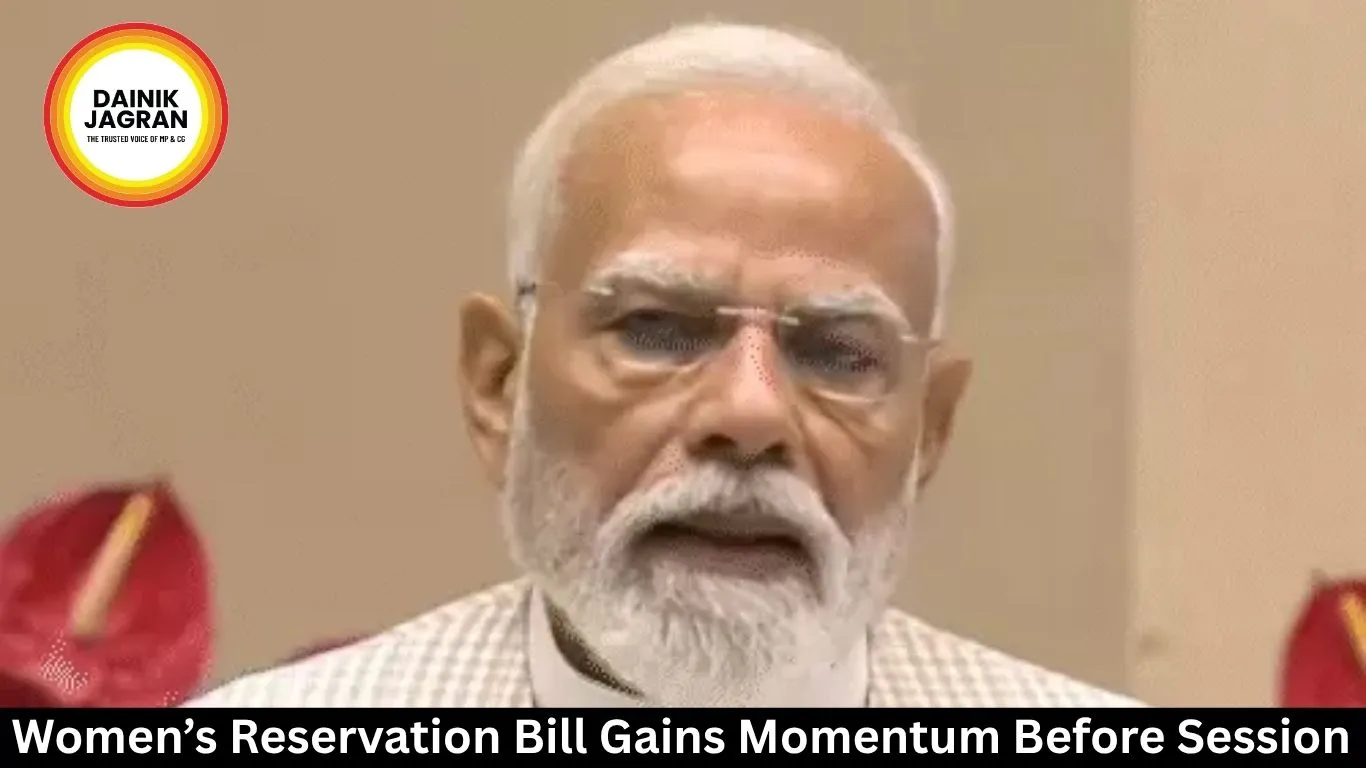
Women’s Reservation Bill Gains Momentum Before Session

Digital Desk

Women’s Reservation Bill Gains Momentum Before Session

Women’s Reservation Bill set for Parliament push from April 16, as PM Modi calls it a historic reform for women’s political empowerment.


Women’s Reservation Bill Push Gains Momentum Ahead of Special Session

Women’s Reservation Bill set for key push as special Parliament session begins April 16, marking a major step in India’s governance reforms

Key Announcement Made

Prime Minister Narendra Modi on Monday described the proposed Women’s Reservation Bill as one of the most significant decisions of the 21st century, signalling renewed momentum ahead of a special Parliament session scheduled from April 16 to 18.

Addressing a women-focused gathering in New Delhi, the Prime Minister said the country stands at the cusp of “creating a new history” with the long-pending framework for political reservation for women nearing implementation.

Special Session Details

The Centre has convened a three-day special session of Parliament to advance the implementation of the Nari Shakti Vandan Act, which seeks to reserve seats for women in the Lok Sabha and state legislative assemblies.

According to officials, the government is likely to introduce key legislative measures, including constitutional amendments and a separate delimitation bill, to operationalise the framework.

Decades-Long Demand

The Women’s Reservation Bill has been under discussion for decades, with multiple governments attempting to build consensus. Modi noted that the current move represents the culmination of sustained efforts by various political parties and stakeholders.

He said the initiative would strengthen women's participation in governance, enabling a smoother transition from grassroots leadership roles in Panchayats to higher legislative bodies.

Key Policy Provisions

The proposed framework links the implementation of reservation to a nationwide census and subsequent delimitation exercise. Due to delays in conducting a fresh census, sources indicated that the government may rely on the 2011 Census data to proceed.

Following delimitation, the number of Lok Sabha seats is expected to rise significantly from 543 to an estimated 816, creating space for reserved seats without reducing existing representation.

Officials confirmed that reservation for Scheduled Castes and Scheduled Tribes will remain unchanged, while there is currently no provision for Other Backward Classes (OBC) within the proposed structure.

Women-Centric Schemes Highlighted

During his address, Modi also highlighted several government initiatives aimed at women’s empowerment, including Beti Bachao Beti Padhao, Ujjwala Yojana, Ayushman Bharat, and Swachh Bharat Abhiyan.

He pointed to improvements in access to sanitation, healthcare, education, and housing, noting that over three crore women have become homeowners under central housing schemes.

The Prime Minister also referred to expanded opportunities for women in sports, skill development, and entrepreneurship, describing them as key drivers of India’s growth story.

Voices From Platform

At the same event, author and Rajya Sabha MP Sudha Murty stressed the importance of empowering women to shape their own futures.

Officials present at the gathering underscored the role of women in grassroots governance, particularly in programmes like the Jal Jeevan Mission, where their participation has been critical to implementation success.

Implementation Roadmap

Government sources indicated that two major legislative changes are in the pipeline — a constitutional amendment to enable reservation and a delimitation framework to restructure constituencies.

The timeline for full implementation is expected to extend to 2029, factoring in administrative processes and electoral adjustments.

Impact And Outlook

The Women’s Reservation Bill is widely seen as a transformative reform in India’s political landscape, with potential to significantly increase female representation in lawmaking bodies.

Policy analysts say the move could reshape governance priorities, bring greater focus on social development issues, and improve inclusivity in decision-making.

As the special session approaches, political observers will closely track how the government navigates legislative hurdles and builds consensus across parties for this long-awaited reform.

The Women’s Reservation Bill remains a key public interest story and a major India News Update, with implications for future electoral and governance frameworks.


--------

🚨 Beat the News Rush – Join Now!

Get breaking alerts, hot exclusives, and game-changing stories instantly on your phone. No delays, no fluff – just the edge you need. ⚡

Tap to join: 

🟢 WhatsApp Channel: Dainik Jagran MP CG

Crave more?

🅕 Facebook: Dainik Jagran MP CG English

🅧 Twitter (X): Dainik Jagran MP CG

🅘 Instagram: Dainik Jagran MP CG

Share the fire – keep your crew ahead! 🗞️🔥

english.dainikjagranmpcg.com
13 Apr 2026 By Abhishek Joshi

Women’s Reservation Bill Gains Momentum Before Session

Digital Desk

Women’s Reservation Bill Push Gains Momentum Ahead of Special Session

Women’s Reservation Bill set for key push as special Parliament session begins April 16, marking a major step in India’s governance reforms

Key Announcement Made

Prime Minister Narendra Modi on Monday described the proposed Women’s Reservation Bill as one of the most significant decisions of the 21st century, signalling renewed momentum ahead of a special Parliament session scheduled from April 16 to 18.

Addressing a women-focused gathering in New Delhi, the Prime Minister said the country stands at the cusp of “creating a new history” with the long-pending framework for political reservation for women nearing implementation.

Special Session Details

The Centre has convened a three-day special session of Parliament to advance the implementation of the Nari Shakti Vandan Act, which seeks to reserve seats for women in the Lok Sabha and state legislative assemblies.

According to officials, the government is likely to introduce key legislative measures, including constitutional amendments and a separate delimitation bill, to operationalise the framework.

Decades-Long Demand

The Women’s Reservation Bill has been under discussion for decades, with multiple governments attempting to build consensus. Modi noted that the current move represents the culmination of sustained efforts by various political parties and stakeholders.

He said the initiative would strengthen women's participation in governance, enabling a smoother transition from grassroots leadership roles in Panchayats to higher legislative bodies.

Key Policy Provisions

The proposed framework links the implementation of reservation to a nationwide census and subsequent delimitation exercise. Due to delays in conducting a fresh census, sources indicated that the government may rely on the 2011 Census data to proceed.

Following delimitation, the number of Lok Sabha seats is expected to rise significantly from 543 to an estimated 816, creating space for reserved seats without reducing existing representation.

Officials confirmed that reservation for Scheduled Castes and Scheduled Tribes will remain unchanged, while there is currently no provision for Other Backward Classes (OBC) within the proposed structure.

Women-Centric Schemes Highlighted

During his address, Modi also highlighted several government initiatives aimed at women’s empowerment, including Beti Bachao Beti Padhao, Ujjwala Yojana, Ayushman Bharat, and Swachh Bharat Abhiyan.

He pointed to improvements in access to sanitation, healthcare, education, and housing, noting that over three crore women have become homeowners under central housing schemes.

The Prime Minister also referred to expanded opportunities for women in sports, skill development, and entrepreneurship, describing them as key drivers of India’s growth story.

Voices From Platform

At the same event, author and Rajya Sabha MP Sudha Murty stressed the importance of empowering women to shape their own futures.

Officials present at the gathering underscored the role of women in grassroots governance, particularly in programmes like the Jal Jeevan Mission, where their participation has been critical to implementation success.

Implementation Roadmap

Government sources indicated that two major legislative changes are in the pipeline — a constitutional amendment to enable reservation and a delimitation framework to restructure constituencies.

The timeline for full implementation is expected to extend to 2029, factoring in administrative processes and electoral adjustments.

Impact And Outlook

The Women’s Reservation Bill is widely seen as a transformative reform in India’s political landscape, with potential to significantly increase female representation in lawmaking bodies.

Policy analysts say the move could reshape governance priorities, bring greater focus on social development issues, and improve inclusivity in decision-making.

As the special session approaches, political observers will closely track how the government navigates legislative hurdles and builds consensus across parties for this long-awaited reform.

The Women’s Reservation Bill remains a key public interest story and a major India News Update, with implications for future electoral and governance frameworks.


https://english.dainikjagranmpcg.com/special-news/women%E2%80%99s-reservation-bill-gains-momentum-before-session/article-16817

Related Posts

Latest News


