

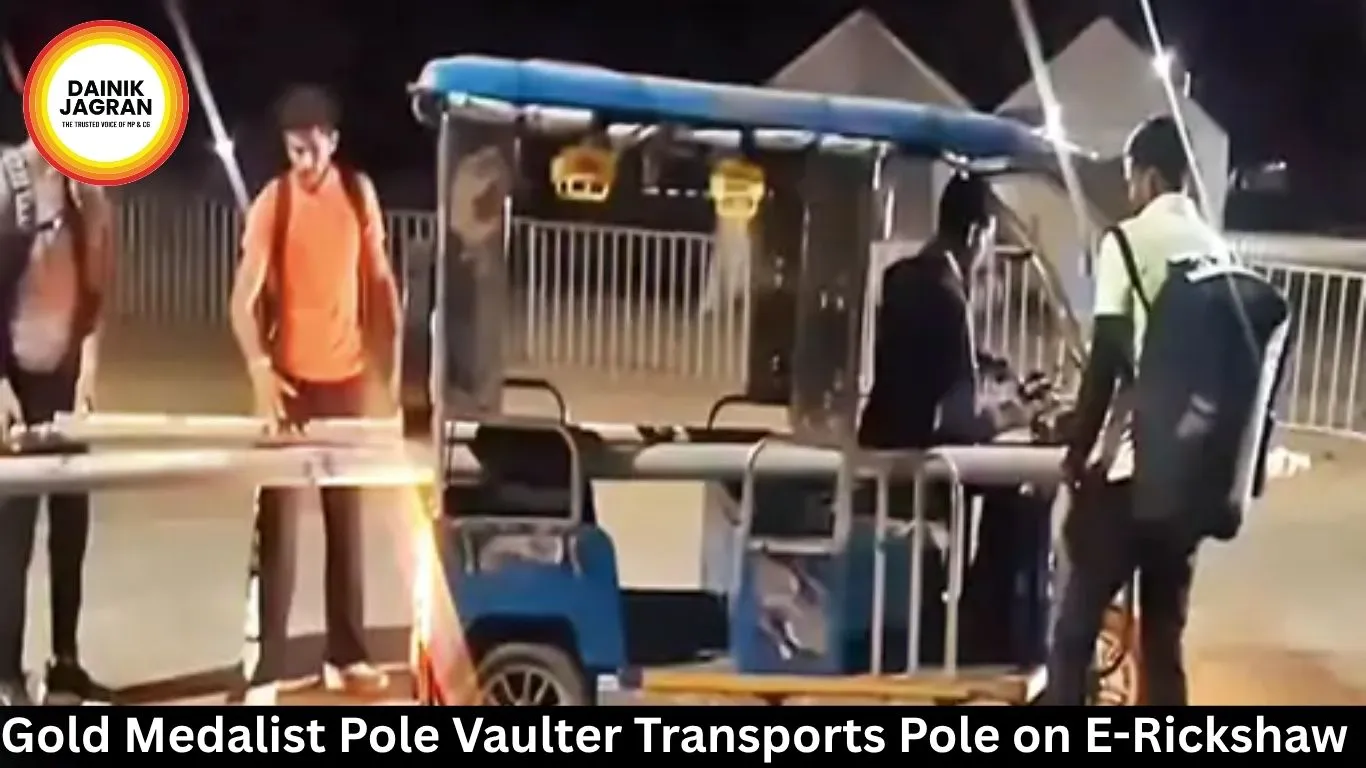
Gold Medalist Pole Vaulter Transports Pole on E-Rickshaw

Digital Desk

 Gold Medalist Pole Vaulter Transports Pole on E-Rickshaw

19-year-old Dev Meeña, national record holder, forced to load fiberglass pole on e-rickshaw after setting 5.45m national record. Highlights infrastructure gaps in Indian athletics.


Gold Medalist Pole Vaulter Forced to Transport 5-Meter Pole on E-Rickshaw

National record holder Dev Meeña faces logistical nightmare despite Commonwealth Games qualification

Dev Kumar Meeña had just etched his name into Indian athletics history. Hours earlier, the 19-year-old pole vaulter from Bhopal had cleared 5.45 metres at the Athletics Federation Cup in Ranchi, setting a new national record alongside teammate Kuldeep Kumar. Yet by Tuesday evening, the champion found himself loading his fragile fiberglass pole onto an e-rickshaw to return to his hotel—a stark reminder of the infrastructure challenges facing India's emerging athletic talent.

The image of the young athlete securing his specialized equipment onto the auto-rickshaw drew immediate attention online and raised fresh questions about support systems for aspiring Olympic hopefuls. Meeña and Kumar, both now qualified for the Commonwealth Games 2026 in Glasgow next month, are among India's most promising track and field prospects. Yet their journey remains marked by practical hurdles that seem incongruous with their achievements.

Record-Breaking Moment Overshadowed

The dual achievement at Ranchi's athletics championship was historic. Both Meeña and Kumar jumped 5.45 metres in the men's pole vault event, breaking the previous national mark. The gold medal went to Meeña, while Kumar secured silver—decided by the number of attempts each athlete required to reach that height. This performance cemented their qualification for Glasgow, where they will represent India on the global stage.

But what should have been an uninterrupted celebration became a logistical puzzle. Specialized pole vault equipment cannot be casually transported. The fiberglass poles used in competition are exceptionally delicate and can span over five metres in length. Any structural damage—a crack, a bend, or pressure damage—renders them unusable and expensive to replace.

The Train Station Incident

This is not Meeña's first brush with institutional obstacles. Earlier this year, while returning from the All India Inter-University Championship, the athlete faced an unexpected confrontation at Panvel railway station. A ticket collector prevented him from carrying his pole aboard the train, insisting that equipment of such length could not be accommodated in regular compartments.

The incident sparked intervention from Madhya Pradesh's Sports Minister Viswas Sarang, who took cognizance of the matter and directed railway authorities to permit athletes to transport their specialized equipment. Yet the ease of that resolution contrasts sharply with the day-to-day reality athletes face in moving between competitions.

The Vulnerability of Fragile Equipment

Pole vault poles represent a unique challenge in sports logistics. Unlike cricket bats or badminton rackets, they require meticulous handling. The materials used—typically fiberglass composites—are lightweight yet sensitive to pressure and temperature variations. Improper storage or rough handling can compromise their structural integrity, affecting performance and safety.

For athletes like Meeña and Kumar, who come from modest backgrounds in central India, accessing specialized transport or storage facilities remains difficult. What appears as a simple inconvenience—loading equipment onto a three-wheeler—reflects deeper systemic gaps in sports infrastructure.

Rising from Small-Town Roots

Meeña hails from Silfodkheda, a small village in Khategaon block of Madhya Pradesh. His ascent in pole vault has been meteoric. In February 2025, he cleared 5.32 metres at the Uttarakhand National Games. Just two months later, at the National Federation Senior Athletics Championship in April, he improved his own record to 5.35 metres. The 5.45-metre jump at Ranchi represents another breakthrough for the teenager.

His trajectory suggests Indian athletics has found a genuine talent. Yet the absence of adequate support—from transport logistics to equipment management—risks hindering further progress. Athletes of his caliber typically benefit from institutional backing, dedicated equipment handling, and seamless travel arrangements.

Looking Toward Glasgow

With the Commonwealth Games less than two months away, Meeña and Kumar face another critical phase in their athletic careers. The Glasgow competition will test their performance against some of the Commonwealth's best pole vaulters. Success there could open doors to international athletics circuits and sponsorships that would ease their current struggles.

However, these immediate challenges underscore a broader concern within Indian sports administration. While individual athletes demonstrate exceptional talent and determination, the supporting ecosystem—transport facilities, equipment storage, institutional coordination—remains underdeveloped. The image of a gold medalist securing his vital equipment to an e-rickshaw symbolizes this disconnect.

Coach Ghanshyam Yadav has been instrumental in Meeña's development. Yet coaching excellence alone cannot compensate for infrastructure gaps that force young champions to improvise at every step.

What Needs to Change

The incident at Ranchi, following the earlier railway station confrontation, suggests a need for clearer protocols. State and national sports bodies must establish guidelines enabling athletes to transport specialized equipment without bureaucratic friction. This is not a luxury but a necessity for athletes competing at higher levels.

Meeña's achievement deserves more than viral social media images showing his struggles. It demands systemic responses—from railways facilitating equipment transport to airports and venues offering dedicated handling services. Other countries treat athlete logistics as integral to competitive success; India must recognize the same.

The 19-year-old continues training at Bhopal's TT Nagar Stadium, preparing for his Commonwealth Games debut. His focus remains on jumping higher, breaking more records. But he shouldn't have to fight logistical battles to do so.


--------

🚨 Beat the News Rush – Join Now!

Get breaking alerts, hot exclusives, and game-changing stories instantly on your phone. No delays, no fluff – just the edge you need. ⚡

Tap to join: 

🟢 WhatsApp Channel: Dainik Jagran MP CG

Crave more?

🅕 Facebook: Dainik Jagran MP CG English

🅧 Twitter (X): Dainik Jagran MP CG

🅘 Instagram: Dainik Jagran MP CG

Share the fire – keep your crew ahead! 🗞️🔥

english.dainikjagranmpcg.com
26 May 2026 By Abhishek Joshi

Gold Medalist Pole Vaulter Transports Pole on E-Rickshaw

Digital Desk

Gold Medalist Pole Vaulter Forced to Transport 5-Meter Pole on E-Rickshaw

National record holder Dev Meeña faces logistical nightmare despite Commonwealth Games qualification

Dev Kumar Meeña had just etched his name into Indian athletics history. Hours earlier, the 19-year-old pole vaulter from Bhopal had cleared 5.45 metres at the Athletics Federation Cup in Ranchi, setting a new national record alongside teammate Kuldeep Kumar. Yet by Tuesday evening, the champion found himself loading his fragile fiberglass pole onto an e-rickshaw to return to his hotel—a stark reminder of the infrastructure challenges facing India's emerging athletic talent.

The image of the young athlete securing his specialized equipment onto the auto-rickshaw drew immediate attention online and raised fresh questions about support systems for aspiring Olympic hopefuls. Meeña and Kumar, both now qualified for the Commonwealth Games 2026 in Glasgow next month, are among India's most promising track and field prospects. Yet their journey remains marked by practical hurdles that seem incongruous with their achievements.

Record-Breaking Moment Overshadowed

The dual achievement at Ranchi's athletics championship was historic. Both Meeña and Kumar jumped 5.45 metres in the men's pole vault event, breaking the previous national mark. The gold medal went to Meeña, while Kumar secured silver—decided by the number of attempts each athlete required to reach that height. This performance cemented their qualification for Glasgow, where they will represent India on the global stage.

But what should have been an uninterrupted celebration became a logistical puzzle. Specialized pole vault equipment cannot be casually transported. The fiberglass poles used in competition are exceptionally delicate and can span over five metres in length. Any structural damage—a crack, a bend, or pressure damage—renders them unusable and expensive to replace.

The Train Station Incident

This is not Meeña's first brush with institutional obstacles. Earlier this year, while returning from the All India Inter-University Championship, the athlete faced an unexpected confrontation at Panvel railway station. A ticket collector prevented him from carrying his pole aboard the train, insisting that equipment of such length could not be accommodated in regular compartments.

The incident sparked intervention from Madhya Pradesh's Sports Minister Viswas Sarang, who took cognizance of the matter and directed railway authorities to permit athletes to transport their specialized equipment. Yet the ease of that resolution contrasts sharply with the day-to-day reality athletes face in moving between competitions.

The Vulnerability of Fragile Equipment

Pole vault poles represent a unique challenge in sports logistics. Unlike cricket bats or badminton rackets, they require meticulous handling. The materials used—typically fiberglass composites—are lightweight yet sensitive to pressure and temperature variations. Improper storage or rough handling can compromise their structural integrity, affecting performance and safety.

For athletes like Meeña and Kumar, who come from modest backgrounds in central India, accessing specialized transport or storage facilities remains difficult. What appears as a simple inconvenience—loading equipment onto a three-wheeler—reflects deeper systemic gaps in sports infrastructure.

Rising from Small-Town Roots

Meeña hails from Silfodkheda, a small village in Khategaon block of Madhya Pradesh. His ascent in pole vault has been meteoric. In February 2025, he cleared 5.32 metres at the Uttarakhand National Games. Just two months later, at the National Federation Senior Athletics Championship in April, he improved his own record to 5.35 metres. The 5.45-metre jump at Ranchi represents another breakthrough for the teenager.

His trajectory suggests Indian athletics has found a genuine talent. Yet the absence of adequate support—from transport logistics to equipment management—risks hindering further progress. Athletes of his caliber typically benefit from institutional backing, dedicated equipment handling, and seamless travel arrangements.

Looking Toward Glasgow

With the Commonwealth Games less than two months away, Meeña and Kumar face another critical phase in their athletic careers. The Glasgow competition will test their performance against some of the Commonwealth's best pole vaulters. Success there could open doors to international athletics circuits and sponsorships that would ease their current struggles.

However, these immediate challenges underscore a broader concern within Indian sports administration. While individual athletes demonstrate exceptional talent and determination, the supporting ecosystem—transport facilities, equipment storage, institutional coordination—remains underdeveloped. The image of a gold medalist securing his vital equipment to an e-rickshaw symbolizes this disconnect.

Coach Ghanshyam Yadav has been instrumental in Meeña's development. Yet coaching excellence alone cannot compensate for infrastructure gaps that force young champions to improvise at every step.

What Needs to Change

The incident at Ranchi, following the earlier railway station confrontation, suggests a need for clearer protocols. State and national sports bodies must establish guidelines enabling athletes to transport specialized equipment without bureaucratic friction. This is not a luxury but a necessity for athletes competing at higher levels.

Meeña's achievement deserves more than viral social media images showing his struggles. It demands systemic responses—from railways facilitating equipment transport to airports and venues offering dedicated handling services. Other countries treat athlete logistics as integral to competitive success; India must recognize the same.

The 19-year-old continues training at Bhopal's TT Nagar Stadium, preparing for his Commonwealth Games debut. His focus remains on jumping higher, breaking more records. But he shouldn't have to fight logistical battles to do so.


https://english.dainikjagranmpcg.com/sports/-gold-medalist-pole-vaulter-transports-pole-on-e-rickshaw/article-19272

Related Posts

Latest News


