India Wins Gold at Global Esports Games Mumbai 2026 — How One Historic Tournament Changed Everything for Indian Esports
Digital Desk
India crowned Overall Champion at Global Esports Games Mumbai 2026. Anuhith Gosala wins Clash Royale gold as Mumbai hosts South Asia's first-ever GEG World Finals. Full analysis inside.
India Wins Gold at Global Esports Games Mumbai 2026 — How One Historic Tournament Changed Everything for Indian Esports
A sold-out arena in Mumbai. A home crowd on its feet. An Indian athlete lifting a world title in front of his own country. This was not cricket — and that is exactly the point.
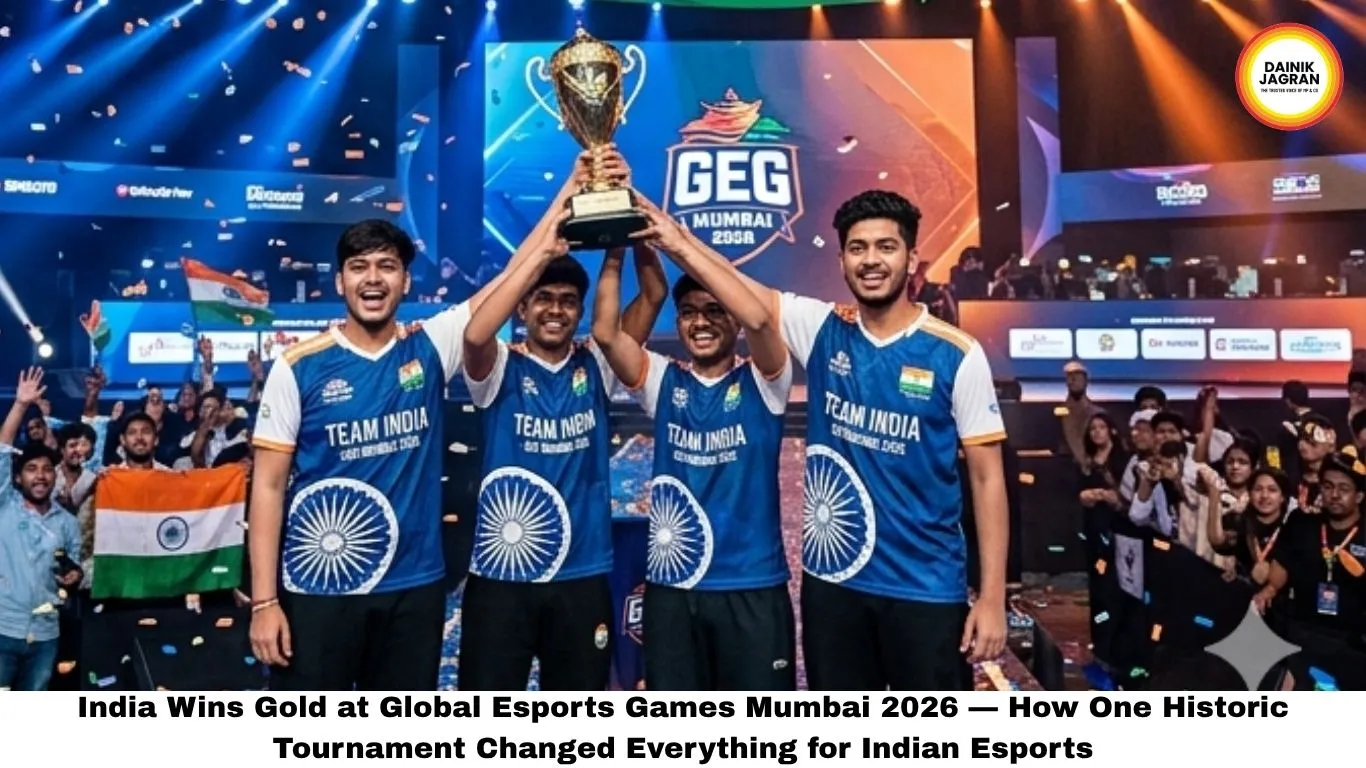
On March 23, 2026, the Global Esports Games Mumbai World Finals came to a stunning conclusion at the MMRDA Grounds in Bandra Kurla Complex, Mumbai — and India left as the Overall Champion. Anuhith Gosala delivered one of the most memorable individual performances in Indian esports history, winning the Clash Royale gold medal in a nail-biting 3-2 grand final against Kazakhstan's Miras. The Indian DOTA 2 team added a bronze medal to complete a historic sweep. Forty-eight elite athletes from 19 nations had arrived in Mumbai to compete. India sent them home knowing they had witnessed the emergence of a genuine esports powerhouse.
The Road to Gold: Resilience Under Pressure
The path to India's Clash Royale gold was not a smooth procession — and that makes it all the more meaningful. Gosala's campaign hit a significant obstacle in the upper bracket finals, where he suffered a 0-2 loss to Kazakhstan. For many competitors, that setback would have ended the dream. Instead, Gosala fought back through the lower bracket — first defeating the USA 2-1 in a high-pressure lower bracket final before securing a place in the grand finale.
In the rematch against the same Kazakh opponent who had beaten him earlier, Gosala delivered five extraordinary games of Clash Royale — absorbing pressure, shifting momentum, and ultimately winning 3-2 in a grand final that had the Mumbai crowd roaring at every move. Reflecting on his victory, Gosala called the moment surreal. The preparation, he said, was relentless. The pressure was intense. But hearing the cheers of a home crowd while lifting a world title is an experience that cannot be replicated anywhere else.
That is not just a sporting story. It is a statement about what Indian esports has become.
What the GEG Mumbai Edition Represented — Beyond the Medals
The Global Esports Games Mumbai 2026 was far more than a four-day competition. It was the first time the prestigious GEG World Finals had ever been held in South Asia — following previous editions in Singapore, Istanbul, and Riyadh. The choice of Mumbai as host city was a deliberate signal from the Global Esports Federation that India is no longer simply a market to be courted. It is a destination to be invested in.
The numbers justify that confidence. India's esports market currently stands at approximately $38 million and is projected to reach $132 million by FY30 — a compound annual growth rate of 26%. The country has 2.8 million competitive esports players, 40 professional teams, and active competition across nearly 20 major game titles. For context, this is an ecosystem that barely existed in any organised form a decade ago. Its growth trajectory now rivals some of the most established esports markets in Southeast Asia and Europe.
The Mumbai event's global broadcast reach was projected at over 40 million viewers — a number that places it firmly in the category of major international sporting events by any reasonable measure.
Institutional Backing: Government Finally Takes Esports Seriously
One of the most significant aspects of the GEG Mumbai finals was the level of institutional recognition it received. Maharashtra Chief Minister Devendra Fadnavis personally inaugurated the event — sending an unambiguous signal that esports has arrived as a legitimate pillar of India's digital economy strategy, not merely a niche entertainment category.
Fadnavis's framing of the event was notably forward-looking. The future, he said, will be shaped by technology, innovation, and digital ecosystems. Hosting the Global Esports Games in Mumbai was positioned not as a cultural event but as an economic one — designed to strengthen Maharashtra and India's standing as an emerging global hub for digital innovation.
This institutional framing matters enormously. For years, Indian esports athletes operated in a policy vacuum — without government recognition, without clear pathways to funding, and without the kind of structural support that cricket, wrestling, and even chess have long enjoyed. The GEG Mumbai finals, inaugurated by a sitting Chief Minister and backed by Maharashtra Tourism, represents a categorical shift in how the state views competitive gaming.
The announcement of a 10-year strategic partnership between the Global Esports Federation and India — focused on developing digital infrastructure and esports talent — makes this more than a one-time event. It is a long-term national commitment.
Jackie Chan, Los Angeles, and the Global Momentum
Two landmark announcements emerged from the closing ceremony of the GEG Mumbai finals that signal the broader ambitions of the global esports movement. First, global film icon Jackie Chan was named the official Ambassador of the Global Esports Federation — a move designed to bridge the gap between mainstream entertainment audiences and competitive gaming. For a sport still working to build mass cultural recognition beyond its core fanbase, Chan's appointment carries genuine strategic value across Asian and global markets.
Second, the ceremonial flag handover at the Mumbai closing ceremony officially confirmed the next stop on the GEG global circuit: Los Angeles, December 2026. India's athletes — carrying the momentum of a home world title — will now prepare for their next international campaign in North America's entertainment capital. The contrast between Mumbai and Los Angeles as back-to-back hosts of the world's premier national-team esports championship is itself a statement about how global and genuinely diverse the esports movement has become.
The Bigger Picture: What India's Gold Medal Means for a Generation
In a country where sport means cricket for the overwhelming majority of its 1.4 billion citizens, a sold-out arena cheering for a Clash Royale final is a genuinely transformative image. It is not merely about one gold medal or one tournament. It is about the normalisation of esports as a legitimate competitive pursuit — one that commands national pride, institutional backing, and the same emotional investment that has historically been reserved for willow and leather on a cricket ground.
For the thousands of young Indians who play Clash Royale, DOTA 2, BGMI, and other titles — not casually, but competitively and seriously — the image of Anuhith Gosala holding a gold medal on a world stage in front of a home crowd is the equivalent of watching a cricketer lift the World Cup. It validates their pursuit. It legitimises their ambition. And it tells them, for the first time with real institutional authority, that there is a pathway from a bedroom setup in any Indian city to the podium of a world championship.
That is not a small thing. In the context of India's digital generation and the economy they are inheriting, it may be one of the most important sporting moments of 2026.
Mumbai Delivered — Now India Must Build on It
The Global Esports Games Mumbai 2026 was a landmark event by every measure. A first-ever South Asian hosting. A home gold medal. A 10-year national partnership. Forty million viewers. A world-class venue in the heart of India's financial capital. And a generation of young Indian gamers who watched their country stand on top of a world podium.
The GEF President's closing words captured the spirit perfectly: Mumbai delivered exceptional energy, passion, and hospitality. The city set a new benchmark for excellence. Now the challenge for India's government, its esports federations, its broadcasters, and its sponsors is to build on this foundation — not treat it as a destination, but as a departure point.

India Wins Gold at Global Esports Games Mumbai 2026 — How One Historic Tournament Changed Everything for Indian Esports
Digital Desk
India Wins Gold at Global Esports Games Mumbai 2026 — How One Historic Tournament Changed Everything for Indian Esports
A sold-out arena in Mumbai. A home crowd on its feet. An Indian athlete lifting a world title in front of his own country. This was not cricket — and that is exactly the point.
On March 23, 2026, the Global Esports Games Mumbai World Finals came to a stunning conclusion at the MMRDA Grounds in Bandra Kurla Complex, Mumbai — and India left as the Overall Champion. Anuhith Gosala delivered one of the most memorable individual performances in Indian esports history, winning the Clash Royale gold medal in a nail-biting 3-2 grand final against Kazakhstan's Miras. The Indian DOTA 2 team added a bronze medal to complete a historic sweep. Forty-eight elite athletes from 19 nations had arrived in Mumbai to compete. India sent them home knowing they had witnessed the emergence of a genuine esports powerhouse.
The Road to Gold: Resilience Under Pressure
The path to India's Clash Royale gold was not a smooth procession — and that makes it all the more meaningful. Gosala's campaign hit a significant obstacle in the upper bracket finals, where he suffered a 0-2 loss to Kazakhstan. For many competitors, that setback would have ended the dream. Instead, Gosala fought back through the lower bracket — first defeating the USA 2-1 in a high-pressure lower bracket final before securing a place in the grand finale.
In the rematch against the same Kazakh opponent who had beaten him earlier, Gosala delivered five extraordinary games of Clash Royale — absorbing pressure, shifting momentum, and ultimately winning 3-2 in a grand final that had the Mumbai crowd roaring at every move. Reflecting on his victory, Gosala called the moment surreal. The preparation, he said, was relentless. The pressure was intense. But hearing the cheers of a home crowd while lifting a world title is an experience that cannot be replicated anywhere else.
That is not just a sporting story. It is a statement about what Indian esports has become.
What the GEG Mumbai Edition Represented — Beyond the Medals
The Global Esports Games Mumbai 2026 was far more than a four-day competition. It was the first time the prestigious GEG World Finals had ever been held in South Asia — following previous editions in Singapore, Istanbul, and Riyadh. The choice of Mumbai as host city was a deliberate signal from the Global Esports Federation that India is no longer simply a market to be courted. It is a destination to be invested in.
The numbers justify that confidence. India's esports market currently stands at approximately $38 million and is projected to reach $132 million by FY30 — a compound annual growth rate of 26%. The country has 2.8 million competitive esports players, 40 professional teams, and active competition across nearly 20 major game titles. For context, this is an ecosystem that barely existed in any organised form a decade ago. Its growth trajectory now rivals some of the most established esports markets in Southeast Asia and Europe.
The Mumbai event's global broadcast reach was projected at over 40 million viewers — a number that places it firmly in the category of major international sporting events by any reasonable measure.
Institutional Backing: Government Finally Takes Esports Seriously
One of the most significant aspects of the GEG Mumbai finals was the level of institutional recognition it received. Maharashtra Chief Minister Devendra Fadnavis personally inaugurated the event — sending an unambiguous signal that esports has arrived as a legitimate pillar of India's digital economy strategy, not merely a niche entertainment category.
Fadnavis's framing of the event was notably forward-looking. The future, he said, will be shaped by technology, innovation, and digital ecosystems. Hosting the Global Esports Games in Mumbai was positioned not as a cultural event but as an economic one — designed to strengthen Maharashtra and India's standing as an emerging global hub for digital innovation.
This institutional framing matters enormously. For years, Indian esports athletes operated in a policy vacuum — without government recognition, without clear pathways to funding, and without the kind of structural support that cricket, wrestling, and even chess have long enjoyed. The GEG Mumbai finals, inaugurated by a sitting Chief Minister and backed by Maharashtra Tourism, represents a categorical shift in how the state views competitive gaming.
The announcement of a 10-year strategic partnership between the Global Esports Federation and India — focused on developing digital infrastructure and esports talent — makes this more than a one-time event. It is a long-term national commitment.
Jackie Chan, Los Angeles, and the Global Momentum
Two landmark announcements emerged from the closing ceremony of the GEG Mumbai finals that signal the broader ambitions of the global esports movement. First, global film icon Jackie Chan was named the official Ambassador of the Global Esports Federation — a move designed to bridge the gap between mainstream entertainment audiences and competitive gaming. For a sport still working to build mass cultural recognition beyond its core fanbase, Chan's appointment carries genuine strategic value across Asian and global markets.
Second, the ceremonial flag handover at the Mumbai closing ceremony officially confirmed the next stop on the GEG global circuit: Los Angeles, December 2026. India's athletes — carrying the momentum of a home world title — will now prepare for their next international campaign in North America's entertainment capital. The contrast between Mumbai and Los Angeles as back-to-back hosts of the world's premier national-team esports championship is itself a statement about how global and genuinely diverse the esports movement has become.
The Bigger Picture: What India's Gold Medal Means for a Generation
In a country where sport means cricket for the overwhelming majority of its 1.4 billion citizens, a sold-out arena cheering for a Clash Royale final is a genuinely transformative image. It is not merely about one gold medal or one tournament. It is about the normalisation of esports as a legitimate competitive pursuit — one that commands national pride, institutional backing, and the same emotional investment that has historically been reserved for willow and leather on a cricket ground.
For the thousands of young Indians who play Clash Royale, DOTA 2, BGMI, and other titles — not casually, but competitively and seriously — the image of Anuhith Gosala holding a gold medal on a world stage in front of a home crowd is the equivalent of watching a cricketer lift the World Cup. It validates their pursuit. It legitimises their ambition. And it tells them, for the first time with real institutional authority, that there is a pathway from a bedroom setup in any Indian city to the podium of a world championship.
That is not a small thing. In the context of India's digital generation and the economy they are inheriting, it may be one of the most important sporting moments of 2026.
Mumbai Delivered — Now India Must Build on It
The Global Esports Games Mumbai 2026 was a landmark event by every measure. A first-ever South Asian hosting. A home gold medal. A 10-year national partnership. Forty million viewers. A world-class venue in the heart of India's financial capital. And a generation of young Indian gamers who watched their country stand on top of a world podium.
The GEF President's closing words captured the spirit perfectly: Mumbai delivered exceptional energy, passion, and hospitality. The city set a new benchmark for excellence. Now the challenge for India's government, its esports federations, its broadcasters, and its sponsors is to build on this foundation — not treat it as a destination, but as a departure point.