

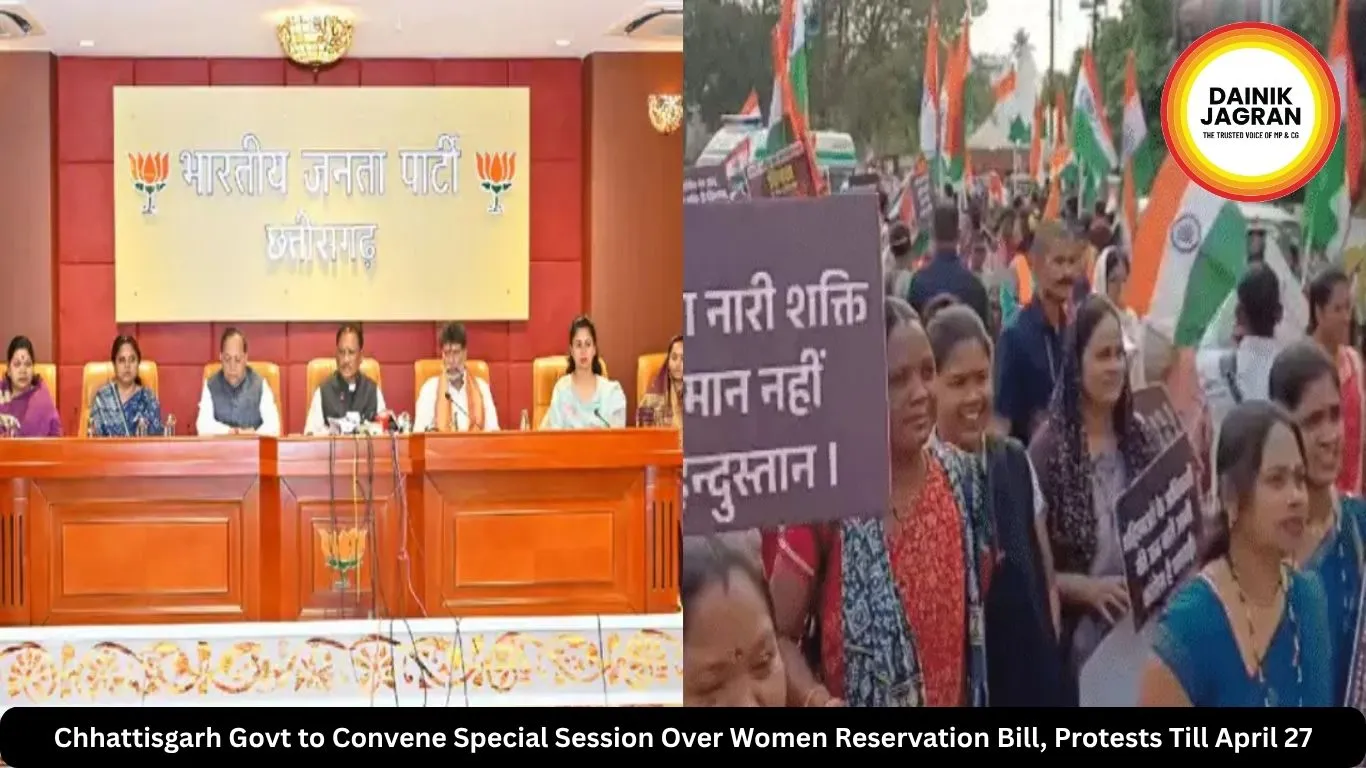
Chhattisgarh Govt to Convene Special Session Over Women Reservation Bill, Protests Till April 27
Chhattisgarh to call special session over Women Reservation Bill failure, with protests against Opposition continuing till April 27.
The Chhattisgarh government is preparing to convene a one-day special session of the state Assembly amid the political fallout over the Women Reservation Bill failing to pass in the Lok Sabha. Chief Minister Vishnu Deo Sai announced the move during a public rally in Raipur, indicating that a condemnation motion against the Opposition will be introduced.
The development comes as part of a broader political response by the ruling party, which has intensified its attack on Opposition parties over their stance on the proposed legislation.
Political Showdown Intensifies
Addressing a gathering at a rally organised by the BJP Mahila Morcha, Sai accused Opposition parties of obstructing a key reform aimed at empowering women. He stated that the government would formally register its disapproval through a resolution in the Assembly.
According to officials, the process to convene the session will involve a Cabinet decision, followed by approval from the Governor before formal notification.
Statewide Protest Strategy
Parallel to the legislative move, the party has launched a series of protests across the state targeting the Opposition. Demonstrations began on April 20 and are scheduled to continue until April 27.
Party leaders outlined a structured campaign, including district-level public meetings on April 23 and 24, followed by symbolic protests such as effigy burning at the mandal level on April 26 and 27.
Bill Fails in Lok Sabha
The controversy stems from the failure of the Constitution (131st Amendment) Bill related to women’s reservation in the Lok Sabha. The bill secured 298 votes in favour and 230 against, falling short of the required 352 votes needed for passage.
The proposed legislation aimed to increase Lok Sabha seats from 543 to 816 and reserve 33 percent of seats for women, a move projected as a significant step toward gender representation in Indian politics.
Centre Reacts Strongly
Following the bill’s defeat, Prime Minister Narendra Modi publicly expressed regret, apologising to women across the country. He criticised Opposition parties, alleging that political interests had taken precedence over national priorities.
Government sources indicated that the Centre had made efforts to build consensus during a special parliamentary session, but divisions among parties ultimately led to the bill’s failure.
State-Level Context
In Chhattisgarh, the ruling leadership has highlighted existing provisions for women’s representation. Officials pointed out that women currently hold 57 percent reservation in Panchayati Raj institutions and over 20 percent representation in the state Assembly.
The government has used these figures to underline its commitment to women’s empowerment while framing the Opposition’s position as inconsistent with broader gender equity goals.
Impact and Next Steps
The proposed special session is expected to escalate political tensions in the state, particularly as protests continue in the run-up to the end of April. Analysts view the move as part of a larger political strategy to consolidate support among women voters and shape public discourse ahead of upcoming elections.
--------
π¨ Beat the News Rush β Join Now!
Get breaking alerts, hot exclusives, and game-changing stories instantly on your phone. No delays, no fluff β just the edge you need. β‘
Tap to join:Β
π’ WhatsApp Channel: Dainik Jagran MP CG
Crave more?
π Facebook: Dainik Jagran MP CG English
π § Twitter (X): Dainik Jagran MP CG
π Instagram: Dainik Jagran MP CG
Share the fire β keep your crew ahead! ποΈπ₯
Chhattisgarh Govt to Convene Special Session Over Women Reservation Bill, Protests Till April 27
The Chhattisgarh government is preparing to convene a one-day special session of the state Assembly amid the political fallout over the Women Reservation Bill failing to pass in the Lok Sabha. Chief Minister Vishnu Deo Sai announced the move during a public rally in Raipur, indicating that a condemnation motion against the Opposition will be introduced.
The development comes as part of a broader political response by the ruling party, which has intensified its attack on Opposition parties over their stance on the proposed legislation.
Political Showdown Intensifies
Addressing a gathering at a rally organised by the BJP Mahila Morcha, Sai accused Opposition parties of obstructing a key reform aimed at empowering women. He stated that the government would formally register its disapproval through a resolution in the Assembly.
According to officials, the process to convene the session will involve a Cabinet decision, followed by approval from the Governor before formal notification.
Statewide Protest Strategy
Parallel to the legislative move, the party has launched a series of protests across the state targeting the Opposition. Demonstrations began on April 20 and are scheduled to continue until April 27.
Party leaders outlined a structured campaign, including district-level public meetings on April 23 and 24, followed by symbolic protests such as effigy burning at the mandal level on April 26 and 27.
Bill Fails in Lok Sabha
The controversy stems from the failure of the Constitution (131st Amendment) Bill related to women’s reservation in the Lok Sabha. The bill secured 298 votes in favour and 230 against, falling short of the required 352 votes needed for passage.
The proposed legislation aimed to increase Lok Sabha seats from 543 to 816 and reserve 33 percent of seats for women, a move projected as a significant step toward gender representation in Indian politics.
Centre Reacts Strongly
Following the bill’s defeat, Prime Minister Narendra Modi publicly expressed regret, apologising to women across the country. He criticised Opposition parties, alleging that political interests had taken precedence over national priorities.
Government sources indicated that the Centre had made efforts to build consensus during a special parliamentary session, but divisions among parties ultimately led to the bill’s failure.
State-Level Context
In Chhattisgarh, the ruling leadership has highlighted existing provisions for women’s representation. Officials pointed out that women currently hold 57 percent reservation in Panchayati Raj institutions and over 20 percent representation in the state Assembly.
The government has used these figures to underline its commitment to women’s empowerment while framing the Opposition’s position as inconsistent with broader gender equity goals.
Impact and Next Steps
The proposed special session is expected to escalate political tensions in the state, particularly as protests continue in the run-up to the end of April. Analysts view the move as part of a larger political strategy to consolidate support among women voters and shape public discourse ahead of upcoming elections.


