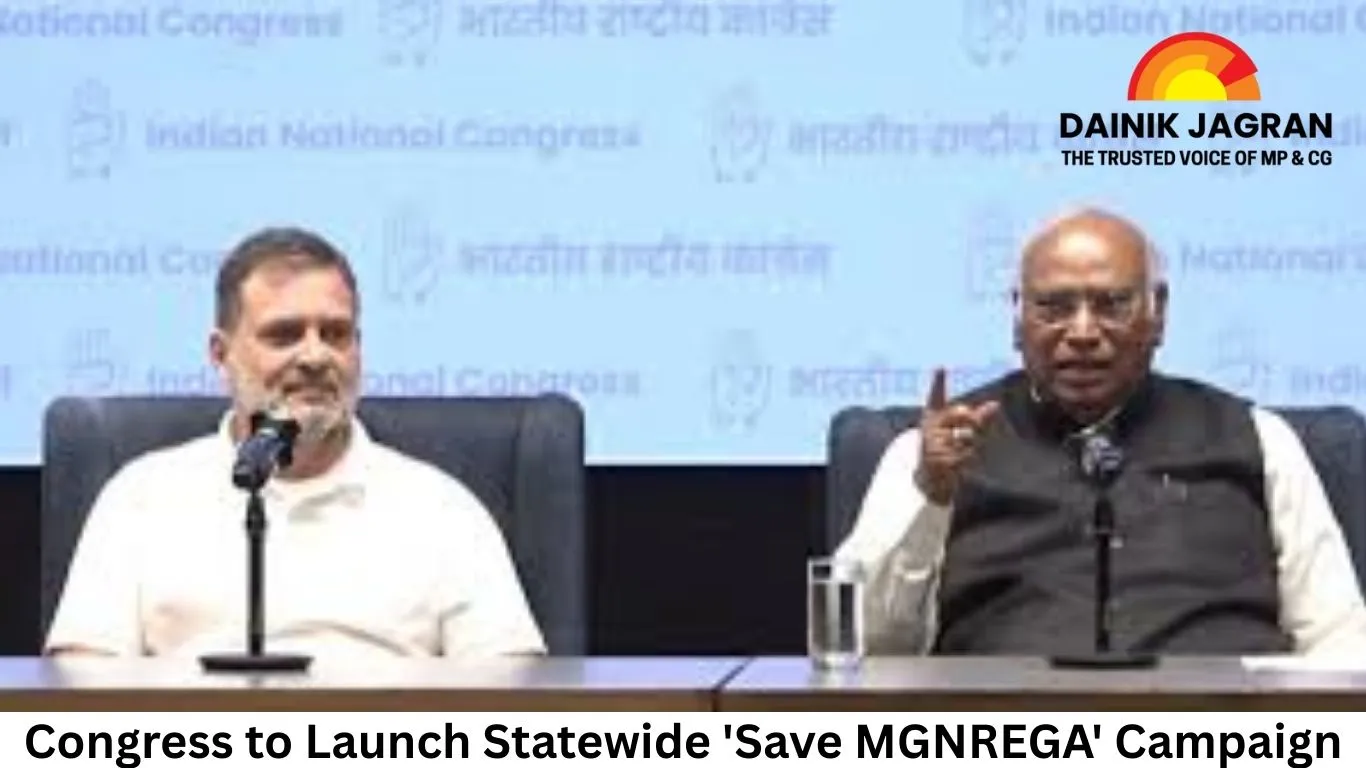
Congress to Launch Statewide 'Save MGNREGA' Campaign in Chhattisgarh from January 5
Digital Desk
The Congress party in Chhattisgarh is gearing up for a major statewide agitation starting January 5, 2026, to protest the central government's recent replacement of the Mahatma Gandhi National Rural Employment Guarantee Act (MGNREGA) with the new Viksit Bharat-Guarantee for Rozgar and Ajeevika Mission (Gramin) Act, 2025 (commonly referred to as VB-G RAM G or G-RAM-G Act).
The decision was taken at a Congress Working Committee (CWC) meeting in Delhi, where the party announced a nationwide "MGNREGA Bachao Andolan" (Save MGNREGA Movement). In Chhattisgarh, Congress leaders and workers will visit villages and hold meetings in gram panchayats to inform rural labourers about the changes and their potential impact.
State Congress president Deepak Baij has accused the BJP-led central government of deliberately weakening the demand-driven nature of MGNREGA, which was a legal guarantee of employment. He described the new law as a "direct attack" on the livelihood of crores of rural workers, claiming it shifts the scheme from a rights-based entitlement to a budget-constrained, supply-driven program controlled by the Centre.
Key concerns raised by the Congress include:
- Weakening of Legal Guarantee: Under MGNREGA, employment was demand-driven with no fixed budget cap. The new Act introduces normative allocations set by the Centre, and any excess expenditure must be borne by states.
- Pause During Farming Season: The law mandates a blackout period (aggregated 60 days) during peak agricultural seasons, which the party says could reduce actual working days and affect labourers' bargaining power.
- Increased Financial Burden on States: Funding shifts to a 60:40 ratio (Centre:State) for most states like Chhattisgarh, up from the earlier pattern where the Centre bore nearly all wage costs. This could strain state resources and limit scheme implementation.
- Unfulfilled Promises: While the new Act increases guaranteed days from 100 to 125, Congress points out that in Chhattisgarh, most families currently get only around 52 days on average (as per 2023-24 data), with just 14% receiving the full 100 days. They question how the 125-day claim will be met realistically.
- Countering Government Narratives: The party alleges the Centre is holding gram sabhas before December 26 to portray the new law positively, spreading "misinformation" while actually stripping workers of their core rights.
Baij has directed district, block, and city Congress committees, along with frontal organisations, to mobilise workers, elected representatives, and activists for peaceful awareness drives in every gram sabha. The goal is to highlight how the changes threaten timely wages, local planning autonomy, and overall rural income security.
The Congress vows to fight the amendments from villages to Parliament, calling it an assault on one of India's largest social security nets, particularly benefiting women, tribals, and marginalised communities in states like Chhattisgarh. The movement aims to build public pressure for the restoration of MGNREGA's original framework.

--------
🚨 Beat the News Rush – Join Now!
Get breaking alerts, hot exclusives, and game-changing stories instantly on your phone. No delays, no fluff – just the edge you need. ⚡
Tap to join:
🟢 WhatsApp Channel: Dainik Jagran MP CG
Crave more?
🅕 Facebook: Dainik Jagran MP CG English
🅧 Twitter (X): Dainik Jagran MP CG
🅘 Instagram: Dainik Jagran MP CG
Share the fire – keep your crew ahead! 🗞️🔥
Congress to Launch Statewide 'Save MGNREGA' Campaign in Chhattisgarh from January 5
Digital Desk
The decision was taken at a Congress Working Committee (CWC) meeting in Delhi, where the party announced a nationwide "MGNREGA Bachao Andolan" (Save MGNREGA Movement). In Chhattisgarh, Congress leaders and workers will visit villages and hold meetings in gram panchayats to inform rural labourers about the changes and their potential impact.
State Congress president Deepak Baij has accused the BJP-led central government of deliberately weakening the demand-driven nature of MGNREGA, which was a legal guarantee of employment. He described the new law as a "direct attack" on the livelihood of crores of rural workers, claiming it shifts the scheme from a rights-based entitlement to a budget-constrained, supply-driven program controlled by the Centre.
Key concerns raised by the Congress include:
- Weakening of Legal Guarantee: Under MGNREGA, employment was demand-driven with no fixed budget cap. The new Act introduces normative allocations set by the Centre, and any excess expenditure must be borne by states.
- Pause During Farming Season: The law mandates a blackout period (aggregated 60 days) during peak agricultural seasons, which the party says could reduce actual working days and affect labourers' bargaining power.
- Increased Financial Burden on States: Funding shifts to a 60:40 ratio (Centre:State) for most states like Chhattisgarh, up from the earlier pattern where the Centre bore nearly all wage costs. This could strain state resources and limit scheme implementation.
- Unfulfilled Promises: While the new Act increases guaranteed days from 100 to 125, Congress points out that in Chhattisgarh, most families currently get only around 52 days on average (as per 2023-24 data), with just 14% receiving the full 100 days. They question how the 125-day claim will be met realistically.
- Countering Government Narratives: The party alleges the Centre is holding gram sabhas before December 26 to portray the new law positively, spreading "misinformation" while actually stripping workers of their core rights.
Baij has directed district, block, and city Congress committees, along with frontal organisations, to mobilise workers, elected representatives, and activists for peaceful awareness drives in every gram sabha. The goal is to highlight how the changes threaten timely wages, local planning autonomy, and overall rural income security.
The Congress vows to fight the amendments from villages to Parliament, calling it an assault on one of India's largest social security nets, particularly benefiting women, tribals, and marginalised communities in states like Chhattisgarh. The movement aims to build public pressure for the restoration of MGNREGA's original framework.