


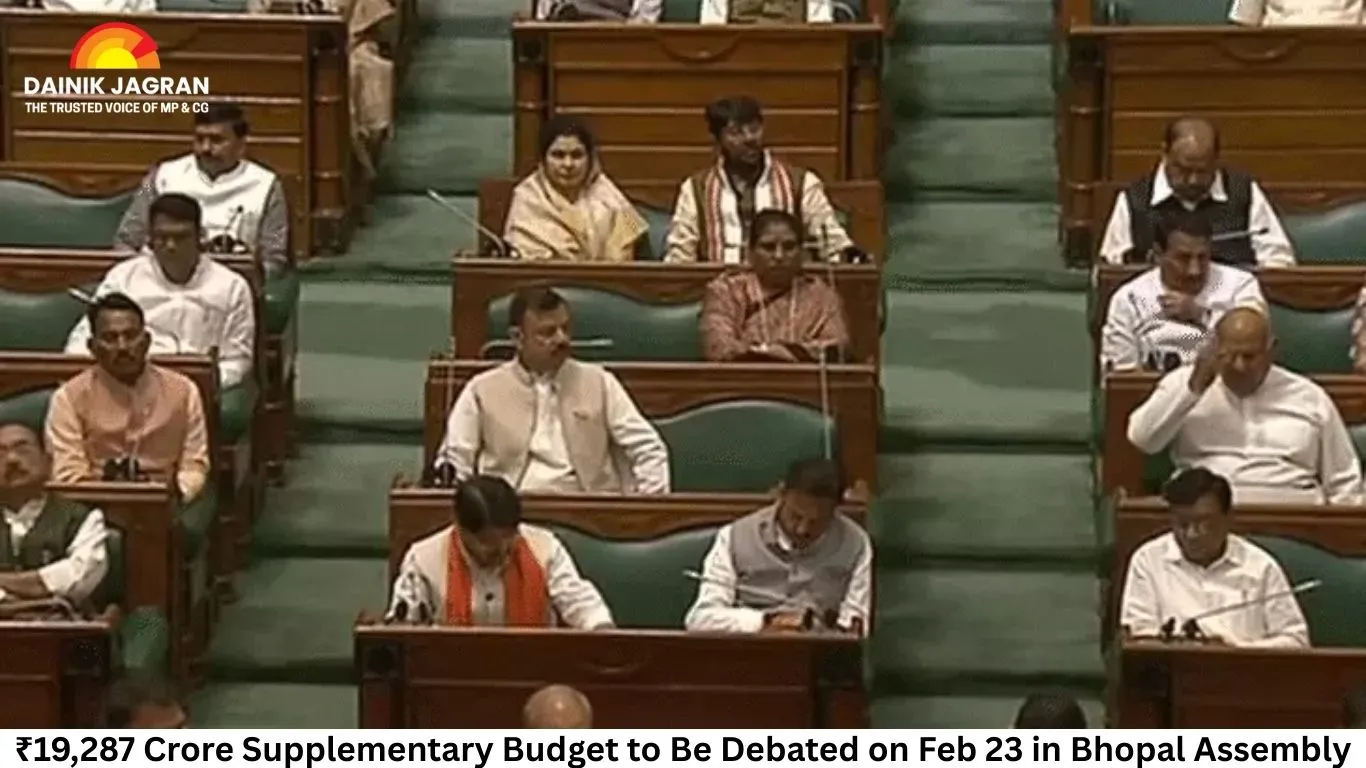
₹19,287 Crore Supplementary Budget to Be Debated on Feb 23 in Bhopal Assembly
Digital Desk
Deputy Chief Minister and Finance Minister Jagdish Devda informed the House that ₹950 crore has been allocated to service interest on new loans, while ₹700 crore is set aside for interest on existing liabilities. The provision forms part of the state’s broader effort to manage borrowing while sustaining expenditure across infrastructure, welfare, and development sectors.
Of the total outlay, ₹8,934.03 crore is assigned to revenue expenditure and ₹10,353 crore to capital spending. The budget includes ₹100 crore for the General Administration Department and another ₹100 crore as the state’s contribution to the National Disaster Response Fund. The Forest Department will receive ₹161 crore toward interest payments on afforestation funds, while ₹1,250 crore has been proposed for investment promotion schemes under the industrial policy framework.
Several allocations target sector-specific priorities. The Finance Department will utilize ₹1,650 crore for debt servicing, and the Commercial Tax Department has been allotted ₹1,388 crore for transfers under various heads. The Labour Department is set to receive ₹615 crore for the Chief Minister’s Jan Kalyan (Sambal) scheme. Additional provisions include ₹321 crore for the District Mineral Fund and ₹140 crore for reserves mandated under mining laws.
Infrastructure spending features prominently. The Energy Department has been allocated ₹2,630 crore to extend short-term loans to power companies. The Urban Development Department will receive ₹1,569 crore as grants to local bodies under the 15th Finance Commission framework, ₹248 crore for million-plus city grants, and ₹370 crore for departmental institutional loans. Public Works has been assigned ₹1,337 crore for land acquisition compensation, ₹225 crore for rural road upgrades, and ₹125 crore for major bridge construction.
Irrigation and water resources also form a major component, with ₹4,700 crore designated for projects under the Narmada Valley development framework and ₹300 crore each for dam and canal works and the Jal Jeevan Mission. Education-linked welfare schemes, including scholarships for meritorious students, together account for over ₹700 crore.
The debate is expected to test the government’s fiscal strategy as lawmakers examine whether the borrowing-linked allocations strike the right balance between development spending and debt sustainability. The outcome may shape spending priorities for the remainder of the financial year.
.jpg)




