

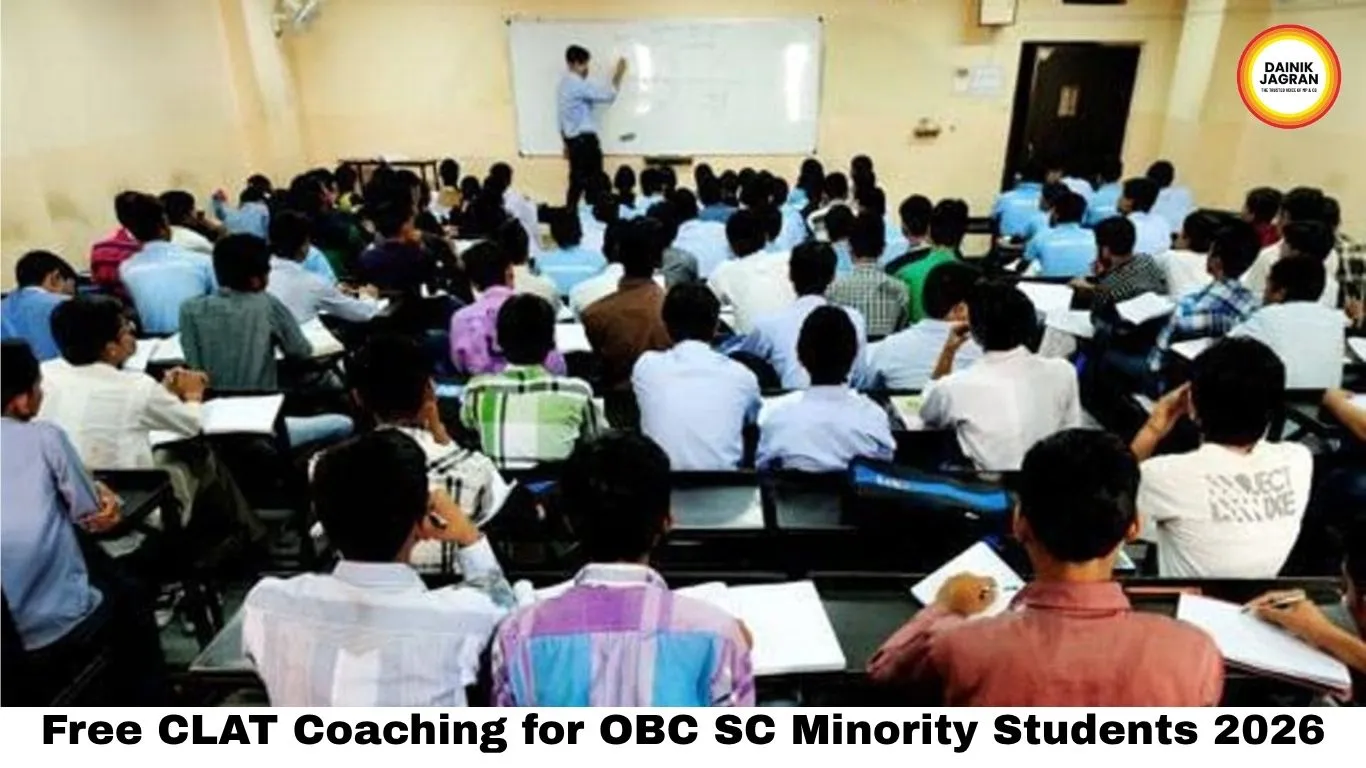
Free CLAT Coaching for OBC SC Minority Students 2026 — Full Guide
Digital Desk
Complete guide to free CLAT coaching schemes for SC, OBC and Minority students in 2026 — Central Government scheme with ₹4,000 stipend, Delhi scheme, MP and CG state programmes, eligibility and how to apply.
Free CLAT Coaching for OBC, SC and Minority Students 2026 — Every Scheme, Every Benefit, Every Application Process in One Place
From the Central Government's Free Coaching Scheme with ₹75,000 fee reimbursement and ₹4,000 monthly stipend to Delhi's new SC/ST/OBC/Minority coaching initiative — here is the complete verified guide for aspiring law students from marginalised communities.
The Law School Dream — And the Financial Wall
CLAT — the Common Law Admission Test — is the gateway to India's National Law Universities, including the prestigious NLSIU Bengaluru, NALSAR Hyderabad, NUJS Kolkata and 22 other NLUs across the country. An NLU degree opens doors to top law firms, civil services, judicial services and corporate legal departments. For students from SC, OBC and minority communities, the dream is real — but the cost of quality CLAT coaching, which can run from ₹50,000 to over ₹2 lakh at private institutes, has historically put that dream out of reach.
Multiple government schemes — at the central and state level — exist specifically to close that gap. Most eligible students have never heard of them. This is a complete guide to every scheme currently available.
SCHEME 1 — Central Government Free Coaching Scheme for SC and OBC Students
Administered by: Ministry of Social Justice and Empowerment (MSJE) Implemented through: Dr. Ambedkar Foundation (DAF) via Dr. Ambedkar Centres of Excellence (DACE) at central universities
What It Covers: CLAT is explicitly listed as a covered examination under the scheme — under the professional courses category alongside CAT, NEET, IIT-JEE, and international tests like GRE, GMAT, SAT and TOEFL.
Financial Benefits:
- Full coaching fee reimbursement — up to ₹75,000 for civil services preparation; specific amounts vary by exam category
- Monthly stipend of ₹4,000 for up to 12 months
- Additional incentives for candidates clearing specific stages
Eligibility:
- SC and OBC candidates only (minorities moved to separate Ministry of Minority Affairs scheme)
- Family income must not exceed ₹8 lakh per annum from all sources
- Must have the required educational qualification for the exam
- Must have an Aadhaar-linked bank account
Seat Distribution:
- Total seats: 3,500 per year nationally
- SC: OBC ratio — 70:30
- 30 percent of seats in each category reserved for female candidates
- 60 percent of total slots for graduation-level entrance exams (CLAT falls in this category)
How to Apply:
- Through participating Dr. Ambedkar Centres of Excellence at central universities
- Official portal: socialjustice.gov.in
- Application form available at grants-msje.gov.in
SCHEME 2 — Free Coaching and Allied Scheme for Minority Communities
Administered by: Ministry of Minority Affairs Target Beneficiaries: Students from six notified minority communities — Muslim, Christian, Sikh, Buddhist, Parsi and Jain
What It Covers: Financial support for free coaching at selected coaching institutions for competitive examinations — including CLAT, UPSC, SSC, banking exams, IIT-JEE, NEET and other professional entrance tests.
Financial Benefits:
- Coaching fees directly paid to empanelled coaching institutions
- Living allowance provided to outstation candidates
- Coaching at selected empanelled institutes across India
Eligibility:
- Must belong to one of the six notified minority communities
- Family income ceiling: ₹6 lakh per annum
- Must have cleared the minimum educational qualification for the target exam
How to Apply:
- Through the National Minorities Development and Finance Corporation (NMDFC)
- State Channelising Agencies (SCAs) under each state's Minority Affairs Department
- Central portal: minorityaffairs.gov.in
- India.gov.in national services portal also accepts applications
SCHEME 3 — Delhi Free Coaching Scheme 2026 for SC/ST/OBC/Minority Students
Administered by: Government of Delhi under Chief Minister Rekha Gupta Target Beneficiaries: SC, ST, OBC and Minority students who are permanent residents of Delhi
What It Covers: Free coaching for JEE, NEET, CLAT and other competitive examinations at empanelled coaching institutes in Delhi.
Financial Benefits:
- Full coaching fees covered
- Stipend for study and travel expenses
- Strict attendance and performance tracking built into the scheme
Eligibility:
- Permanent resident of Delhi
- Must belong to SC, ST, OBC or Minority category
- Income criteria apply — specific ceiling to be confirmed at district welfare office
How to Apply:
- Through Delhi's Social Welfare Department
- Applications available at district offices and the Delhi government's e-district portal
SCHEME 4 — State-Level SC/OBC Free Coaching Schemes — Madhya Pradesh and Chhattisgarh
Madhya Pradesh: The MP government runs free coaching programmes for SC, ST and OBC students through the Scheduled Caste Welfare Department and the OBC and Minority Welfare Department. CLAT coaching is covered under the professional entrance exam category. Applications are processed through the district Social Justice offices (Samajik Nyay Vibhag) in each district. Students in Bhopal, Indore, Jabalpur and Gwalior can visit their respective collectorate welfare sections to apply.
Chhattisgarh: Chhattisgarh's Scheduled Caste and Scheduled Tribe Development Department runs free coaching centres — called Pre-Examination Training Centres (PETCs) — in Raipur, Bilaspur and Jagdalpur. These centres cover CLAT along with UPSC, PSC, banking and other competitive examinations. Seats are limited and allocated by merit within category. Applications open annually — typically in April and May for the academic cycle beginning June.
Key Documents Required — All Schemes
For virtually every scheme listed above, the following documents are required at the time of application:
- Caste certificate (SC/OBC/Minority community certificate as applicable)
- Income certificate — issued by a Revenue Officer not below the rank of Tehsildar for self-employed families; from employer plus Revenue Officer consolidated certificate for salaried families
- Class 10 and 12 mark sheets and certificates
- Aadhaar card (mandatory — must be linked to bank account)
- Bank account details (Aadhaar-linked account required for DBT transfers)
- Domicile/residence certificate (for state schemes)
- Passport-size photographs
The CLAT Exam — What You Are Preparing For
CLAT 2026 Key Details:
- Conducting Body: Consortium of National Law Universities
- Exam Type: Offline (pen and paper)
- Duration: 2 hours
- Total Marks: 120
- Subjects: English Language, Current Affairs and General Knowledge, Legal Reasoning, Logical Reasoning, Quantitative Techniques
- Negative Marking: 0.25 marks deducted per wrong answer
- Official Portal: consortiumofnlus.ac.in
Top NLUs by CLAT Ranking:
- NLSIU Bengaluru — Cut-off: AIR 1–80
- NALSAR Hyderabad — Cut-off: AIR 80–180
- NLIU Bhopal — Cut-off: AIR 180–350
- WBNUJS Kolkata — Cut-off: AIR 200–400
- NLU Jodhpur — Cut-off: AIR 350–600
SC and OBC category cut-offs are significantly lower — typically 40 to 60 percent of the general category cut-off — making quality coaching the primary differentiating factor for reserved category aspirants.
The Opportunity Most Students Miss
The schemes described above are not widely known among the communities they are designed to serve. The gap between the existence of a scheme and a student in a village in Vidisha or Kanker knowing about it and successfully applying for it is enormous. District welfare offices, school teachers, college guidance counsellors and community leaders have a critical role to play in bridging that gap.
For every SC, OBC or minority student reading this article — the government has set aside seats, money and infrastructure specifically for you to access the same quality of CLAT preparation that private coaching students pay lakhs for. The application process is paperwork-heavy but entirely manageable. The opportunity it unlocks — a seat at an NLU and everything that follows — is one of the most powerful tools for social and economic mobility available to a young person in India today.
Free CLAT Coaching for OBC SC Minority Students 2026 — Full Guide
Digital Desk
Free CLAT Coaching for OBC, SC and Minority Students 2026 — Every Scheme, Every Benefit, Every Application Process in One Place
From the Central Government's Free Coaching Scheme with ₹75,000 fee reimbursement and ₹4,000 monthly stipend to Delhi's new SC/ST/OBC/Minority coaching initiative — here is the complete verified guide for aspiring law students from marginalised communities.
The Law School Dream — And the Financial Wall
CLAT — the Common Law Admission Test — is the gateway to India's National Law Universities, including the prestigious NLSIU Bengaluru, NALSAR Hyderabad, NUJS Kolkata and 22 other NLUs across the country. An NLU degree opens doors to top law firms, civil services, judicial services and corporate legal departments. For students from SC, OBC and minority communities, the dream is real — but the cost of quality CLAT coaching, which can run from ₹50,000 to over ₹2 lakh at private institutes, has historically put that dream out of reach.
Multiple government schemes — at the central and state level — exist specifically to close that gap. Most eligible students have never heard of them. This is a complete guide to every scheme currently available.
SCHEME 1 — Central Government Free Coaching Scheme for SC and OBC Students
Administered by: Ministry of Social Justice and Empowerment (MSJE) Implemented through: Dr. Ambedkar Foundation (DAF) via Dr. Ambedkar Centres of Excellence (DACE) at central universities
What It Covers: CLAT is explicitly listed as a covered examination under the scheme — under the professional courses category alongside CAT, NEET, IIT-JEE, and international tests like GRE, GMAT, SAT and TOEFL.
Financial Benefits:
- Full coaching fee reimbursement — up to ₹75,000 for civil services preparation; specific amounts vary by exam category
- Monthly stipend of ₹4,000 for up to 12 months
- Additional incentives for candidates clearing specific stages
Eligibility:
- SC and OBC candidates only (minorities moved to separate Ministry of Minority Affairs scheme)
- Family income must not exceed ₹8 lakh per annum from all sources
- Must have the required educational qualification for the exam
- Must have an Aadhaar-linked bank account
Seat Distribution:
- Total seats: 3,500 per year nationally
- SC: OBC ratio — 70:30
- 30 percent of seats in each category reserved for female candidates
- 60 percent of total slots for graduation-level entrance exams (CLAT falls in this category)
How to Apply:
- Through participating Dr. Ambedkar Centres of Excellence at central universities
- Official portal: socialjustice.gov.in
- Application form available at grants-msje.gov.in
SCHEME 2 — Free Coaching and Allied Scheme for Minority Communities
Administered by: Ministry of Minority Affairs Target Beneficiaries: Students from six notified minority communities — Muslim, Christian, Sikh, Buddhist, Parsi and Jain
What It Covers: Financial support for free coaching at selected coaching institutions for competitive examinations — including CLAT, UPSC, SSC, banking exams, IIT-JEE, NEET and other professional entrance tests.
Financial Benefits:
- Coaching fees directly paid to empanelled coaching institutions
- Living allowance provided to outstation candidates
- Coaching at selected empanelled institutes across India
Eligibility:
- Must belong to one of the six notified minority communities
- Family income ceiling: ₹6 lakh per annum
- Must have cleared the minimum educational qualification for the target exam
How to Apply:
- Through the National Minorities Development and Finance Corporation (NMDFC)
- State Channelising Agencies (SCAs) under each state's Minority Affairs Department
- Central portal: minorityaffairs.gov.in
- India.gov.in national services portal also accepts applications
SCHEME 3 — Delhi Free Coaching Scheme 2026 for SC/ST/OBC/Minority Students
Administered by: Government of Delhi under Chief Minister Rekha Gupta Target Beneficiaries: SC, ST, OBC and Minority students who are permanent residents of Delhi
What It Covers: Free coaching for JEE, NEET, CLAT and other competitive examinations at empanelled coaching institutes in Delhi.
Financial Benefits:
- Full coaching fees covered
- Stipend for study and travel expenses
- Strict attendance and performance tracking built into the scheme
Eligibility:
- Permanent resident of Delhi
- Must belong to SC, ST, OBC or Minority category
- Income criteria apply — specific ceiling to be confirmed at district welfare office
How to Apply:
- Through Delhi's Social Welfare Department
- Applications available at district offices and the Delhi government's e-district portal
SCHEME 4 — State-Level SC/OBC Free Coaching Schemes — Madhya Pradesh and Chhattisgarh
Madhya Pradesh: The MP government runs free coaching programmes for SC, ST and OBC students through the Scheduled Caste Welfare Department and the OBC and Minority Welfare Department. CLAT coaching is covered under the professional entrance exam category. Applications are processed through the district Social Justice offices (Samajik Nyay Vibhag) in each district. Students in Bhopal, Indore, Jabalpur and Gwalior can visit their respective collectorate welfare sections to apply.
Chhattisgarh: Chhattisgarh's Scheduled Caste and Scheduled Tribe Development Department runs free coaching centres — called Pre-Examination Training Centres (PETCs) — in Raipur, Bilaspur and Jagdalpur. These centres cover CLAT along with UPSC, PSC, banking and other competitive examinations. Seats are limited and allocated by merit within category. Applications open annually — typically in April and May for the academic cycle beginning June.
Key Documents Required — All Schemes
For virtually every scheme listed above, the following documents are required at the time of application:
- Caste certificate (SC/OBC/Minority community certificate as applicable)
- Income certificate — issued by a Revenue Officer not below the rank of Tehsildar for self-employed families; from employer plus Revenue Officer consolidated certificate for salaried families
- Class 10 and 12 mark sheets and certificates
- Aadhaar card (mandatory — must be linked to bank account)
- Bank account details (Aadhaar-linked account required for DBT transfers)
- Domicile/residence certificate (for state schemes)
- Passport-size photographs
The CLAT Exam — What You Are Preparing For
CLAT 2026 Key Details:
- Conducting Body: Consortium of National Law Universities
- Exam Type: Offline (pen and paper)
- Duration: 2 hours
- Total Marks: 120
- Subjects: English Language, Current Affairs and General Knowledge, Legal Reasoning, Logical Reasoning, Quantitative Techniques
- Negative Marking: 0.25 marks deducted per wrong answer
- Official Portal: consortiumofnlus.ac.in
Top NLUs by CLAT Ranking:
- NLSIU Bengaluru — Cut-off: AIR 1–80
- NALSAR Hyderabad — Cut-off: AIR 80–180
- NLIU Bhopal — Cut-off: AIR 180–350
- WBNUJS Kolkata — Cut-off: AIR 200–400
- NLU Jodhpur — Cut-off: AIR 350–600
SC and OBC category cut-offs are significantly lower — typically 40 to 60 percent of the general category cut-off — making quality coaching the primary differentiating factor for reserved category aspirants.
The Opportunity Most Students Miss
The schemes described above are not widely known among the communities they are designed to serve. The gap between the existence of a scheme and a student in a village in Vidisha or Kanker knowing about it and successfully applying for it is enormous. District welfare offices, school teachers, college guidance counsellors and community leaders have a critical role to play in bridging that gap.
For every SC, OBC or minority student reading this article — the government has set aside seats, money and infrastructure specifically for you to access the same quality of CLAT preparation that private coaching students pay lakhs for. The application process is paperwork-heavy but entirely manageable. The opportunity it unlocks — a seat at an NLU and everything that follows — is one of the most powerful tools for social and economic mobility available to a young person in India today.


