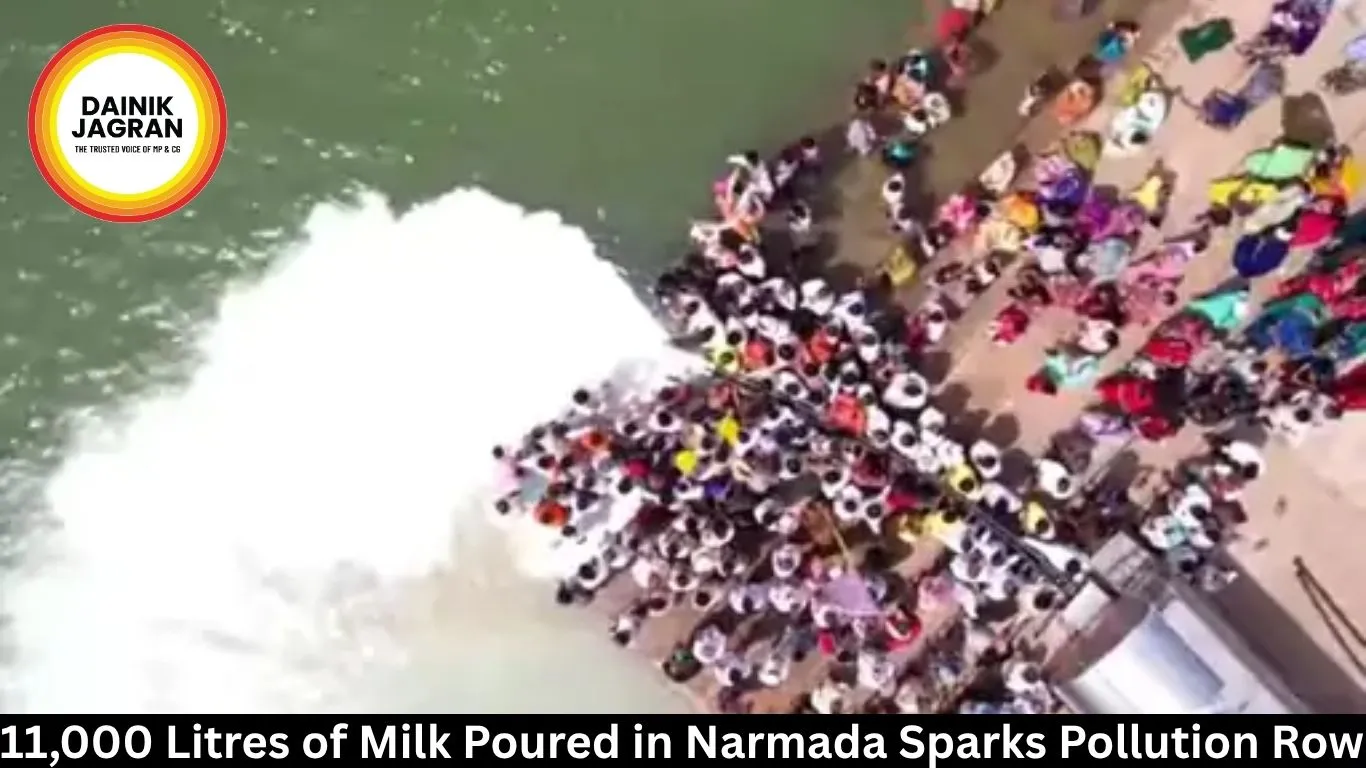
11,000 Litres of Milk Poured in Narmada Sparks Pollution Row

Digital Desk

11,000 Litres of Milk Poured in Narmada Sparks Pollution Row

Nearly 11,000 litres of milk were poured into Narmada river in Sehore during a religious ritual, triggering environmental concerns over water quality, aquatic life, and public health risks in Madhya Pradesh.


Narmada Milk Offering Triggers Environmental Alarm in Madhya Pradesh

Experts warn the 11,000-litre milk ritual in Sehore could cause months-long pollution and aquatic damage to the already stressed Narmada river.

Faith Meets Ecological Fallout

Tankers of milk rolled into Satdev village on a Wednesday morning, and nearly 11,000 litres of milk flowed into the Narmada River — an offering that was meant to sanctify the waters but has since set off alarm bells among environmental scientists, water experts, and activists across Madhya Pradesh and beyond.

The ceremony, which concluded on April 8, 2026, was the culmination of a 21-day Mahayajna organised under the guidance of Sant Shivanand Maharaj at the Pataleshwar Mahadev Temple in Sehore district. What began as a religious expression has quickly become a flashpoint in an ongoing national debate over the intersection of faith and ecological responsibility.

The Ritual and Its Scale

The milk was brought in tankers to the riverbank and poured into the flowing water amid chanting of mantras in the presence of a crowd of devotees. Organisers offered the milk as part of rituals and prayers for the purity of the waters, the well-being of pilgrims, and prosperity.

The milk offering continued across all 21 days — approximately 151 litres daily, with 1,100 litres poured on day one and 11,000 litres on the final day alone. According to devotee Pawan Pawar, the act was one of devotion: the Sant treats the Narmada as a mother, and the offering as a form of Abhishek — a sacred consecration ritual.

Experts Sound Pollution Warning

The scale of the offering, however, has drawn firm criticism from environmental specialists. Bhopal-based environmentalist Subhash Pandey described the consequences in stark scientific terms.

Pandey said 11,000 litres of milk acts as a significant organic pollutant — "highly oxygen-demanding" and capable of leading to "oxygen depletion, aquatic mortality, eutrophication, and loss of potability," adding that such effects are "predictable from dairy-effluent chemistry and have been documented in similar incidents worldwide."

Wildlife activist Ajay Dube reinforced that concern. He warned that large quantities of organic matter can deplete dissolved oxygen in water, adversely affecting the river ecosystem and impacting local communities dependent on the river for drinking water, as well as threatening aquatic life and domestic animals.

The 'Second Phase' Danger

What worries experts most is not the immediate impact but what Pandey calls the "second phase" of contamination. In the first phase, dissolved oxygen levels crash — the normal range of 6 to 8 mg/L can drop to between 1 and 3 mg/L, endangering fish and other aquatic life. In the second phase, the decomposition of dead organisms accelerates bacterial and fungal growth, pushing Biochemical Oxygen Demand (BOD) even higher. The normal BOD for a healthy river is under 3 mg/L; milk alone can push it to 1,000 mg/L or beyond. This chain reaction, according to Pandey, can persist for months, rendering river water downstream unsafe to drink across several kilometres.

Milk dramatically increases BOD because its high organic content — fats, proteins, and lactose — is rapidly broken down by microorganisms, consuming vast amounts of dissolved oxygen, which directly affects aquatic life.

A River Already Under Stress

The timing adds to existing concerns. The Narmada is one of the most heavily dammed rivers in India, and flow is particularly low during the summer months, which means the impact of any pollutant is far greater compared to rivers with stronger flows.

Originating from Amarkantak, the Narmada flows over 1,300 km through Madhya Pradesh, Maharashtra, and Gujarat before emptying into the Arabian Sea. It serves as a vital water source for millions, supporting irrigation, livelihoods, and ecosystems. International bodies, including the World Resources Institute, have previously listed the Narmada among rivers facing significant environmental risk.

Regulatory Silence Draws Criticism

Pandey has criticised the absence of institutional response. He said the Madhya Pradesh Pollution Control Board should have come forward, tested the water, and issued a public report, but gave nothing. He pointed to clear provisions under the Environment Protection Act 1986 and the Water Act 1974 to act against anyone who pollutes a potable water body — intentionally or otherwise.

The Biological Diversity Act 2002 and the National Green Tribunal Act 2010 also carry provisions against actions that harm river ecosystems. Experts argue that the absence of enforcement enables recurrence, regardless of intent.

The Road Ahead

The Satdev incident has reignited a broader conversation about how religious practices can be made ecologically responsible. Environmentalists stress that religious offerings must be symbolic and mindful of their ecological consequences. Pandey has called for both stronger enforcement and social awareness, stressing that protecting the Narmada pollution issue requires a balance between faith and responsibility — not just legal action after the damage is done.

With summer flows already low and millions depending on Narmada water for daily needs, the call from experts is clear: what is offered in devotion must not come at the cost of the river itself.


 

--------

🚨 Beat the News Rush – Join Now!

Get breaking alerts, hot exclusives, and game-changing stories instantly on your phone. No delays, no fluff – just the edge you need. ⚡

Tap to join: 

🟢 WhatsApp Channel: Dainik Jagran MP CG

Crave more?

🅕 Facebook: Dainik Jagran MP CG English

🅧 Twitter (X): Dainik Jagran MP CG

🅘 Instagram: Dainik Jagran MP CG

Share the fire – keep your crew ahead! 🗞️🔥

english.dainikjagranmpcg.com
14 Apr 2026 By Abhishek Joshi

11,000 Litres of Milk Poured in Narmada Sparks Pollution Row

Digital Desk

Narmada Milk Offering Triggers Environmental Alarm in Madhya Pradesh

Experts warn the 11,000-litre milk ritual in Sehore could cause months-long pollution and aquatic damage to the already stressed Narmada river.

Faith Meets Ecological Fallout

Tankers of milk rolled into Satdev village on a Wednesday morning, and nearly 11,000 litres of milk flowed into the Narmada River — an offering that was meant to sanctify the waters but has since set off alarm bells among environmental scientists, water experts, and activists across Madhya Pradesh and beyond.

The ceremony, which concluded on April 8, 2026, was the culmination of a 21-day Mahayajna organised under the guidance of Sant Shivanand Maharaj at the Pataleshwar Mahadev Temple in Sehore district. What began as a religious expression has quickly become a flashpoint in an ongoing national debate over the intersection of faith and ecological responsibility.

The Ritual and Its Scale

The milk was brought in tankers to the riverbank and poured into the flowing water amid chanting of mantras in the presence of a crowd of devotees. Organisers offered the milk as part of rituals and prayers for the purity of the waters, the well-being of pilgrims, and prosperity.

The milk offering continued across all 21 days — approximately 151 litres daily, with 1,100 litres poured on day one and 11,000 litres on the final day alone. According to devotee Pawan Pawar, the act was one of devotion: the Sant treats the Narmada as a mother, and the offering as a form of Abhishek — a sacred consecration ritual.

Experts Sound Pollution Warning

The scale of the offering, however, has drawn firm criticism from environmental specialists. Bhopal-based environmentalist Subhash Pandey described the consequences in stark scientific terms.

Pandey said 11,000 litres of milk acts as a significant organic pollutant — "highly oxygen-demanding" and capable of leading to "oxygen depletion, aquatic mortality, eutrophication, and loss of potability," adding that such effects are "predictable from dairy-effluent chemistry and have been documented in similar incidents worldwide."

Wildlife activist Ajay Dube reinforced that concern. He warned that large quantities of organic matter can deplete dissolved oxygen in water, adversely affecting the river ecosystem and impacting local communities dependent on the river for drinking water, as well as threatening aquatic life and domestic animals.

The 'Second Phase' Danger

What worries experts most is not the immediate impact but what Pandey calls the "second phase" of contamination. In the first phase, dissolved oxygen levels crash — the normal range of 6 to 8 mg/L can drop to between 1 and 3 mg/L, endangering fish and other aquatic life. In the second phase, the decomposition of dead organisms accelerates bacterial and fungal growth, pushing Biochemical Oxygen Demand (BOD) even higher. The normal BOD for a healthy river is under 3 mg/L; milk alone can push it to 1,000 mg/L or beyond. This chain reaction, according to Pandey, can persist for months, rendering river water downstream unsafe to drink across several kilometres.

Milk dramatically increases BOD because its high organic content — fats, proteins, and lactose — is rapidly broken down by microorganisms, consuming vast amounts of dissolved oxygen, which directly affects aquatic life.

A River Already Under Stress

The timing adds to existing concerns. The Narmada is one of the most heavily dammed rivers in India, and flow is particularly low during the summer months, which means the impact of any pollutant is far greater compared to rivers with stronger flows.

Originating from Amarkantak, the Narmada flows over 1,300 km through Madhya Pradesh, Maharashtra, and Gujarat before emptying into the Arabian Sea. It serves as a vital water source for millions, supporting irrigation, livelihoods, and ecosystems. International bodies, including the World Resources Institute, have previously listed the Narmada among rivers facing significant environmental risk.

Regulatory Silence Draws Criticism

Pandey has criticised the absence of institutional response. He said the Madhya Pradesh Pollution Control Board should have come forward, tested the water, and issued a public report, but gave nothing. He pointed to clear provisions under the Environment Protection Act 1986 and the Water Act 1974 to act against anyone who pollutes a potable water body — intentionally or otherwise.

The Biological Diversity Act 2002 and the National Green Tribunal Act 2010 also carry provisions against actions that harm river ecosystems. Experts argue that the absence of enforcement enables recurrence, regardless of intent.

The Road Ahead

The Satdev incident has reignited a broader conversation about how religious practices can be made ecologically responsible. Environmentalists stress that religious offerings must be symbolic and mindful of their ecological consequences. Pandey has called for both stronger enforcement and social awareness, stressing that protecting the Narmada pollution issue requires a balance between faith and responsibility — not just legal action after the damage is done.

With summer flows already low and millions depending on Narmada water for daily needs, the call from experts is clear: what is offered in devotion must not come at the cost of the river itself.

 

https://english.dainikjagranmpcg.com/states/madhya-pradesh/11000-litres-of-milk-poured-in-narmada-sparks-pollution-row/article-16850

Related Posts

Latest News