

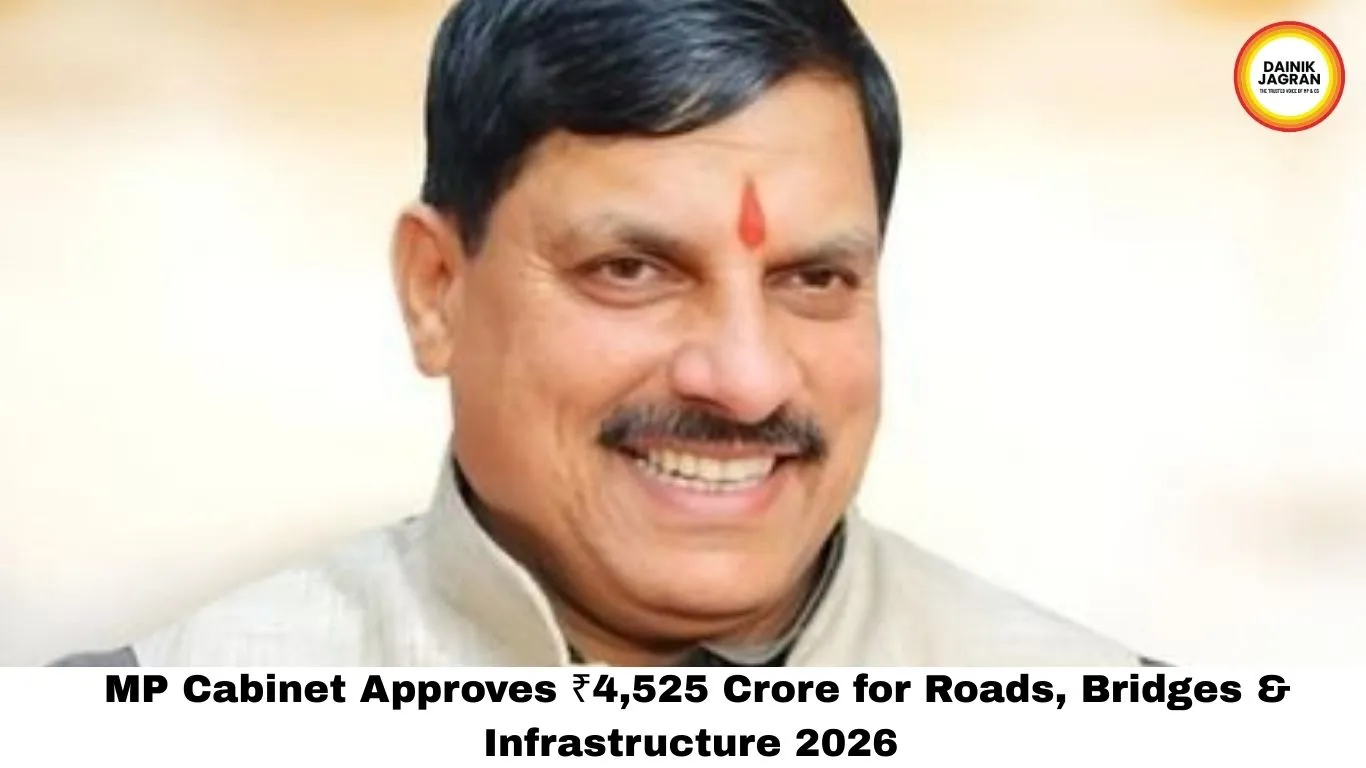
MP Cabinet Approves ₹4,525 Crore for Roads, Bridges & Infrastructure 2026 — Ujjain Elevated Corridor, Two Road Development Programmes & ₹40 Wheat Bonus for Farmers in One Power-Packed Meeting
Digital Desk
MP Cabinet clears ₹4,525 crore for PWD projects including Ujjain elevated corridor, two road programmes, and ₹40/quintal wheat MSP bonus for Rabi farmers 2026.
One Cabinet Meeting. ₹4,525 Crore. And a State on the Move.
On Tuesday evening, March 17, Chief Minister Dr. Mohan Yadav chaired a cabinet meeting at the state secretariat in Bhopal that packed more financial firepower into a single session than most state governments manage in a quarter. The MP Cabinet PWD approval of ₹4,525 crore covers roads, bridges, elevated corridors, government building maintenance, and irrigation — and it arrives alongside a farmers' bonus announcement that will directly affect millions of wheat growers heading into the Rabi procurement season.
Taken together, the decisions from Tuesday's cabinet are a clear statement of intent: Madhya Pradesh under the Mohan Yadav government is making infrastructure its primary growth lever — and it is doing so at scale.
Roads First: What the ₹4,525 Crore PWD Package Actually Contains
The headline figure breaks down into a series of targeted, time-bound allocations under the Public Works Department — each addressing a specific gap in Madhya Pradesh's road and urban infrastructure.
The single largest allocation — ₹945.20 crore — goes toward the construction of an elevated corridor in Ujjain. This is a transformational project for a city that draws millions of pilgrims every year, particularly during events like the Simhastha Kumbh. An elevated corridor will ease chronic traffic congestion in Ujjain's ancient core, improve access to religious sites, and reduce travel times across the city significantly.
Two fresh road development programmes received funding that together total over ₹3,000 crore. The Madhya Pradesh Road Development Programme-6 covering 2026 to 2031 received ₹1,543 crore, while MPRDP-7 for the same period received ₹1,476 crore. These are not one-time expenditures but multi-year commitments to systematically upgrade and expand the state road network through the end of the decade.
Additional allocations include ₹50.10 crore for the continuation of NDB-funded bridge and road construction projects — keeping externally-aided infrastructure work on schedule — and ₹7.38 crore for public participation scheme development running through March 2031.
On the maintenance side, ₹200.35 crore was approved for upkeep of government residences and rest houses across the state, and ₹300.70 crore was cleared for maintenance of office buildings including the Satpura and Vindhyachal Bhawans, as well as continued operation of the Shaurya Smarak in Bhopal.
Wheat Farmers Get a Bonus — With a Safety Net for Surplus
In a decision that will be closely watched by farming communities, the cabinet approved a bonus of ₹40 per quintal on wheat procured from farmers at the Minimum Support Price during the Rabi Marketing Year 2026-27.
This is a meaningful addition on top of the existing MSP — and critically, the state government has also built in a mechanism to handle surplus wheat that the Government of India declines to accept. Such surplus will be disposed of through open tender by the Madhya Pradesh State Civil Supplies Corporation, with the state bearing the costs. The bonus will be paid through regular budget provisions, and surplus disposal costs will be reimbursed under the Chief Minister's Farmers Crop Procurement Assistance Scheme.
This three-part structure — bonus, procurement commitment, and surplus management — addresses one of the most persistent anxieties for wheat farmers in MP: the fear that even when a good harvest arrives, the system will not absorb it at a fair price.
Beyond Roads: Irrigation, Governance, and a Renaming That Signals Direction
The cabinet also approved ₹228.42 crore for the Panwar Micro Irrigation Project in Rewa district. This project, with a command area of 7,350 hectares, will serve 37 villages across the Jawa and Teonthar tehsils — bringing reliable irrigation infrastructure to a region that has historically depended on erratic rainfall. Direct beneficiary farmers in these villages will see a measurable shift in agricultural security as this project rolls out.
On the administrative side, the cabinet cleared amendments to the MP Business Allocation Rules, transferring the State's Store Purchase and Service Procurement Rules from the MSME Department to the Finance Department — a consolidation move aimed at improving procurement oversight with no additional financial burden on the exchequer.
Perhaps the most symbolically resonant decision was the renaming of the Animal Husbandry and Dairy Development Department to the Gaupalan and Animal Husbandry Department. The word Gaupalan — meaning cow rearing and protection — replaces the more functional bureaucratic label, placing the protection and nurturing of cattle explicitly at the centre of the department's stated identity. The directorate will be renamed accordingly. This is a pointed cultural and political signal, consistent with the Mohan Yadav government's broader emphasis on Hindu values in governance.
Infrastructure Is Politics — But It Is Also Real Life
The decisions from Tuesday's MP Cabinet meeting will produce kilometres of new roads, a transformed Ujjain skyline, better-irrigated farmland in Rewa, and a few thousand rupees more in the pockets of wheat farmers. These are not abstractions. They are concrete changes in how people travel, farm, and live in Madhya Pradesh.
At the same time, it is worth asking the accountability question that every large infrastructure allocation demands: will the money reach the ground efficiently, or will it be eaten by delays, contractor lapses, and cost overruns? MP has a track record that includes both genuine delivery and significant leakage. The ₹4,525 crore announced on Tuesday is only as valuable as the roads, bridges, and corridors it actually produces.
The ₹40 wheat bonus is similarly conditional on functional procurement machinery — which MP has been building steadily but unevenly. Farmers in Vidisha, Hoshangabad, and Sehore, where wheat production is highest, will be watching whether the system holds up at scale during the March-April procurement window.
For now, the ambition is clear. The Mohan Yadav cabinet has laid out a blueprint for the infrastructure and agricultural investment that Madhya Pradesh needs to sustain its growth trajectory through 2031. The test, as always, will be in the execution — and the people of this state, who have waited long enough for roads that hold and harvests that pay, are watching closely.
--------
🚨 Beat the News Rush – Join Now!
Get breaking alerts, hot exclusives, and game-changing stories instantly on your phone. No delays, no fluff – just the edge you need. ⚡
Tap to join:
🟢 WhatsApp Channel: Dainik Jagran MP CG
Crave more?
🅕 Facebook: Dainik Jagran MP CG English
🅧 Twitter (X): Dainik Jagran MP CG
🅘 Instagram: Dainik Jagran MP CG
Share the fire – keep your crew ahead! 🗞️🔥
MP Cabinet Approves ₹4,525 Crore for Roads, Bridges & Infrastructure 2026 — Ujjain Elevated Corridor, Two Road Development Programmes & ₹40 Wheat Bonus for Farmers in One Power-Packed Meeting
Digital Desk
One Cabinet Meeting. ₹4,525 Crore. And a State on the Move.
On Tuesday evening, March 17, Chief Minister Dr. Mohan Yadav chaired a cabinet meeting at the state secretariat in Bhopal that packed more financial firepower into a single session than most state governments manage in a quarter. The MP Cabinet PWD approval of ₹4,525 crore covers roads, bridges, elevated corridors, government building maintenance, and irrigation — and it arrives alongside a farmers' bonus announcement that will directly affect millions of wheat growers heading into the Rabi procurement season.
Taken together, the decisions from Tuesday's cabinet are a clear statement of intent: Madhya Pradesh under the Mohan Yadav government is making infrastructure its primary growth lever — and it is doing so at scale.
Roads First: What the ₹4,525 Crore PWD Package Actually Contains
The headline figure breaks down into a series of targeted, time-bound allocations under the Public Works Department — each addressing a specific gap in Madhya Pradesh's road and urban infrastructure.
The single largest allocation — ₹945.20 crore — goes toward the construction of an elevated corridor in Ujjain. This is a transformational project for a city that draws millions of pilgrims every year, particularly during events like the Simhastha Kumbh. An elevated corridor will ease chronic traffic congestion in Ujjain's ancient core, improve access to religious sites, and reduce travel times across the city significantly.
Two fresh road development programmes received funding that together total over ₹3,000 crore. The Madhya Pradesh Road Development Programme-6 covering 2026 to 2031 received ₹1,543 crore, while MPRDP-7 for the same period received ₹1,476 crore. These are not one-time expenditures but multi-year commitments to systematically upgrade and expand the state road network through the end of the decade.
Additional allocations include ₹50.10 crore for the continuation of NDB-funded bridge and road construction projects — keeping externally-aided infrastructure work on schedule — and ₹7.38 crore for public participation scheme development running through March 2031.
On the maintenance side, ₹200.35 crore was approved for upkeep of government residences and rest houses across the state, and ₹300.70 crore was cleared for maintenance of office buildings including the Satpura and Vindhyachal Bhawans, as well as continued operation of the Shaurya Smarak in Bhopal.
Wheat Farmers Get a Bonus — With a Safety Net for Surplus
In a decision that will be closely watched by farming communities, the cabinet approved a bonus of ₹40 per quintal on wheat procured from farmers at the Minimum Support Price during the Rabi Marketing Year 2026-27.
This is a meaningful addition on top of the existing MSP — and critically, the state government has also built in a mechanism to handle surplus wheat that the Government of India declines to accept. Such surplus will be disposed of through open tender by the Madhya Pradesh State Civil Supplies Corporation, with the state bearing the costs. The bonus will be paid through regular budget provisions, and surplus disposal costs will be reimbursed under the Chief Minister's Farmers Crop Procurement Assistance Scheme.
This three-part structure — bonus, procurement commitment, and surplus management — addresses one of the most persistent anxieties for wheat farmers in MP: the fear that even when a good harvest arrives, the system will not absorb it at a fair price.
Beyond Roads: Irrigation, Governance, and a Renaming That Signals Direction
The cabinet also approved ₹228.42 crore for the Panwar Micro Irrigation Project in Rewa district. This project, with a command area of 7,350 hectares, will serve 37 villages across the Jawa and Teonthar tehsils — bringing reliable irrigation infrastructure to a region that has historically depended on erratic rainfall. Direct beneficiary farmers in these villages will see a measurable shift in agricultural security as this project rolls out.
On the administrative side, the cabinet cleared amendments to the MP Business Allocation Rules, transferring the State's Store Purchase and Service Procurement Rules from the MSME Department to the Finance Department — a consolidation move aimed at improving procurement oversight with no additional financial burden on the exchequer.
Perhaps the most symbolically resonant decision was the renaming of the Animal Husbandry and Dairy Development Department to the Gaupalan and Animal Husbandry Department. The word Gaupalan — meaning cow rearing and protection — replaces the more functional bureaucratic label, placing the protection and nurturing of cattle explicitly at the centre of the department's stated identity. The directorate will be renamed accordingly. This is a pointed cultural and political signal, consistent with the Mohan Yadav government's broader emphasis on Hindu values in governance.
Infrastructure Is Politics — But It Is Also Real Life
The decisions from Tuesday's MP Cabinet meeting will produce kilometres of new roads, a transformed Ujjain skyline, better-irrigated farmland in Rewa, and a few thousand rupees more in the pockets of wheat farmers. These are not abstractions. They are concrete changes in how people travel, farm, and live in Madhya Pradesh.
At the same time, it is worth asking the accountability question that every large infrastructure allocation demands: will the money reach the ground efficiently, or will it be eaten by delays, contractor lapses, and cost overruns? MP has a track record that includes both genuine delivery and significant leakage. The ₹4,525 crore announced on Tuesday is only as valuable as the roads, bridges, and corridors it actually produces.
The ₹40 wheat bonus is similarly conditional on functional procurement machinery — which MP has been building steadily but unevenly. Farmers in Vidisha, Hoshangabad, and Sehore, where wheat production is highest, will be watching whether the system holds up at scale during the March-April procurement window.
For now, the ambition is clear. The Mohan Yadav cabinet has laid out a blueprint for the infrastructure and agricultural investment that Madhya Pradesh needs to sustain its growth trajectory through 2031. The test, as always, will be in the execution — and the people of this state, who have waited long enough for roads that hold and harvests that pay, are watching closely.


