

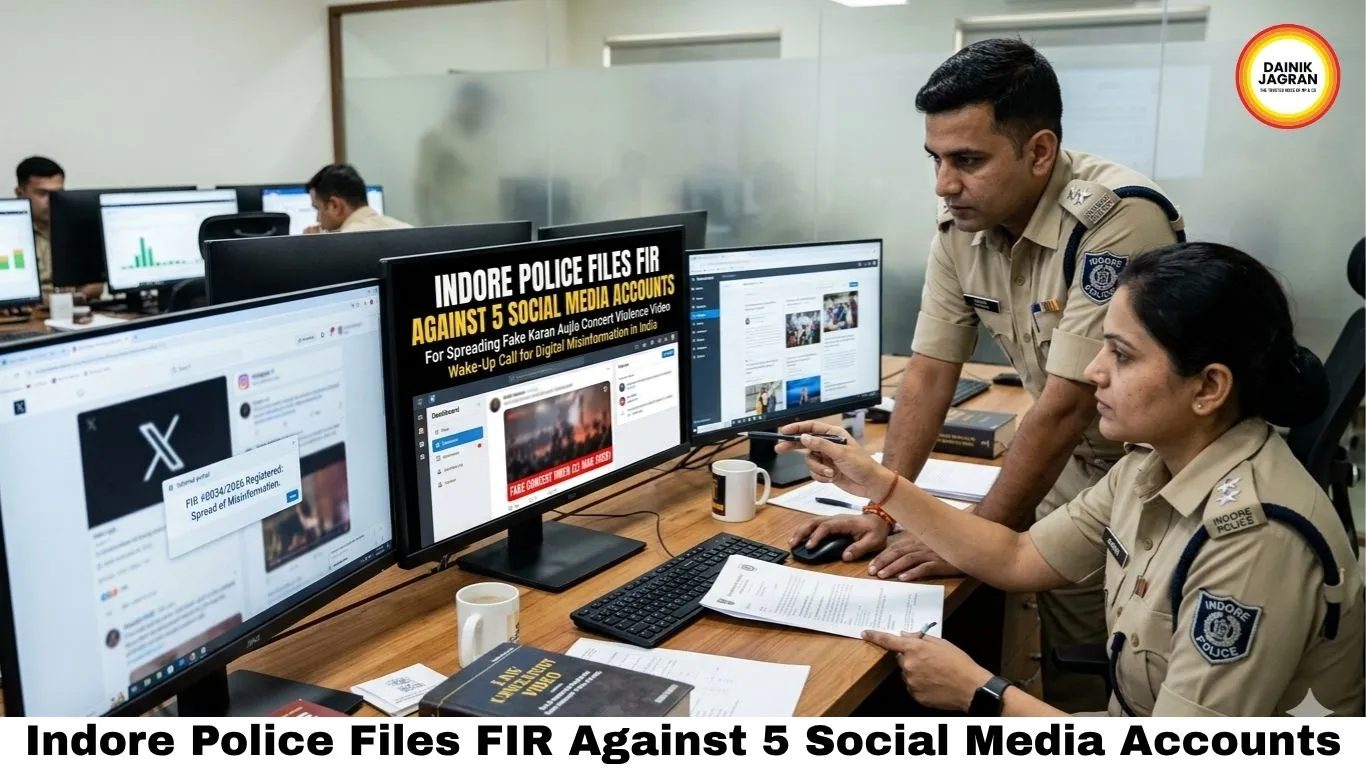
Indore Police Files FIR Against 5 Social Media Accounts for Spreading Fake Karan Aujla Concert Violence Video — A Wake-Up Call for Digital Misinformation in India
Digital Desk
Indore police registers FIR against 5 social media accounts for circulating a fake fight video falsely linked to Karan Aujla's concert. Here's what it means for India's fake news crisis
Indore Police Files FIR Against 5 Social Media Accounts for Spreading Fake Karan Aujla Concert Violence Video — A Wake-Up Call for Digital Misinformation in India
In an era where a recycled video clip can ignite panic across an entire city within hours, Indore police have drawn a firm line — and five social media accounts are now facing the legal consequences.
In a significant crackdown on digital misinformation, the Khajrana Police in Indore, Madhya Pradesh, have registered FIRs under the Bharatiya Nyaya Sanhita against five social media accounts for deliberately circulating a fake video of a violent physical altercation — falsely claiming it took place during a live concert by popular Punjabi singer Karan Aujla in the city. The accounts named in the FIRs are Metro City, O Ban News, Indore Express, Indore Viral Official, and Rooh-E-Indore. The action follows a swift investigation by the Indore Police's dedicated social media monitoring team, which traced the clip to an entirely unrelated concert in Mumbai — making it one of the clearest and most well-documented cases of deliberate viral misinformation in recent Madhya Pradesh history.
What Actually Happened — The Full Timeline
On March 21, 2026, a video began spreading rapidly across social media platforms purportedly showing a violent brawl breaking out during Karan Aujla's concert held in the Khajrana police station jurisdiction in Indore. The clip spread fast — shared widely across Facebook pages, Instagram reels, and WhatsApp groups — accompanied by captions that named the Indore venue and created immediate alarm among residents, concert-goers, and families of those who had attended the event.
The Indore Police's social media monitoring team moved quickly. A detailed investigation into the clip's origin revealed that the video was not from Indore at all. It was an old recording from a concert in Mumbai — unrelated to Karan Aujla's Indore event in both location and time. The five social media accounts had taken this old footage, repackaged it with fabricated local context, and deliberately re-circulated it to generate panic, engagement, and viral spread among Indore's digital community.
Upon confirming the misinformation, Khajrana Police registered cases against all five account operators under relevant sections of the Bharatiya Nyaya Sanhita and initiated further investigation to identify and trace the individuals behind the accounts.
Why This Case Is More Than Just a Local FIR
On the surface, this may appear to be a routine local law enforcement action. It is not. The Indore social media FIR case of 2026 is significant for several interconnected reasons that go well beyond a single fake video in a single city.
First, it demonstrates that India's police machinery — when equipped with dedicated social media monitoring infrastructure — is capable of acting with speed and precision. From the time the video went viral on March 21 to the registration of FIRs, the response window was remarkably tight. This is the kind of agile digital enforcement that India's information ecosystem urgently needs more of.
Second, it signals that the era of consequence-free viral misinformation in India may be ending. For years, anonymous and semi-anonymous social media pages in India have operated with near-total impunity — manufacturing outrage, recycling old footage, and building audiences on the currency of fabricated local drama. The Khajrana action sends a direct message: local pages with local audiences are not invisible to local police.
Third, the case arrives at a critical moment for India's evolving digital regulatory landscape. The IT (Intermediary Guidelines and Digital Media Ethics Code) Amendment Rules of 2026 — which came into effect in February 2026 — now require social media platforms to take down unlawful content within three hours and mandate clear labelling of AI-generated material. The Indore case, while not involving AI-generated content, fits squarely within the spirit of these new rules: content that is deliberately misleading, locally targeted, and designed to cause panic must be actioned rapidly.
The Five Accounts: Regional Pages With Regional Power
The five accounts named in the FIRs — Metro City, O Ban News, Indore Express, Indore Viral Official, and Rooh-E-Indore — are representative of a category of social media presence that has grown enormously across India's tier-2 and tier-3 cities over the past several years. These are hyperlocal digital news and entertainment pages that have accumulated significant local followings by positioning themselves as community voices — sharing local events, crime news, political updates, and viral content with a regional flavour.
The problem is structural. Many such pages operate with minimal editorial oversight, no verification processes, and an incentive model built entirely around engagement metrics. A violent video with a local caption generates far more clicks, shares, and followers than a measured, accurate piece of community journalism. The financial rewards of virality — through advertising revenue, sponsored posts, and growing follower counts — create a perverse incentive to publish first and verify never.
When these pages — some with hundreds of thousands of followers in their respective cities — amplify a fake violent incident, the impact on ground-level public sentiment, security perception, and communal harmony can be severe. In a city like Indore, which has experienced its share of communal tensions in recent history, a falsely labelled violence video can have consequences that go far beyond digital discomfort.
The Legal Framework: BNS and What It Means for Viral Misinformation
The FIRs registered by Khajrana Police invoke relevant sections of the Bharatiya Nyaya Sanhita — India's newly enacted criminal code that replaced the Indian Penal Code in 2024. The BNS carries provisions that are directly applicable to the deliberate spreading of false information designed to cause public fear, panic, or disorder. These sections complement the existing provisions of the Information Technology Act and, together, provide a reasonably robust legal basis for prosecuting deliberate digital misinformation.
However, the effectiveness of this framework depends entirely on enforcement consistency. Hundreds of similar fake viral videos circulate across India every day — falsely attributed to wrong locations, wrong communities, and wrong events. The Indore case should not remain an exceptional instance of enforcement. It must become the standard template.
What Platforms Must Do — And Are Not Doing Enough Of
India's new IT Rules place a significant portion of misinformation accountability on social media platforms themselves. The three-hour takedown window for unlawful content is a meaningful obligation — but its implementation is far from uniform. Large platforms like Meta and YouTube have grievance redressal mechanisms in place, but the speed, accuracy, and consistency of their responses to local Indian misinformation — particularly content in regional languages and from smaller accounts — remains inadequate.
Platforms must invest far more meaningfully in regional language moderation, proactive misinformation detection for hyperlocal content, and transparent reporting on takedown compliance. The Indore case involved five accounts spreading a fake video for several days before police action was taken. A platform-level detection mechanism should have flagged and removed this content within hours — not left it to a police monitoring team to catch.
A Small City Action With National Significance
The Indore social media FIR case of 2026 is small in scale but large in implication. Five pages, one fake video, one swift police action — and a clear signal to India's sprawling ecosystem of hyperlocal digital accounts that the law is watching, and that recycling old footage with false local captions is not harmless content strategy. It is a criminal offence.
India's digital public square is only as trustworthy as its least accountable participants. The Khajrana Police have demonstrated what responsible enforcement looks like. Now the question is whether platforms, other state police units, and India's central digital regulators will build on this moment — or let it remain an isolated example in a sea of unchecked misinformation.
The Indore FIR against five social media accounts is not just a local law enforcement story. It is a blueprint for how India must respond to the daily epidemic of hyperlocal fake news — swiftly, transparently, and without exception.
Indore Police Files FIR Against 5 Social Media Accounts for Spreading Fake Karan Aujla Concert Violence Video — A Wake-Up Call for Digital Misinformation in India
Digital Desk
Indore Police Files FIR Against 5 Social Media Accounts for Spreading Fake Karan Aujla Concert Violence Video — A Wake-Up Call for Digital Misinformation in India
In an era where a recycled video clip can ignite panic across an entire city within hours, Indore police have drawn a firm line — and five social media accounts are now facing the legal consequences.
In a significant crackdown on digital misinformation, the Khajrana Police in Indore, Madhya Pradesh, have registered FIRs under the Bharatiya Nyaya Sanhita against five social media accounts for deliberately circulating a fake video of a violent physical altercation — falsely claiming it took place during a live concert by popular Punjabi singer Karan Aujla in the city. The accounts named in the FIRs are Metro City, O Ban News, Indore Express, Indore Viral Official, and Rooh-E-Indore. The action follows a swift investigation by the Indore Police's dedicated social media monitoring team, which traced the clip to an entirely unrelated concert in Mumbai — making it one of the clearest and most well-documented cases of deliberate viral misinformation in recent Madhya Pradesh history.
What Actually Happened — The Full Timeline
On March 21, 2026, a video began spreading rapidly across social media platforms purportedly showing a violent brawl breaking out during Karan Aujla's concert held in the Khajrana police station jurisdiction in Indore. The clip spread fast — shared widely across Facebook pages, Instagram reels, and WhatsApp groups — accompanied by captions that named the Indore venue and created immediate alarm among residents, concert-goers, and families of those who had attended the event.
The Indore Police's social media monitoring team moved quickly. A detailed investigation into the clip's origin revealed that the video was not from Indore at all. It was an old recording from a concert in Mumbai — unrelated to Karan Aujla's Indore event in both location and time. The five social media accounts had taken this old footage, repackaged it with fabricated local context, and deliberately re-circulated it to generate panic, engagement, and viral spread among Indore's digital community.
Upon confirming the misinformation, Khajrana Police registered cases against all five account operators under relevant sections of the Bharatiya Nyaya Sanhita and initiated further investigation to identify and trace the individuals behind the accounts.
Why This Case Is More Than Just a Local FIR
On the surface, this may appear to be a routine local law enforcement action. It is not. The Indore social media FIR case of 2026 is significant for several interconnected reasons that go well beyond a single fake video in a single city.
First, it demonstrates that India's police machinery — when equipped with dedicated social media monitoring infrastructure — is capable of acting with speed and precision. From the time the video went viral on March 21 to the registration of FIRs, the response window was remarkably tight. This is the kind of agile digital enforcement that India's information ecosystem urgently needs more of.
Second, it signals that the era of consequence-free viral misinformation in India may be ending. For years, anonymous and semi-anonymous social media pages in India have operated with near-total impunity — manufacturing outrage, recycling old footage, and building audiences on the currency of fabricated local drama. The Khajrana action sends a direct message: local pages with local audiences are not invisible to local police.
Third, the case arrives at a critical moment for India's evolving digital regulatory landscape. The IT (Intermediary Guidelines and Digital Media Ethics Code) Amendment Rules of 2026 — which came into effect in February 2026 — now require social media platforms to take down unlawful content within three hours and mandate clear labelling of AI-generated material. The Indore case, while not involving AI-generated content, fits squarely within the spirit of these new rules: content that is deliberately misleading, locally targeted, and designed to cause panic must be actioned rapidly.
The Five Accounts: Regional Pages With Regional Power
The five accounts named in the FIRs — Metro City, O Ban News, Indore Express, Indore Viral Official, and Rooh-E-Indore — are representative of a category of social media presence that has grown enormously across India's tier-2 and tier-3 cities over the past several years. These are hyperlocal digital news and entertainment pages that have accumulated significant local followings by positioning themselves as community voices — sharing local events, crime news, political updates, and viral content with a regional flavour.
The problem is structural. Many such pages operate with minimal editorial oversight, no verification processes, and an incentive model built entirely around engagement metrics. A violent video with a local caption generates far more clicks, shares, and followers than a measured, accurate piece of community journalism. The financial rewards of virality — through advertising revenue, sponsored posts, and growing follower counts — create a perverse incentive to publish first and verify never.
When these pages — some with hundreds of thousands of followers in their respective cities — amplify a fake violent incident, the impact on ground-level public sentiment, security perception, and communal harmony can be severe. In a city like Indore, which has experienced its share of communal tensions in recent history, a falsely labelled violence video can have consequences that go far beyond digital discomfort.
The Legal Framework: BNS and What It Means for Viral Misinformation
The FIRs registered by Khajrana Police invoke relevant sections of the Bharatiya Nyaya Sanhita — India's newly enacted criminal code that replaced the Indian Penal Code in 2024. The BNS carries provisions that are directly applicable to the deliberate spreading of false information designed to cause public fear, panic, or disorder. These sections complement the existing provisions of the Information Technology Act and, together, provide a reasonably robust legal basis for prosecuting deliberate digital misinformation.
However, the effectiveness of this framework depends entirely on enforcement consistency. Hundreds of similar fake viral videos circulate across India every day — falsely attributed to wrong locations, wrong communities, and wrong events. The Indore case should not remain an exceptional instance of enforcement. It must become the standard template.
What Platforms Must Do — And Are Not Doing Enough Of
India's new IT Rules place a significant portion of misinformation accountability on social media platforms themselves. The three-hour takedown window for unlawful content is a meaningful obligation — but its implementation is far from uniform. Large platforms like Meta and YouTube have grievance redressal mechanisms in place, but the speed, accuracy, and consistency of their responses to local Indian misinformation — particularly content in regional languages and from smaller accounts — remains inadequate.
Platforms must invest far more meaningfully in regional language moderation, proactive misinformation detection for hyperlocal content, and transparent reporting on takedown compliance. The Indore case involved five accounts spreading a fake video for several days before police action was taken. A platform-level detection mechanism should have flagged and removed this content within hours — not left it to a police monitoring team to catch.
A Small City Action With National Significance
The Indore social media FIR case of 2026 is small in scale but large in implication. Five pages, one fake video, one swift police action — and a clear signal to India's sprawling ecosystem of hyperlocal digital accounts that the law is watching, and that recycling old footage with false local captions is not harmless content strategy. It is a criminal offence.
India's digital public square is only as trustworthy as its least accountable participants. The Khajrana Police have demonstrated what responsible enforcement looks like. Now the question is whether platforms, other state police units, and India's central digital regulators will build on this moment — or let it remain an isolated example in a sea of unchecked misinformation.
The Indore FIR against five social media accounts is not just a local law enforcement story. It is a blueprint for how India must respond to the daily epidemic of hyperlocal fake news — swiftly, transparently, and without exception.


