


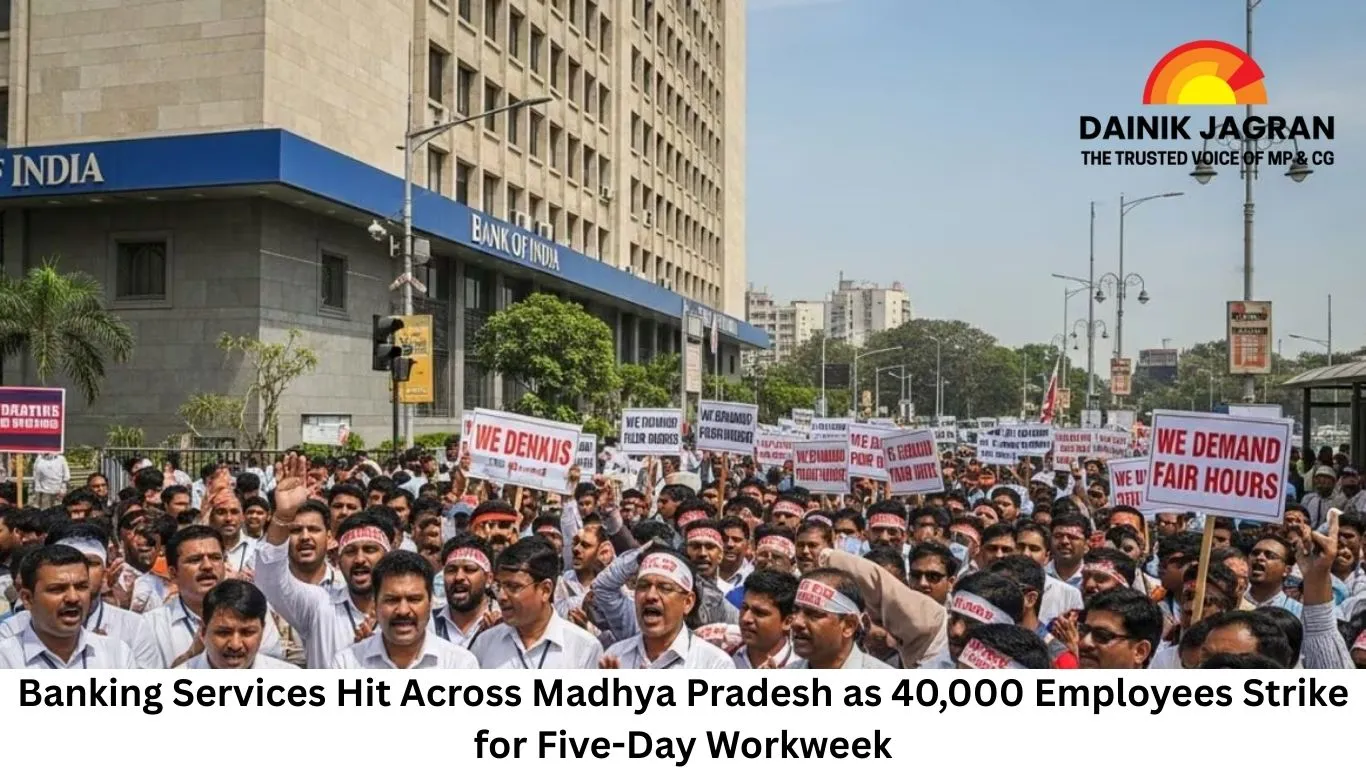
Banking Services Hit Across Madhya Pradesh as 40,000 Employees Strike for Five-Day Workweek
Digital Desk
The strike was called by the United Forum of Bank Unions (UFBU), an umbrella body representing bank employees’ unions across public, private, foreign, regional rural and cooperative banks. Branches in major cities including Bhopal, Indore, Jabalpur, Gwalior and Ujjain remained shut, with padlocks visible at several locations.
Routine banking services such as cheque clearing, cash deposits and withdrawals, loan processing and customer services were hit. Union leaders warned that prolonged disruption could also impact ATM cash availability, particularly in urban centres with high transaction volumes.
Employees of major public sector banks—including State Bank of India, Bank of Baroda, Bank of India, Canara Bank, Central Bank of India, Union Bank of India, Indian Bank, Indian Overseas Bank, UCO Bank, Punjab & Sind Bank and Bank of Maharashtra—participated in the strike. Staff from several private sector banks also extended support, intensifying the impact.
UFBU’s Madhya Pradesh coordinator V.K. Sharma said the strike centres on a single, long-pending demand: implementation of a five-day workweek in the banking sector by declaring all Saturdays as holidays. Currently, only the second and fourth Saturdays are non-working days.
Sharma said the issue dates back to the 10th bipartite settlement and 7th joint note signed in 2015 between the Indian Banks’ Association (IBA) and employee unions. At that time, half-day Saturdays were converted into full working days, with an assurance that the demand for a five-day week would be considered later.
Further discussions were held in 2022 and 2023, during which the government and IBA agreed in principle to increase weekday working hours by 40 minutes to compensate for making remaining Saturdays holidays. A formal proposal was subsequently submitted to the Centre.
“Despite repeated assurances, the proposal has been pending for nearly two years. Employees were left with no option but to resume agitation,” Sharma said.
UFBU had earlier announced a two-day strike in March last year but deferred it after the government indicated that the matter was under active consideration. With no final decision taken, unions revived the strike call.
Union leaders said the five-day week would align banking with other central government offices, improve work-life balance and enhance efficiency. The government and banking authorities are yet to issue a formal response to Tuesday’s strike.
.jpg)




