


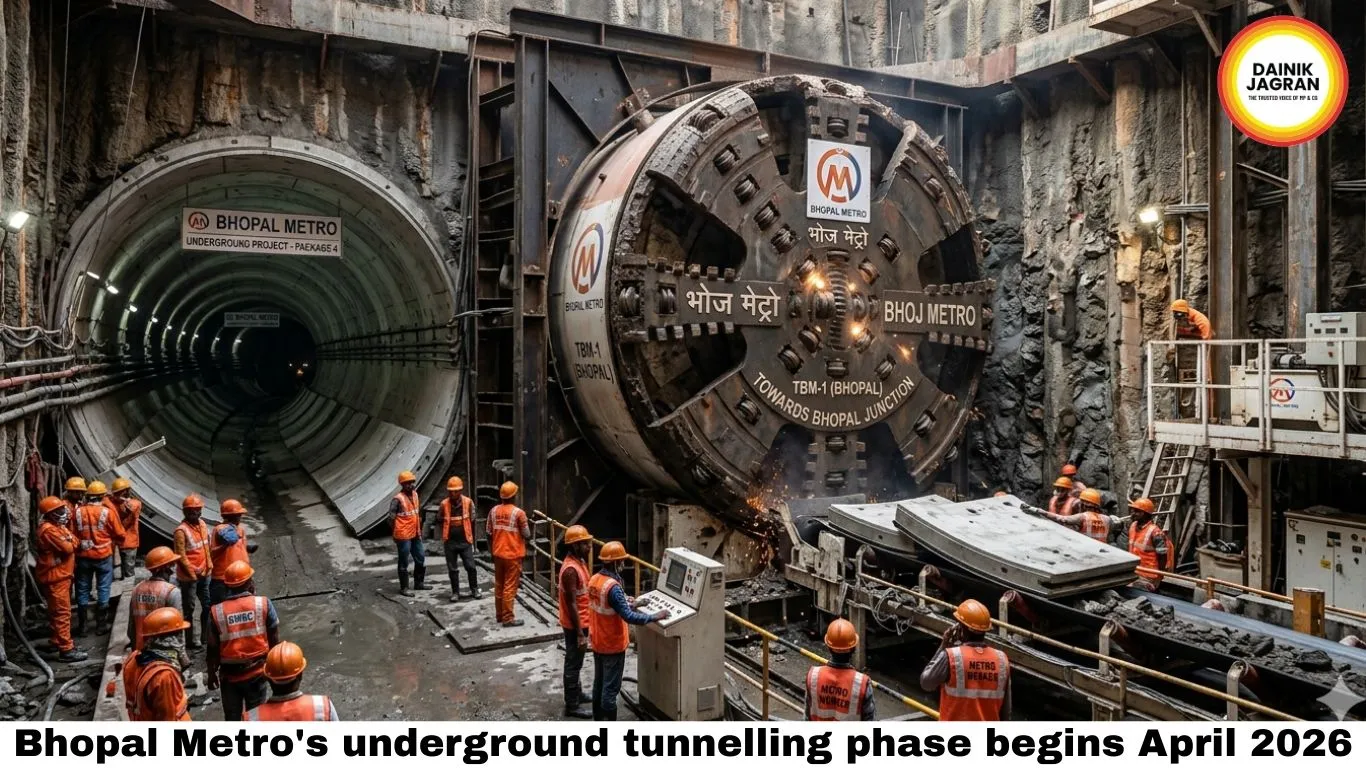
Bhopal Metro Underground Work 2026: Two TBMs to Start Drilling 20 Metres Below City in April — 3.39 km Tunnel, ₹769 Crore Contract, Zero Vibration Promise
Digital Desk
Bhopal's metro rail project has entered the most complex and consequential phase of its construction journey. After years of elevated viaduct work visible above the city's skyline, the action is now shifting underground — literally. Two massive Tunnel Boring Machines are set to begin drilling 20 metres beneath Bhopal's oldest and most densely populated neighbourhoods in the first week of April 2026, carving a 3.39-kilometre underground corridor that will connect Pul Patra to Sindhi Colony along the Orange Line. The underground section represents the boldest and most technically demanding chapter in the Bhoj Metro story — and it is about to begin.
Where the Project Stands: 20% Complete, One Section Already Running
Overall, the Bhopal Metro Phase 1 project — covering 27.90 kilometres across two lines and 28 stations — stands at approximately 20 percent completion as of early 2026, with an estimated revised project cost of around ₹7,500 crore.
The most visible milestone came on December 21, 2025, when the elevated priority corridor between Subhash Nagar and AIIMS Bhopal was formally inaugurated and opened for commercial passenger operations. This 7.4-kilometre stretch — which took over eight years and missed five successive deadlines to reach launch day — now runs daily services and has given Bhopal its first taste of metro travel. The city had been waiting since 2019.
With the elevated section now operational, the Madhya Pradesh Metro Rail Corporation Limited has turned its full attention to the underground section — the engineering challenge that makes every elevated viaduct look straightforward by comparison.
The Machines: Two Robbins TBMs, ₹100 Crore Each
The tools at the centre of this next phase are two Earth Pressure Balance Tunnel Boring Machines manufactured by the Robbins Company at their facility in Bengaluru. Each machine costs approximately ₹100 crore and is engineered specifically for the geological and urban conditions beneath Bhopal's historic core. The two TBMs have already arrived in the state capital and the assembly of their components is currently underway — a process expected to be completed by the end of March. Once assembly is done, the machines will be lowered into a 20-metre deep launching shaft near Puttha Mill, from where they will begin cutting through the earth in the first week of April.
Each TBM excavates a tunnel with a diameter of 5.8 metres — wide enough for the twin tunnels that will carry metro trains in opposite directions through the underground corridor. The Robbins EPB machines are designed for mixed-face ground conditions and urban settings where surface disruption must be minimised.
The underground tunnelling contract — worth ₹769 crore — has been awarded to a joint venture between Kalpataru Projects International Limited and Gulermak, a Turkish tunnelling specialist with extensive metro experience across Asia and Europe.
The Route: Six Segments, Three Major Stations
The underground construction has been divided into six strategic segments. The TBMs will first be deployed from the southern side of Bhopal Junction towards Pul Patra. Subsequent phases will move northwards, culminating at Sindhi Colony station. The key underground stations along this corridor are Aishbagh, Sindhi Colony, DIG Bungalow, and Krishi Mandi. Pul Bogda will serve as a major interchange station — the point where the Orange Line and Blue Line of the metro network will converge, making it one of the most critical nodes in Bhopal's entire transit system.
The 3.39-kilometre tunnel will pass directly beneath some of the city's most sensitive areas — including Bhopal Railway Junction, Nadra Bus Stand, and the densely built neighbourhoods of Pul Patra and Mangalwara, where colonial-era buildings, narrow lanes, and active utility networks make underground work exceptionally challenging.
Zero Vibration: How They Will Drill Without Disturbing the City Above
The most common concern about metro tunnelling in historic urban neighbourhoods is ground vibration — the risk that drilling will shake foundations, crack walls, and disturb the daily life of residents living directly above the tunnel path. Officials at MPMRCL have addressed this directly.
The Earth Pressure Balance TBM works by maintaining constant pressure against the excavated face, preventing ground settlement and surface subsidence. As the cutter head grinds forward, a segment erector simultaneously installs pre-cast concrete rings to form the tunnel walls — providing immediate structural support and preventing any void from forming behind the machine. Excavated soil is removed via a screw conveyor and slurry pipes without ever stopping the drilling cycle.
Engineers will also sequence work to limit vibrations and continuously monitor nearby structures for settlement and movement. Coordination with heritage conservation bodies and utility departments — for water mains, sewer lines, and electrical cables running beneath the old city — is already underway.
The Political Dimension: Alok Sharma and the Underground Demand
The progress of Bhopal Metro has become a political flashpoint, with BJP MP Alok Sharma and local MLA Bhagwan Das Sabnani both publicly demanding that more of the metro network be built underground rather than elevated — particularly through residential neighbourhoods where elevated viaducts disrupt light, air, and property values. Sharma has argued that given the heritage character of central Bhopal, an elevated metro is visually incompatible with the city's character and that the additional cost of underground construction is justified.
Metro officials have maintained that the current route plan — combining elevated and underground sections as originally approved — balances cost, engineering feasibility, and timeline. The underground section currently underway represents the segment where underground was always the only viable option: beneath the old city's historic core.
The Full Phase 1 Picture: Two Lines, 28 Stations, 2027 Target
Bhopal Metro Phase 1 consists of two lines. The Orange Line runs 14.99 kilometres from Karond Intersection to AIIMS Bhopal, with 16 stations covering both elevated and underground sections. The Blue Line covers 12.88 kilometres from Bhadbhada Square to Ratnagiri Tiraha, with 13 stations passing through Habibganj Railway Station, Board Office Square, and MP Nagar.
The project is financed through a combination of Central Government contribution, Madhya Pradesh state government equity, an Asian Development Bank loan, and a 400 million euro loan from the European Investment Bank signed in December 2019. Full Phase 1 operations — across both lines and all 28 stations — are now expected by 2027.
When the TBMs begin turning in April 2026, it will mark the moment Bhopal's metro stops being a construction project visible from the road and becomes a subterranean city beneath the city — a transformation that, when complete, will move lakhs of daily commuters through the heart of Madhya Pradesh's capital without a single traffic light, traffic jam, or degree of surface disruption.
.jpg)




