Dense Fog Slows Ambulance Services Across Madhya Pradesh, Raising Night-Time Emergency Risks
Digital Desk
Severe cold and dense fog have disrupted emergency medical services across large parts of Madhya Pradesh, significantly slowing ambulance response times, particularly during night and early morning hours. Health officials said reduced visibility has forced emergency vehicles to operate at lower speeds to avoid accidents, delaying patient reach and inter-hospital transfers in critical cases.
The impact has been most pronounced between 2 am and 6 am, when visibility drops sharply in several districts. Officials managing the state-run 108 Ambulance Service said foggy conditions have directly affected response times, especially for night-time emergencies and Inter Facility Transfer (IFT) cases, where patients require urgent movement between healthcare centres.
The cold wave gripping the state has intensified the challenge. Temperatures in some regions have fallen close to 2 degrees Celsius, while Bhopal recorded its coldest January spell in a decade. Authorities ordered the closure of schools in Indore, Raisen, Gwalior and Narmadapuram on Wednesday as cold wave and cold day conditions persisted.
According to the Meteorological Department, dense fog has covered more than half of Madhya Pradesh. Districts including Gwalior, Bhind, Datia, Niwari, Tikamgarh and Chhatarpur have been facing severely reduced visibility. Foggy conditions were also reported from Bhopal, Ujjain, Neemuch, Mandsaur, Ratlam, Agar-Malwa, Rajgarh, Shajapur, Vidisha, Morena, Sheopur, Shivpuri, Guna, Ashoknagar, Sehore, Sagar, Damoh, Jabalpur, Katni, Panna, Satna, Rewa, Sidhi, Singrauli, Umaria and Shahdol. Cold wave alerts were issued for Bhopal, Sehore, Rajgarh and Shajapur.
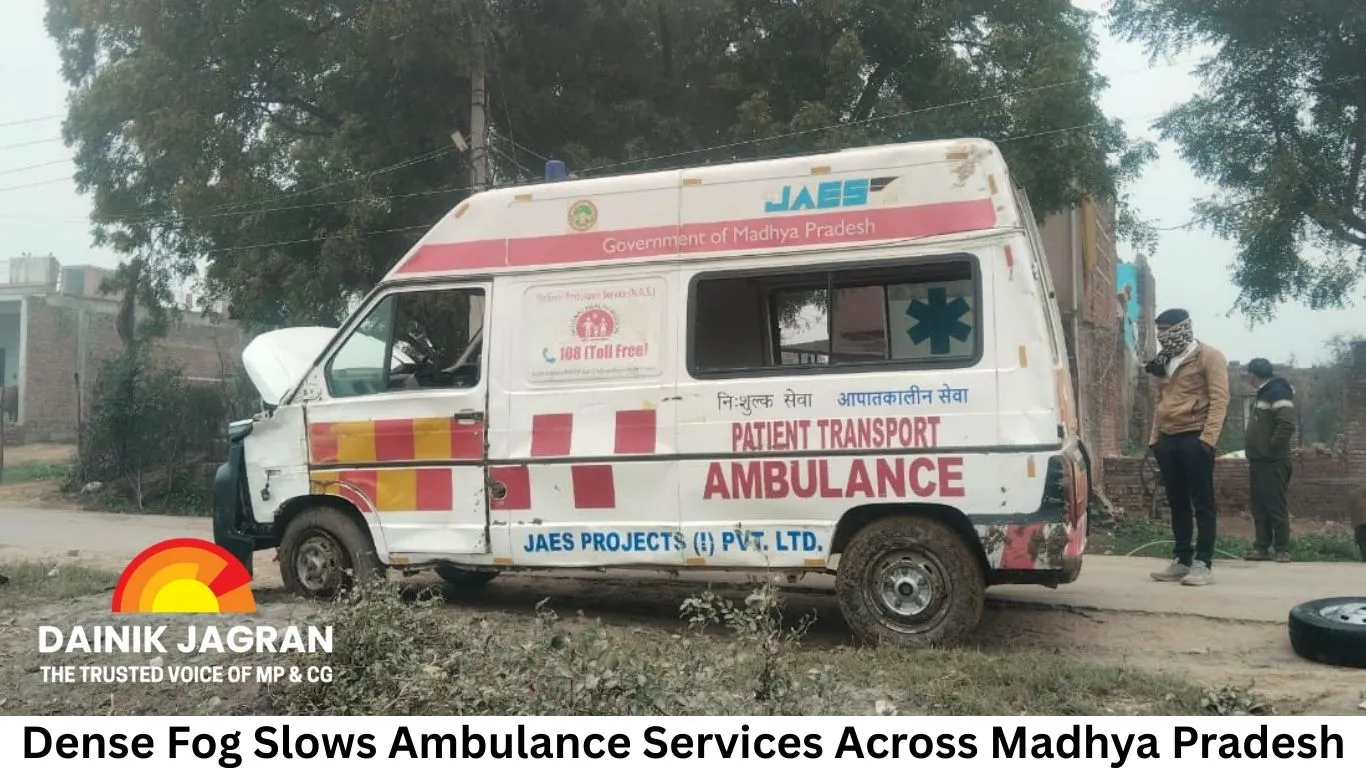
The risks posed by poor visibility were highlighted early Tuesday when an ambulance skidded off the road near Morena around 3 am due to heavy fog. The vehicle’s glass shattered in the incident. While no serious injuries were reported, officials said such accidents underline the dangers faced by emergency responders during fog-bound operations.
Rural and agricultural areas have faced added challenges. Officials said night-time irrigation increases moisture in the air, worsening fog conditions and further limiting visibility on narrow rural roads. Ambulance drivers in these areas are required to exercise extra caution, often leading to additional delays.
Despite the conditions, emergency services remain operational. Tarun Singh, manager of the 108 Ambulance Service, said drivers and staff have received specialised training to operate under low-visibility and extreme winter conditions. “While fog has impacted response time in some cases, teams remain alert and committed to ensuring patients reach healthcare facilities safely,” Singh said, adding that standard operating procedures are being reinforced during the ongoing weather spell.
Authorities said weather conditions are being closely monitored and operational protocols adjusted to balance safety with urgency until visibility improves.

--------
🚨 Beat the News Rush – Join Now!
Get breaking alerts, hot exclusives, and game-changing stories instantly on your phone. No delays, no fluff – just the edge you need. ⚡
Tap to join:
🟢 WhatsApp Channel: Dainik Jagran MP CG
Crave more?
🅕 Facebook: Dainik Jagran MP CG English
🅧 Twitter (X): Dainik Jagran MP CG
🅘 Instagram: Dainik Jagran MP CG
Share the fire – keep your crew ahead! 🗞️🔥
Dense Fog Slows Ambulance Services Across Madhya Pradesh, Raising Night-Time Emergency Risks
Digital Desk
The impact has been most pronounced between 2 am and 6 am, when visibility drops sharply in several districts. Officials managing the state-run 108 Ambulance Service said foggy conditions have directly affected response times, especially for night-time emergencies and Inter Facility Transfer (IFT) cases, where patients require urgent movement between healthcare centres.
The cold wave gripping the state has intensified the challenge. Temperatures in some regions have fallen close to 2 degrees Celsius, while Bhopal recorded its coldest January spell in a decade. Authorities ordered the closure of schools in Indore, Raisen, Gwalior and Narmadapuram on Wednesday as cold wave and cold day conditions persisted.
According to the Meteorological Department, dense fog has covered more than half of Madhya Pradesh. Districts including Gwalior, Bhind, Datia, Niwari, Tikamgarh and Chhatarpur have been facing severely reduced visibility. Foggy conditions were also reported from Bhopal, Ujjain, Neemuch, Mandsaur, Ratlam, Agar-Malwa, Rajgarh, Shajapur, Vidisha, Morena, Sheopur, Shivpuri, Guna, Ashoknagar, Sehore, Sagar, Damoh, Jabalpur, Katni, Panna, Satna, Rewa, Sidhi, Singrauli, Umaria and Shahdol. Cold wave alerts were issued for Bhopal, Sehore, Rajgarh and Shajapur.
The risks posed by poor visibility were highlighted early Tuesday when an ambulance skidded off the road near Morena around 3 am due to heavy fog. The vehicle’s glass shattered in the incident. While no serious injuries were reported, officials said such accidents underline the dangers faced by emergency responders during fog-bound operations.
Rural and agricultural areas have faced added challenges. Officials said night-time irrigation increases moisture in the air, worsening fog conditions and further limiting visibility on narrow rural roads. Ambulance drivers in these areas are required to exercise extra caution, often leading to additional delays.
Despite the conditions, emergency services remain operational. Tarun Singh, manager of the 108 Ambulance Service, said drivers and staff have received specialised training to operate under low-visibility and extreme winter conditions. “While fog has impacted response time in some cases, teams remain alert and committed to ensuring patients reach healthcare facilities safely,” Singh said, adding that standard operating procedures are being reinforced during the ongoing weather spell.
Authorities said weather conditions are being closely monitored and operational protocols adjusted to balance safety with urgency until visibility improves.