

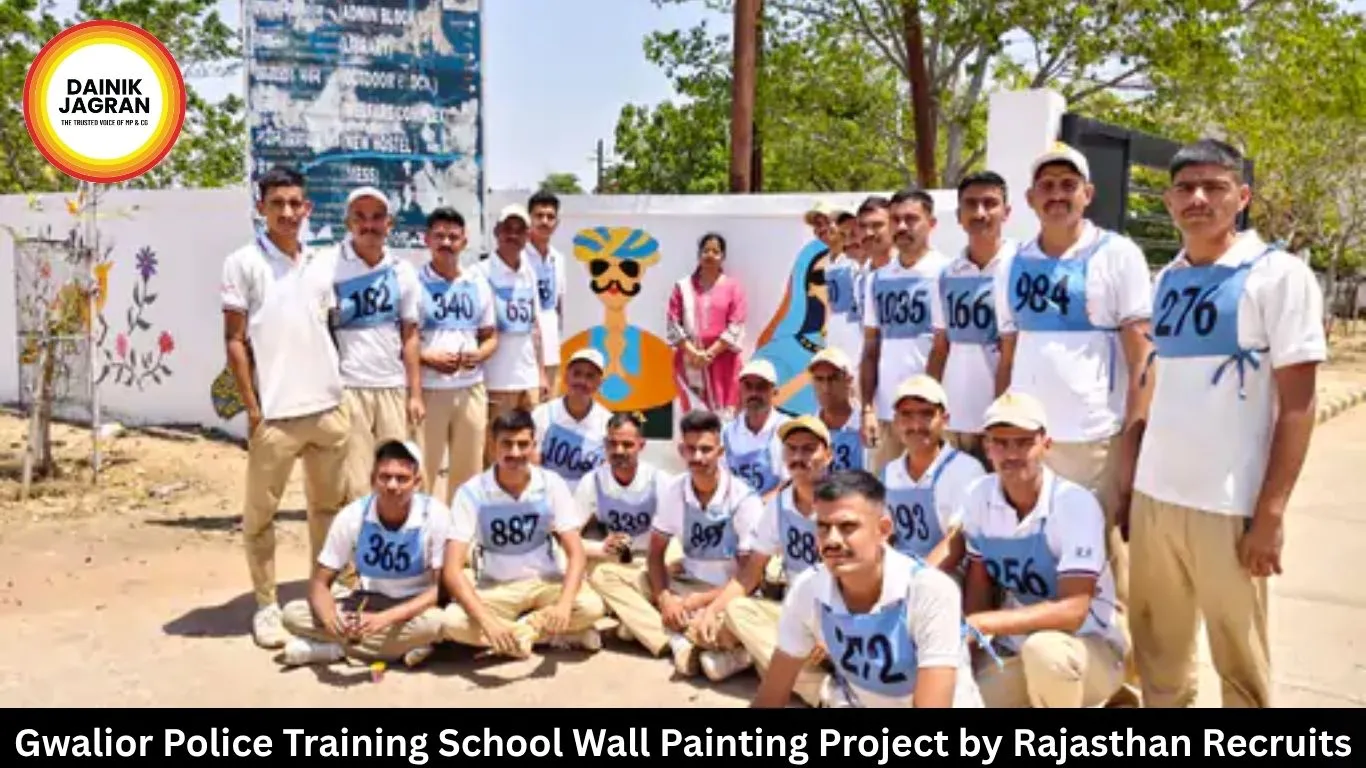
Gwalior Police Training School Wall Painting Project by Rajasthan Recruits
Digital Desk
25 trainee constables from Rajasthan transform Gwalior PTS campus with cultural murals featuring Pichwai, Gond, and Usta art traditions across 350 walls.
Gwalior Police Training School Walls Transform Into Living Art Canvas
Rajasthan-trained recruits bring cultural heritage to life through mural initiative
Canvas of Change
The Police Training School (PTS) in Gwalior's Tighara area is witnessing an unusual burst of artistic activity. Twenty-five trainee constables, handpicked from a batch of 1,020 newly recruited personnel from Rajasthan, have taken on an ambitious wall painting project that is reshaping the sprawling campus into a gallery of cultural expression.
What started as a creative outlet has evolved into something far more significant—a living documentation of cross-state artistic traditions now adorning over 350 walls across the training complex.
Painting Under the Sun
The work has been relentless. These young recruits, many still in the early weeks of their formal police training, spend long hours under the harsh Madhya Pradesh sun, brushes in hand, meticulously filling blank walls with colour and design. The physical demands are considerable, yet the momentum hasn't slowed.
Around 50 walls have already been completed, with several others still in progress. The trainee artists work methodically, ensuring that each stroke captures the essence of the traditions they're attempting to preserve.
Where Traditions Meet
The murals reflect a fascinating blend—Rajasthan's folk heritage merged seamlessly with Madhya Pradesh's indigenous artistic practices. The team has incorporated detailed representations of Nathwara's Pichwai art, with its intricate devotional imagery, alongside Shekhawati's Kachi Ghodi style.
The renowned Usta art of Bikaner also finds representation on these walls. Equally prominent are the geometric patterns and nature-inspired designs characteristic of Gond art, a traditional form deeply rooted in Madhya Pradesh's tribal communities.
Messages Beyond Aesthetics
However, the project transcends mere decorative intent. Woven into these artistic compositions are messages on environmental conservation, sanitation drives, women empowerment, and social awareness. The choice of subjects reflects a deliberate effort to use the visual medium as a tool for public consciousness.
Trainee Ajit, one of the key contributors, explained that the initiative emerged over the past 15 to 20 days through collaborative effort. He stressed that the primary objective extends beyond beautification—it's a conscious attempt to showcase the cultural wealth of both Rajasthan and Madhya Pradesh within a single institutional space.
The Inspiration Behind the Brushstrokes
The project gained momentum following encouragement from the training school's instructor-inspector, Neelam Tanwar, who identified the artistic inclinations within the batch and provided the platform for their expression. Senior police officials, including the local Superintendent of Police, have backed the initiative, offering both guidance and motivation.
The trainees themselves view this work as a point of pride. Many mentioned that combining their passion for art with their new professional commitments has created an unexpected sense of purpose during their training period.
Teamwork in Motion
What becomes evident through conversations with the participating recruits is the genuine spirit of collective effort. The wall painting isn't assigned as a task completion exercise; instead, it functions as a voluntary, team-driven initiative that runs parallel to their standard training schedule.
The recruits report that the experience has fostered camaraderie among the batch while simultaneously contributing to campus aesthetics. The project demonstrates how institutional spaces can become platforms for cultural expression without compromising their primary functions.
Looking Forward
As the mural project continues, the PTS campus has begun attracting attention from visitors and local communities. The initiative has quietly positioned Gwalior's training facility as a space where professional development and creative expression coexist.
Whether this becomes a recurring initiative for future batches remains to be seen. But for now, the walls of the Police Training School stand as a testament to how institutional frameworks can nurture unconventional creativity among its trainees.
The 1,020 recruits from Rajasthan, originally arriving for standardized police training, are leaving their mark in ways far beyond the expected curriculum.
--------
🚨 Beat the News Rush – Join Now!
Get breaking alerts, hot exclusives, and game-changing stories instantly on your phone. No delays, no fluff – just the edge you need. ⚡
Tap to join:
🟢 WhatsApp Channel: Dainik Jagran MP CG
Crave more?
🅕 Facebook: Dainik Jagran MP CG English
🅧 Twitter (X): Dainik Jagran MP CG
🅘 Instagram: Dainik Jagran MP CG
Share the fire – keep your crew ahead! 🗞️🔥
Gwalior Police Training School Wall Painting Project by Rajasthan Recruits
Digital Desk
Gwalior Police Training School Walls Transform Into Living Art Canvas
Rajasthan-trained recruits bring cultural heritage to life through mural initiative
Canvas of Change
The Police Training School (PTS) in Gwalior's Tighara area is witnessing an unusual burst of artistic activity. Twenty-five trainee constables, handpicked from a batch of 1,020 newly recruited personnel from Rajasthan, have taken on an ambitious wall painting project that is reshaping the sprawling campus into a gallery of cultural expression.
What started as a creative outlet has evolved into something far more significant—a living documentation of cross-state artistic traditions now adorning over 350 walls across the training complex.
Painting Under the Sun
The work has been relentless. These young recruits, many still in the early weeks of their formal police training, spend long hours under the harsh Madhya Pradesh sun, brushes in hand, meticulously filling blank walls with colour and design. The physical demands are considerable, yet the momentum hasn't slowed.
Around 50 walls have already been completed, with several others still in progress. The trainee artists work methodically, ensuring that each stroke captures the essence of the traditions they're attempting to preserve.
Where Traditions Meet
The murals reflect a fascinating blend—Rajasthan's folk heritage merged seamlessly with Madhya Pradesh's indigenous artistic practices. The team has incorporated detailed representations of Nathwara's Pichwai art, with its intricate devotional imagery, alongside Shekhawati's Kachi Ghodi style.
The renowned Usta art of Bikaner also finds representation on these walls. Equally prominent are the geometric patterns and nature-inspired designs characteristic of Gond art, a traditional form deeply rooted in Madhya Pradesh's tribal communities.
Messages Beyond Aesthetics
However, the project transcends mere decorative intent. Woven into these artistic compositions are messages on environmental conservation, sanitation drives, women empowerment, and social awareness. The choice of subjects reflects a deliberate effort to use the visual medium as a tool for public consciousness.
Trainee Ajit, one of the key contributors, explained that the initiative emerged over the past 15 to 20 days through collaborative effort. He stressed that the primary objective extends beyond beautification—it's a conscious attempt to showcase the cultural wealth of both Rajasthan and Madhya Pradesh within a single institutional space.
The Inspiration Behind the Brushstrokes
The project gained momentum following encouragement from the training school's instructor-inspector, Neelam Tanwar, who identified the artistic inclinations within the batch and provided the platform for their expression. Senior police officials, including the local Superintendent of Police, have backed the initiative, offering both guidance and motivation.
The trainees themselves view this work as a point of pride. Many mentioned that combining their passion for art with their new professional commitments has created an unexpected sense of purpose during their training period.
Teamwork in Motion
What becomes evident through conversations with the participating recruits is the genuine spirit of collective effort. The wall painting isn't assigned as a task completion exercise; instead, it functions as a voluntary, team-driven initiative that runs parallel to their standard training schedule.
The recruits report that the experience has fostered camaraderie among the batch while simultaneously contributing to campus aesthetics. The project demonstrates how institutional spaces can become platforms for cultural expression without compromising their primary functions.
Looking Forward
As the mural project continues, the PTS campus has begun attracting attention from visitors and local communities. The initiative has quietly positioned Gwalior's training facility as a space where professional development and creative expression coexist.
Whether this becomes a recurring initiative for future batches remains to be seen. But for now, the walls of the Police Training School stand as a testament to how institutional frameworks can nurture unconventional creativity among its trainees.
The 1,020 recruits from Rajasthan, originally arriving for standardized police training, are leaving their mark in ways far beyond the expected curriculum.


