

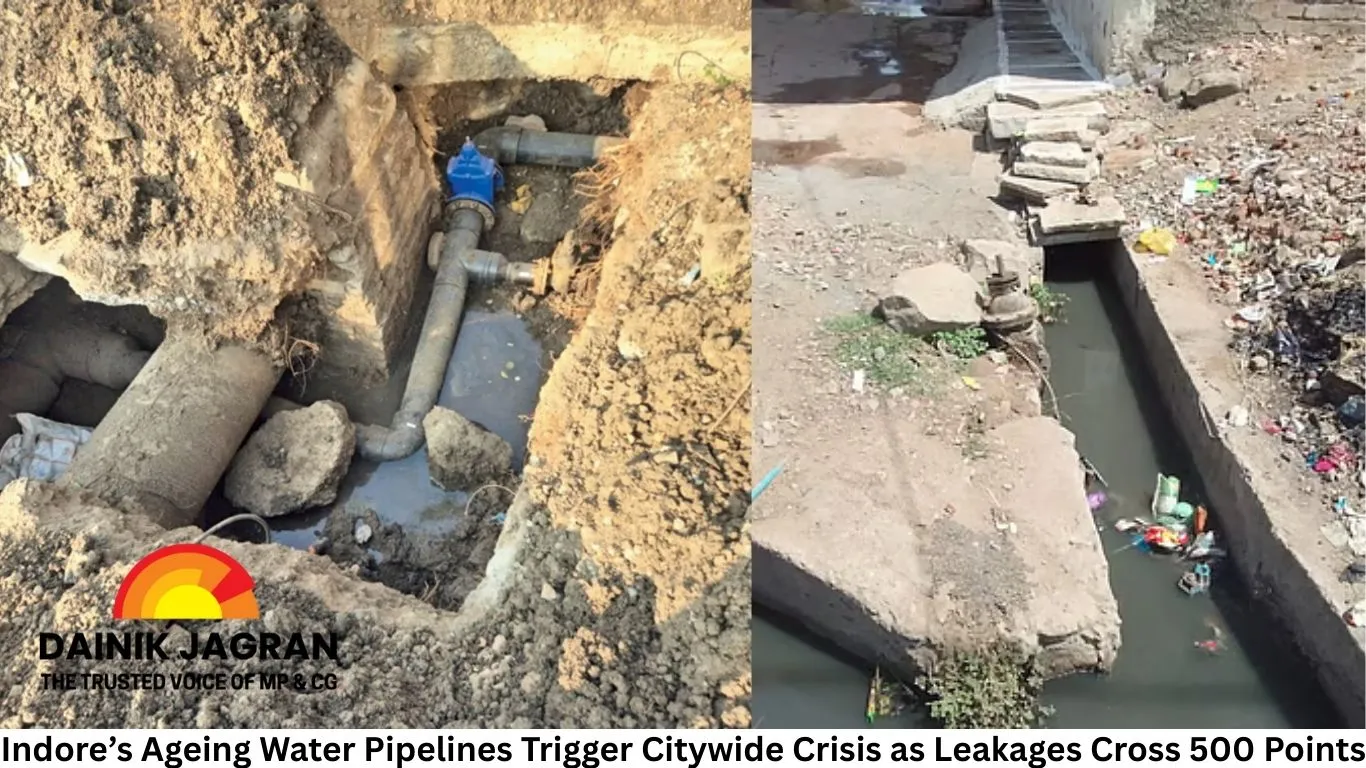
Indore’s Ageing Water Pipelines Trigger Citywide Crisis as Leakages Cross 500 Points
Digital Desk
Indore’s drinking water supply system is under severe strain, with more than 500 active leakage points reported across the city, leaving residents in almost every ward struggling to access safe drinking water. A recent assessment conducted by the Indore Municipal Corporation (IMC) under the Amrit 2 scheme has revealed that large sections of the city’s water pipeline network are dangerously old, damaged and poorly managed.
According to the study, Indore has a total drinking water pipeline network of about 3,500 kilometres, including Narmada trunk and distribution lines. Of this, nearly 650 kilometres of pipelines are in a dilapidated condition, while around 1,100 kilometres are more than 50 years old. Although approximately 550 kilometres of pipelines have been replaced in recent years, old lines have not been completely disconnected, creating serious operational and safety risks.
The report estimates that close to 40 per cent of water loss is occurring within the city due to leakages, with 15 to 17 per cent line loss recorded regularly. Officials said more than 40 per cent of this loss happens in distribution lines, where damaged or corroded pipes allow seepage and contamination.
Several localities, including Juni Indore, Juna Risala, Mill Area, Jabran Colony, Azad Nagar, Musakhedi, Bhagirathpura, Labariya Bheru, Chandannagar and Banganga, have been identified as high-risk zones. Residents in these areas frequently report mixed water supply and foul-smelling tap water, indicating the entry of sewage into drinking water lines.
The problem is compounded by operational gaps. Only about 10 per cent of the Public Health Engineering staff linked to the Narmada project are trained professionals. While 32 engineers are required to manage the system, only four are currently deployed. At the field level, technical staff availability is limited to 20 per cent, with most maintenance work handled by muster workers and private agencies.
Water is supplied on alternate days in Indore, leaving pipelines empty for 30 to 40 hours. Officials explained that during this period, vacuum pressure inside damaged pipes can draw in sewage from nearby drains, especially in areas where sewer and water lines run close to each other.
Another concern flagged in the report is the unregulated connection of borewells to Narmada pipelines to address low pressure complaints. When borewells malfunction or sump systems fail, contamination risks increase significantly.
Municipal officials admit that poor coordination between departments handling water supply, sewerage, roads and other infrastructure projects remains a major challenge. Ongoing construction often damages pipelines, further worsening leakages.
The findings have raised urgent questions about infrastructure planning, manpower shortages and accountability, as the city grapples with ensuring safe drinking water for its growing population.
Indore’s Ageing Water Pipelines Trigger Citywide Crisis as Leakages Cross 500 Points
Digital Desk
According to the study, Indore has a total drinking water pipeline network of about 3,500 kilometres, including Narmada trunk and distribution lines. Of this, nearly 650 kilometres of pipelines are in a dilapidated condition, while around 1,100 kilometres are more than 50 years old. Although approximately 550 kilometres of pipelines have been replaced in recent years, old lines have not been completely disconnected, creating serious operational and safety risks.
The report estimates that close to 40 per cent of water loss is occurring within the city due to leakages, with 15 to 17 per cent line loss recorded regularly. Officials said more than 40 per cent of this loss happens in distribution lines, where damaged or corroded pipes allow seepage and contamination.
Several localities, including Juni Indore, Juna Risala, Mill Area, Jabran Colony, Azad Nagar, Musakhedi, Bhagirathpura, Labariya Bheru, Chandannagar and Banganga, have been identified as high-risk zones. Residents in these areas frequently report mixed water supply and foul-smelling tap water, indicating the entry of sewage into drinking water lines.
The problem is compounded by operational gaps. Only about 10 per cent of the Public Health Engineering staff linked to the Narmada project are trained professionals. While 32 engineers are required to manage the system, only four are currently deployed. At the field level, technical staff availability is limited to 20 per cent, with most maintenance work handled by muster workers and private agencies.
Water is supplied on alternate days in Indore, leaving pipelines empty for 30 to 40 hours. Officials explained that during this period, vacuum pressure inside damaged pipes can draw in sewage from nearby drains, especially in areas where sewer and water lines run close to each other.
Another concern flagged in the report is the unregulated connection of borewells to Narmada pipelines to address low pressure complaints. When borewells malfunction or sump systems fail, contamination risks increase significantly.
Municipal officials admit that poor coordination between departments handling water supply, sewerage, roads and other infrastructure projects remains a major challenge. Ongoing construction often damages pipelines, further worsening leakages.
The findings have raised urgent questions about infrastructure planning, manpower shortages and accountability, as the city grapples with ensuring safe drinking water for its growing population.


