

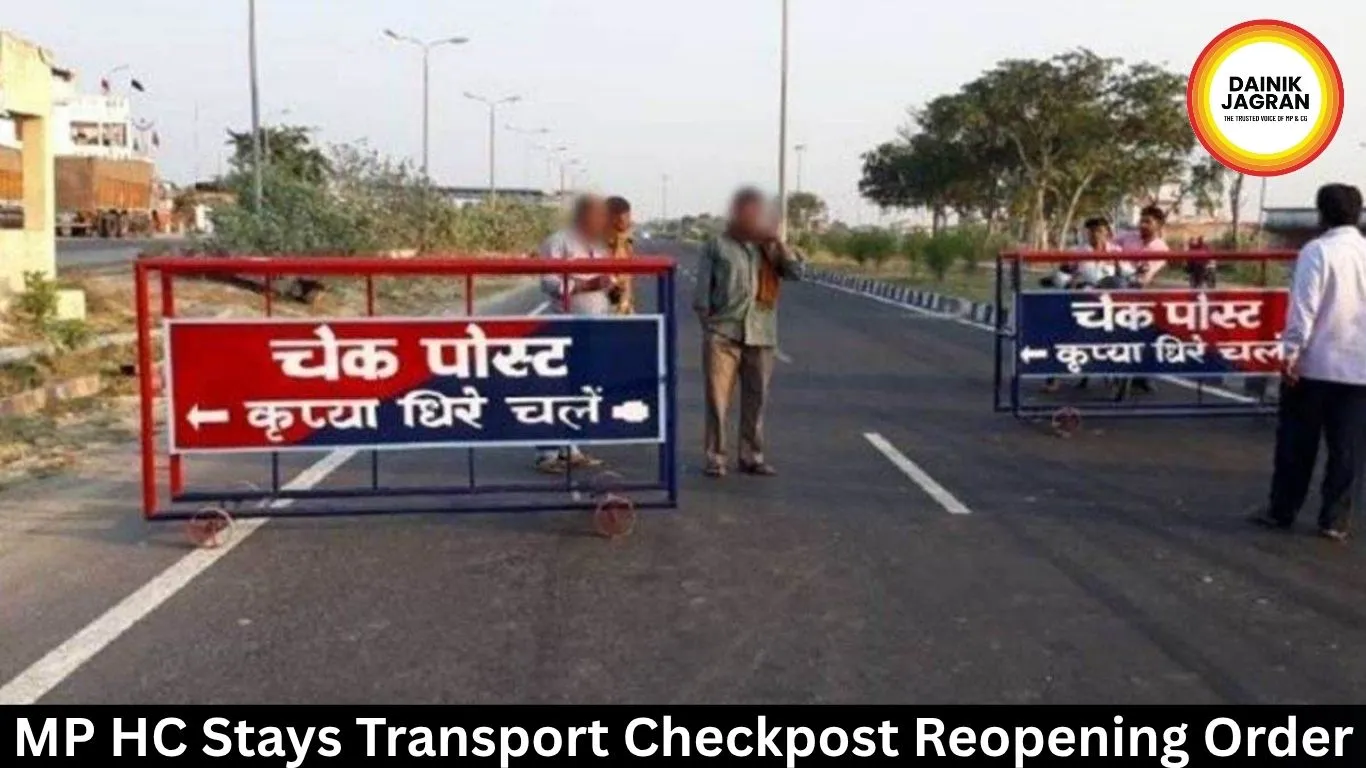
MP HC Stays Transport Checkpost Reopening Order
Digital Desk
Madhya Pradesh High Court stays its own order to reopen RTO transport checkposts, giving truckers relief as the state prepares to appeal against the directive.
MP HC Puts Stay on Reopening of Transport Checkposts
High Court stays its own April order to reopen RTO checkposts in Madhya Pradesh, giving transporters short‑term relief even as government moves to challenge the directive.
Madhya Pradesh’s transport checkposts will not be reopened immediately, as the Madhya Pradesh High Court has put a stay on its earlier order directing the state to restart all closed RTO checkposts within 30 days. The order, passed by the Jabalpur bench on Monday, effectively halts the clock for the government and keeps the naka‑style checking system shut, at least for now. The move has triggered a mixed reaction—relief among truckers and transporters, and fresh anxiety among road‑safety activists and officials tasked with enforcing overloading norms.
Court puts own order on hold
The High Court’s stay relates to a 16 April 2026 order by Justice Vishal Mishra, in which the single bench had directed the state government to restore all inter‑state transport checkposts overloading within 30 days from the date of receipt of the certified copy. The court had treated the 30 June 2024 government order shutting these checkposts as a breach of its earlier understanding in a PIL on overloading, and had warned of contempt proceedings if the direction was not followed.
On Monday, the same bench allowed a review petition filed by transport‑sector stakeholders, including a Jabalpur‑based trucker who had moved the court against the April directive, and stayed the implementation of the 16 April order. Sources within the court registry said the interim stay was granted after the bench heard submissions from both the government’s side and the transport‑sector petitioner, and decided that the issue warranted a closer look by a division bench.
Government backs stay, prepares larger appeal
While the review petition came from the transporters’ side, the central thrust of the day’s argument effectively aligned the state government with those opposing an immediate restart of checkposts. According to officials, the Deputy Advocate General told the court that the state did not favour the forced reopening of the nakas, and indicated that the government would itself move a division bench against the 16 April order.
The government has already directed the Transport Department, through the Chief Secretary, to file a formal appeal. The Transport Commissioner, Kiran Sharma, has been appointed as the awareness officer in the matter, and she is expected to coordinate with the Advocate General’s office and the government’s legal team in Jabalpur. The plan is to challenge the 16 April order on grounds that it does not fully factor in the grievances of transporters and the operational realities of a faceless, tech‑enabled inspection regime that the state is trying to build.
Background: why checkposts were shut
Inter‑state transport checkposts were first shut down across Madhya Pradesh on 1 July 2024, following a decision taken by Chief Minister Dr. Mohan Yadav’s government. The move came after repeated complaints from truckers and transport associations that the nakas had become “centres of extortion,” with allegations of harassment, arbitrary fines and document‑based pressure on drivers.
The transport ministry had long argued that the traditional physical checking system added hours to inter‑state freight, slowed down logistics and encouraged petty corruption at the border. For around 22 months after the closure, the state relied on mobile checking teams, surprise raids and technology‑driven systems such as weigh‑in‑motion sites and CCTV surveillance, even as overloading and crash‑related deaths remained a concern along key freight corridors.
Road safety vs. business convenience
The High Court’s April order had squarely pitched road‑safety imperatives against the ease‑of‑doing‑business concerns of the transport sector. In disposing of the contempt‑cum‑PIL petition, Justice Mishra had underlined that the earlier closure of checkposts directly undermined the state’s own undertakings in a PIL aimed at curbing overloading and preventing heavy‑vehicle‑related accidents.
On the other side, transport associations have long maintained that the nakas were not just regulatory nodes but also layers of discretionary power that often translated into on‑the‑move charges, unnecessary delays and an environment of uncertainty. The national‑level transport lobby, including the All‑India Motor Transport Congress, has repeatedly told the judiciary that reopening old‑style checkposts without a transparent, technology‑backed SOP would only revive the same pattern of harassment.
Impact on truckers and freight corridors
For the moment, the stay gives short‑term relief to truck owners and operators plying on busy routes like Jabalpur–Raipur, Bhopal–Gwalior–Agra and Indore–Surat–Mumbai. In the absence of fixed nakas, transit times have marginally improved, and many owners say they have seen fewer “stop‑and‑penalty” scenarios at the border. At the same time, industry insiders admit that the absence of a structured checking architecture has also diluted the deterrent against overloading, especially on routes where accident statistics remain high.
Road‑safety activists, however, fear that the prolonged stay may delay the creation or reactivation of a robust physical‑cum‑digital enforcement net. They point out that even with mobile teams, the unpredictability of checks reduces the psychological barrier for haulage operators to push beyond permissible loads.
What happens next
The immediate legal path is clear: the state government will now pursue its appeal before a division bench, while the transport‑sector petitioner’s review petition remains pending. The court is expected to finally determine whether the 30 June 2024 closure order genuinely violated earlier undertakings, and whether a compromise structure—such as standardised, technology‑integrated checkposts with faceless assessment—can be carved out.
Administratively, the Transport Department is likely to fast‑track the drafting of a new SOP for any future checkpost regime, this time backed by GPS‑based declarations, digital weigh‑in‑motion systems and centralised dashboards that reduce human discretion at the border. Until the High Court delivers a final verdict, however, Madhya Pradesh’s long‑haul highways will remain in a regulatory grey area—neither fully open to unfettered movement nor fully policed by a re‑commissioned checkpost grid.
--------
🚨 Beat the News Rush – Join Now!
Get breaking alerts, hot exclusives, and game-changing stories instantly on your phone. No delays, no fluff – just the edge you need. ⚡
Tap to join:
🟢 WhatsApp Channel: Dainik Jagran MP CG
Crave more?
🅕 Facebook: Dainik Jagran MP CG English
🅧 Twitter (X): Dainik Jagran MP CG
🅘 Instagram: Dainik Jagran MP CG
Share the fire – keep your crew ahead! 🗞️🔥
MP HC Stays Transport Checkpost Reopening Order
Digital Desk
MP HC Puts Stay on Reopening of Transport Checkposts
High Court stays its own April order to reopen RTO checkposts in Madhya Pradesh, giving transporters short‑term relief even as government moves to challenge the directive.
Madhya Pradesh’s transport checkposts will not be reopened immediately, as the Madhya Pradesh High Court has put a stay on its earlier order directing the state to restart all closed RTO checkposts within 30 days. The order, passed by the Jabalpur bench on Monday, effectively halts the clock for the government and keeps the naka‑style checking system shut, at least for now. The move has triggered a mixed reaction—relief among truckers and transporters, and fresh anxiety among road‑safety activists and officials tasked with enforcing overloading norms.
Court puts own order on hold
The High Court’s stay relates to a 16 April 2026 order by Justice Vishal Mishra, in which the single bench had directed the state government to restore all inter‑state transport checkposts overloading within 30 days from the date of receipt of the certified copy. The court had treated the 30 June 2024 government order shutting these checkposts as a breach of its earlier understanding in a PIL on overloading, and had warned of contempt proceedings if the direction was not followed.
On Monday, the same bench allowed a review petition filed by transport‑sector stakeholders, including a Jabalpur‑based trucker who had moved the court against the April directive, and stayed the implementation of the 16 April order. Sources within the court registry said the interim stay was granted after the bench heard submissions from both the government’s side and the transport‑sector petitioner, and decided that the issue warranted a closer look by a division bench.
Government backs stay, prepares larger appeal
While the review petition came from the transporters’ side, the central thrust of the day’s argument effectively aligned the state government with those opposing an immediate restart of checkposts. According to officials, the Deputy Advocate General told the court that the state did not favour the forced reopening of the nakas, and indicated that the government would itself move a division bench against the 16 April order.
The government has already directed the Transport Department, through the Chief Secretary, to file a formal appeal. The Transport Commissioner, Kiran Sharma, has been appointed as the awareness officer in the matter, and she is expected to coordinate with the Advocate General’s office and the government’s legal team in Jabalpur. The plan is to challenge the 16 April order on grounds that it does not fully factor in the grievances of transporters and the operational realities of a faceless, tech‑enabled inspection regime that the state is trying to build.
Background: why checkposts were shut
Inter‑state transport checkposts were first shut down across Madhya Pradesh on 1 July 2024, following a decision taken by Chief Minister Dr. Mohan Yadav’s government. The move came after repeated complaints from truckers and transport associations that the nakas had become “centres of extortion,” with allegations of harassment, arbitrary fines and document‑based pressure on drivers.
The transport ministry had long argued that the traditional physical checking system added hours to inter‑state freight, slowed down logistics and encouraged petty corruption at the border. For around 22 months after the closure, the state relied on mobile checking teams, surprise raids and technology‑driven systems such as weigh‑in‑motion sites and CCTV surveillance, even as overloading and crash‑related deaths remained a concern along key freight corridors.
Road safety vs. business convenience
The High Court’s April order had squarely pitched road‑safety imperatives against the ease‑of‑doing‑business concerns of the transport sector. In disposing of the contempt‑cum‑PIL petition, Justice Mishra had underlined that the earlier closure of checkposts directly undermined the state’s own undertakings in a PIL aimed at curbing overloading and preventing heavy‑vehicle‑related accidents.
On the other side, transport associations have long maintained that the nakas were not just regulatory nodes but also layers of discretionary power that often translated into on‑the‑move charges, unnecessary delays and an environment of uncertainty. The national‑level transport lobby, including the All‑India Motor Transport Congress, has repeatedly told the judiciary that reopening old‑style checkposts without a transparent, technology‑backed SOP would only revive the same pattern of harassment.
Impact on truckers and freight corridors
For the moment, the stay gives short‑term relief to truck owners and operators plying on busy routes like Jabalpur–Raipur, Bhopal–Gwalior–Agra and Indore–Surat–Mumbai. In the absence of fixed nakas, transit times have marginally improved, and many owners say they have seen fewer “stop‑and‑penalty” scenarios at the border. At the same time, industry insiders admit that the absence of a structured checking architecture has also diluted the deterrent against overloading, especially on routes where accident statistics remain high.
Road‑safety activists, however, fear that the prolonged stay may delay the creation or reactivation of a robust physical‑cum‑digital enforcement net. They point out that even with mobile teams, the unpredictability of checks reduces the psychological barrier for haulage operators to push beyond permissible loads.
What happens next
The immediate legal path is clear: the state government will now pursue its appeal before a division bench, while the transport‑sector petitioner’s review petition remains pending. The court is expected to finally determine whether the 30 June 2024 closure order genuinely violated earlier undertakings, and whether a compromise structure—such as standardised, technology‑integrated checkposts with faceless assessment—can be carved out.
Administratively, the Transport Department is likely to fast‑track the drafting of a new SOP for any future checkpost regime, this time backed by GPS‑based declarations, digital weigh‑in‑motion systems and centralised dashboards that reduce human discretion at the border. Until the High Court delivers a final verdict, however, Madhya Pradesh’s long‑haul highways will remain in a regulatory grey area—neither fully open to unfettered movement nor fully policed by a re‑commissioned checkpost grid.


