

The hearing follows a petition filed on January 20 by the Hindu Front for Justice, seeking permission for uninterrupted worship of Goddess Saraswati throughout Basant Panchami on January 23. The plea, admitted by the apex court, also requests that only Hindu worship be permitted in the Bhojshala complex for the entire day, citing the religious significance of the festival.
Representing the petitioners, senior advocates Vishnu Shankar Jain and Harishankar Jain argued that Basant Panchami coinciding with Friday has historically triggered disputes and that clarity from the court is essential to prevent unrest. The petition also seeks suspension of Friday prayers at the site for the day, a demand contested by Muslim groups who have traditionally offered Jumma namaz at the complex.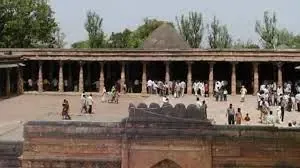
The Bhojshala dispute has long centred on competing claims of worship by Hindu and Muslim communities, particularly when Basant Panchami falls on a Friday. Similar situations in 2006, 2013 and 2016 led to tensions and clashes, prompting heightened administrative and judicial scrutiny.
Anticipating potential law-and-order challenges, the Madhya Pradesh government has deployed a force of nearly 8,000 security personnel in and around Dhar. IG Anurag Singh said police preparations were complete, with 50 per cent of the force already in place by Wednesday night. Continuous monitoring through CCTV, bike patrols and mobile units has been arranged, along with 3D mapping of the area to assess crowd movement and contingencies.
CRPF Inspector General Neetu Bhattacharya visited Dhar on Wednesday to review security arrangements at the Bhojshala complex. The site has been fortified with round-the-clock police deployment, watchtowers, posts and zig-zag barricading. Entry on Basant Panchami will be regulated through controlled access points.
Authorities have also declared a 300-metre radius around the Bhojshala complex a no-fly zone, banning drones, UAVs, paragliders and hot-air balloons. The district administration has prohibited storage of construction material, debris or abandoned kiosks on public roads in the area, warning of confiscation in case of violations.
Historically, worship arrangements at Bhojshala have evolved following disputes dating back to the mid-1990s. Current practices allow Hindu prayers on Tuesdays and Basant Panchami, Muslim namaz on Fridays, and tourist access on other days. However, overlaps between major religious observances have repeatedly tested the arrangement.
With the Supreme Court’s decision expected hours before Basant Panchami, authorities remain on high alert, awaiting clarity that could shape worship protocols and security measures in the district.

Supreme Court to Decide Bhojshala Plea Ahead of Basant Panchami; Massive Security Deployed in Dhar
Digital Desk
The hearing follows a petition filed on January 20 by the Hindu Front for Justice, seeking permission for uninterrupted worship of Goddess Saraswati throughout Basant Panchami on January 23. The plea, admitted by the apex court, also requests that only Hindu worship be permitted in the Bhojshala complex for the entire day, citing the religious significance of the festival.
Representing the petitioners, senior advocates Vishnu Shankar Jain and Harishankar Jain argued that Basant Panchami coinciding with Friday has historically triggered disputes and that clarity from the court is essential to prevent unrest. The petition also seeks suspension of Friday prayers at the site for the day, a demand contested by Muslim groups who have traditionally offered Jumma namaz at the complex.
The Bhojshala dispute has long centred on competing claims of worship by Hindu and Muslim communities, particularly when Basant Panchami falls on a Friday. Similar situations in 2006, 2013 and 2016 led to tensions and clashes, prompting heightened administrative and judicial scrutiny.
Anticipating potential law-and-order challenges, the Madhya Pradesh government has deployed a force of nearly 8,000 security personnel in and around Dhar. IG Anurag Singh said police preparations were complete, with 50 per cent of the force already in place by Wednesday night. Continuous monitoring through CCTV, bike patrols and mobile units has been arranged, along with 3D mapping of the area to assess crowd movement and contingencies.
CRPF Inspector General Neetu Bhattacharya visited Dhar on Wednesday to review security arrangements at the Bhojshala complex. The site has been fortified with round-the-clock police deployment, watchtowers, posts and zig-zag barricading. Entry on Basant Panchami will be regulated through controlled access points.
Authorities have also declared a 300-metre radius around the Bhojshala complex a no-fly zone, banning drones, UAVs, paragliders and hot-air balloons. The district administration has prohibited storage of construction material, debris or abandoned kiosks on public roads in the area, warning of confiscation in case of violations.
Historically, worship arrangements at Bhojshala have evolved following disputes dating back to the mid-1990s. Current practices allow Hindu prayers on Tuesdays and Basant Panchami, Muslim namaz on Fridays, and tourist access on other days. However, overlaps between major religious observances have repeatedly tested the arrangement.
With the Supreme Court’s decision expected hours before Basant Panchami, authorities remain on high alert, awaiting clarity that could shape worship protocols and security measures in the district.
.jpg)




