


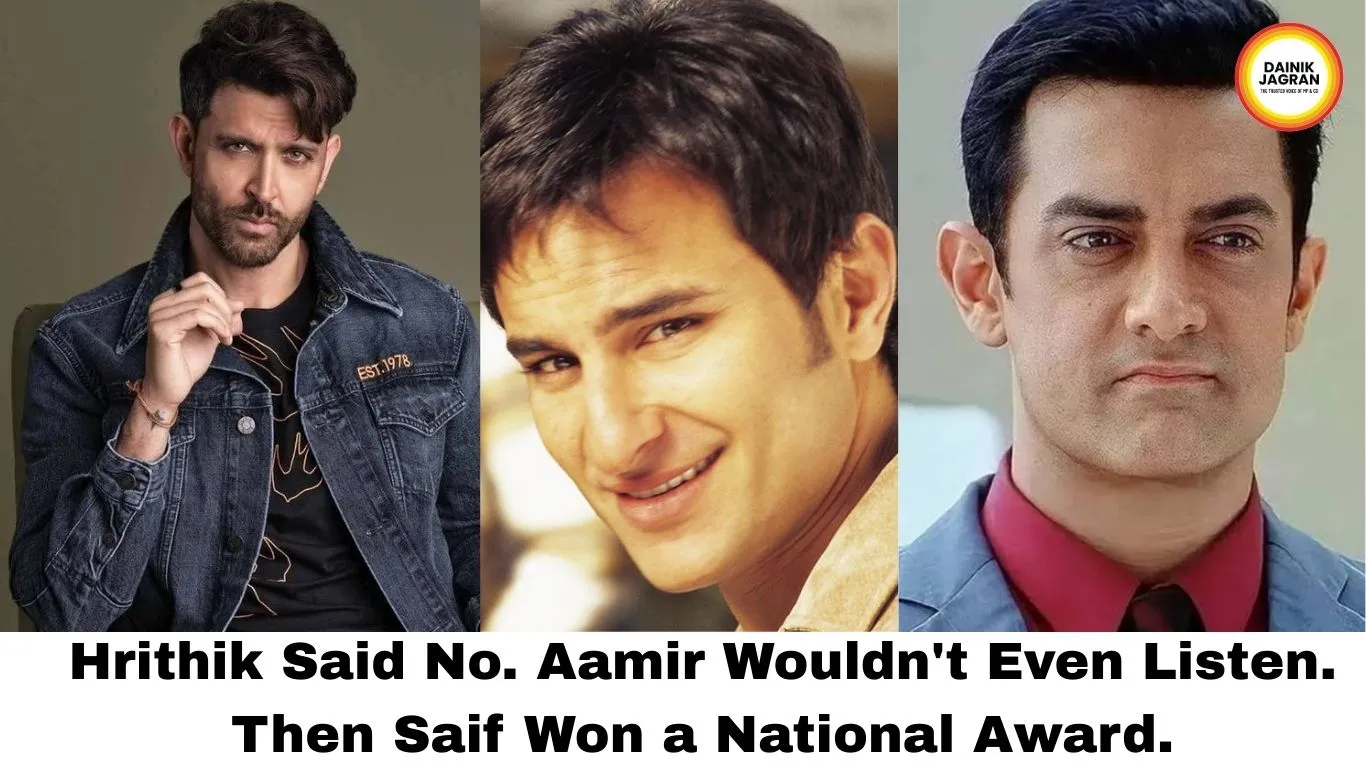
Hrithik Said No. Aamir Wouldn't Even Listen. Then Saif Won a National Award.
Digital Desk
The Film That Nobody Wanted — Until Saif Made It Immortal
In early 2002, director Kunal Kohli had a script he believed in completely. A romantic comedy about a cartoonist and a strong-willed woman whose lives keep intersecting across years and continents — funny, warm, emotionally honest, and built around the kind of adult romantic tension that Bollywood's biggest stars should have been queuing up to explore.
Nobody queued up. Everybody said no.
By the time Hum Tum reached theatres in May 2004, it had been turned down by Hrithik Roshan, refused by Aamir Khan, and abandoned by Vivek Oberoi. Rishi Kapoor had called it bakwas when the supporting role was narrated to him. Even Yash Chopra had reservations about the project, reportedly finding it too risky. The film that would go on to define an era of urbane Hindi romantic comedy — and deliver Saif Ali Khan his National Award — arrived in the world only because every other option fell through.
Director Kunal Kohli, speaking in a fresh interview on the occasion of Hum Tum's re-release discussion, has now laid out the complete casting story in candid detail for the first time. It is one of the most revealing behind-the-scenes accounts in recent Bollywood memory — and at its centre is Hrithik Roshan saying something that very few superstars in the middle of a career crisis would have had the self-awareness to say out loud.
Hrithik: The Script Is Gold. And I Am Not Ready for It.
Kunal Kohli's first choice for Hum Tum was Hrithik Roshan — a natural pick, given that the two had worked together on Mujhse Dosti Karoge in 2002, and that Rani Mukerji, whom Kohli had always envisioned as the female lead, had also been a part of that film. The professional relationship was warm, the creative rapport established. On paper, Hrithik was the obvious fit.
The meeting happened. Hrithik read the script. And then he said something that Kunal Kohli has quoted with obvious respect across multiple interviews over the years.
Hrithik told him the script was pure gold — that he loved it, that it was beautiful. And then he said he did not think he could pull it off. Not because of the script's quality. Because of his own state of mind.
The context matters enormously here. In the period between Mujhse Dosti Karoge and the point at which Hum Tum was being cast, Hrithik had appeared in a string of films that had either underperformed or outright failed: Aap Mujhe Achche Lagne Lage, Na Tum Jaano Na Hum, and Main Prem Ki Diwani Hoon — films that represented a significant fall from the extraordinary expectations that had attached to him following Kaho Naa Pyaar Hai and Kabhi Khushi Kabhie Gham. Koi Mil Gaya, which would rehabilitate his box office standing, had presumably not yet released at the point this conversation occurred.
In this state, Hrithik told Kohli: I know some of my upcoming films are going to flop. I am just in a bad phase right now. I want a hit film behind me before I take this on. Can you wait for a couple of years?
Kohli recalled the moment with warmth rather than resentment: we could see he wasn't making excuses. He simply didn't feel confident enough. He wanted the security of a recent success before stepping into something as tonally specific as this comedy required.
It is worth pausing on the quality of self-knowledge that Hrithik demonstrated in that room. Most actors at his level — facing career pressure, aware of a director's enthusiasm for them, looking at a script they genuinely admired — would have said yes and hoped for the best. Hrithik said no, explained exactly why, and asked for time he knew the production could not give him. It was, by any measure, more honest than the circumstances required.
Aamir: He Never Even Heard the Script
After Hrithik's refusal, Kunal Kohli went to Aamir Khan. The outcome was even more definitive — and the reason for it entirely beyond the script's control.
Aamir Khan was going through his divorce from his first wife Reena Dutta. He did not read the script. He did not ask to hear the narration. He simply told Kohli that he was not in the right frame of mind — that it was a romantic comedy and he was not in that emotional space — and that he would give it a miss.
Kohli, recounting this years later, was careful to be fair to Aamir: he did not reject the film, Kohli clarified. He was not even in a position to engage with it. The divorce had created a personal reality that made a romantic comedy not just unappealing but genuinely inaccessible for him at that moment. It was a case of catastrophically bad timing rather than a creative judgment call.
Vivek Oberoi: The Near-Miss That Became a Footnote
The third actor to be approached was Vivek Oberoi — and his story is the most dramatically ironic of the three. Unlike Hrithik and Aamir, Vivek said yes. He heard the script. He liked it. He gave dates for the shoot.
And then he wanted script changes. The changes that Vivek requested were ones the makers were not willing to make. The dates were cancelled. The casting process collapsed a third time. Kohli and Aditya Chopra found themselves back at square one — with a script they believed in completely, a female lead locked in the form of Rani Mukerji, and no male protagonist.
It was at this point that the solution arrived in the most straightforward way possible. Aditya Chopra looked at the script and said: why don't you think about Saif?
Kohli's account of the moment is almost comic in its speed. He imagined Saif Ali Khan in every frame of the film. Within thirty seconds, he said: he's perfect. The rest, as the cliché goes, is history — though in this case the cliché earns its keep.
The Man Who Was Actually There: Saif Ali Khan
In 2004, Saif Ali Khan was a bankable name but not a consensus leading man of the first order. He had appeared in significant films — Dil Chahta Hai had already demonstrated his comedic timing and contemporary appeal — but the question of whether he could genuinely carry a romantic film as the sole male lead, without an ensemble to share the weight, had not been definitively answered.
Hum Tum answered it. Made on a budget of approximately ₹8 to 8.5 crore, the film earned ₹21 crore net domestically and over ₹42 crore worldwide — a return that made it one of the commercially significant films of 2004. More importantly, Saif's performance as Karan Kapoor won him the National Film Award for Best Actor at the 52nd National Film Awards — the most prestigious individual recognition in Indian cinema, and one that permanently altered the critical standing of an actor who had previously been seen as charming but lightweight.
At the Filmfare Awards, the film swept the board: Kunal Kohli won Best Director, Rani Mukerji won Best Actress, and Saif took Best Performance in a Comic Role. It was also Rishi Kapoor's re-entry film — despite his initial refusal and his description of the script as bakwas, Kohli had convinced him to do the supporting role, and Rishi's performance became one of the most warmly remembered aspects of the film.
When Hrithik Roshan attended the trial screening of Hum Tum before its theatrical release, he reportedly told Kohli: it's a sure-shot hit. He said he could not have done what Saif had done. Whether that was entirely sincere or diplomatic is something only Hrithik knows. What is true is that Koi Mil Gaya had by then restored his commercial standing — the hit he had wanted behind him before taking on a project like Hum Tum had arrived. And the role that might have been his had found the actor it actually needed.
The Script Always Finds Its Actor
The Hum Tum casting story is really a story about timing, self-knowledge, and the way the film industry's most celebrated outcomes so often arrive through a sequence of closed doors rather than open ones.
Hrithik was honest about his limitations at a specific moment. That honesty was a form of respect — for the script, for the director, and for an audience that would have seen through a performance delivered from a place of insecurity. Aamir was going through a private crisis that made professional availability genuinely impossible. Vivek's departure, whatever its precise reasons, removed an actor from a role that was, as Aditya Chopra saw in thirty seconds, always going to be Saif's.
The film industry is full of what-if conversations — What if Hrithik had said yes? Would Hum Tum have been a bigger film? A different film? Would it have launched the same era of urbane romantic comedy? These questions are fun but ultimately unanswerable. What is answerable is this: the film that exists is the film that needed to be made. Saif's Karan Kapoor is not a consolation prize. He is the character. His charm, his comedic lightness, his ability to be simultaneously rakish and emotionally vulnerable — these are not what Hrithik would have brought. They are what Karan Kapoor required.
Hum Tum turns 22 this May. It is being re-released in theatres. A new generation of audiences is discovering it for the first time. And somewhere in the back of every Bollywood enthusiast's mind when they watch it is the knowledge that the man on screen almost was not the man on screen — and that for once, the universe got the casting exactly right.
.jpg)




