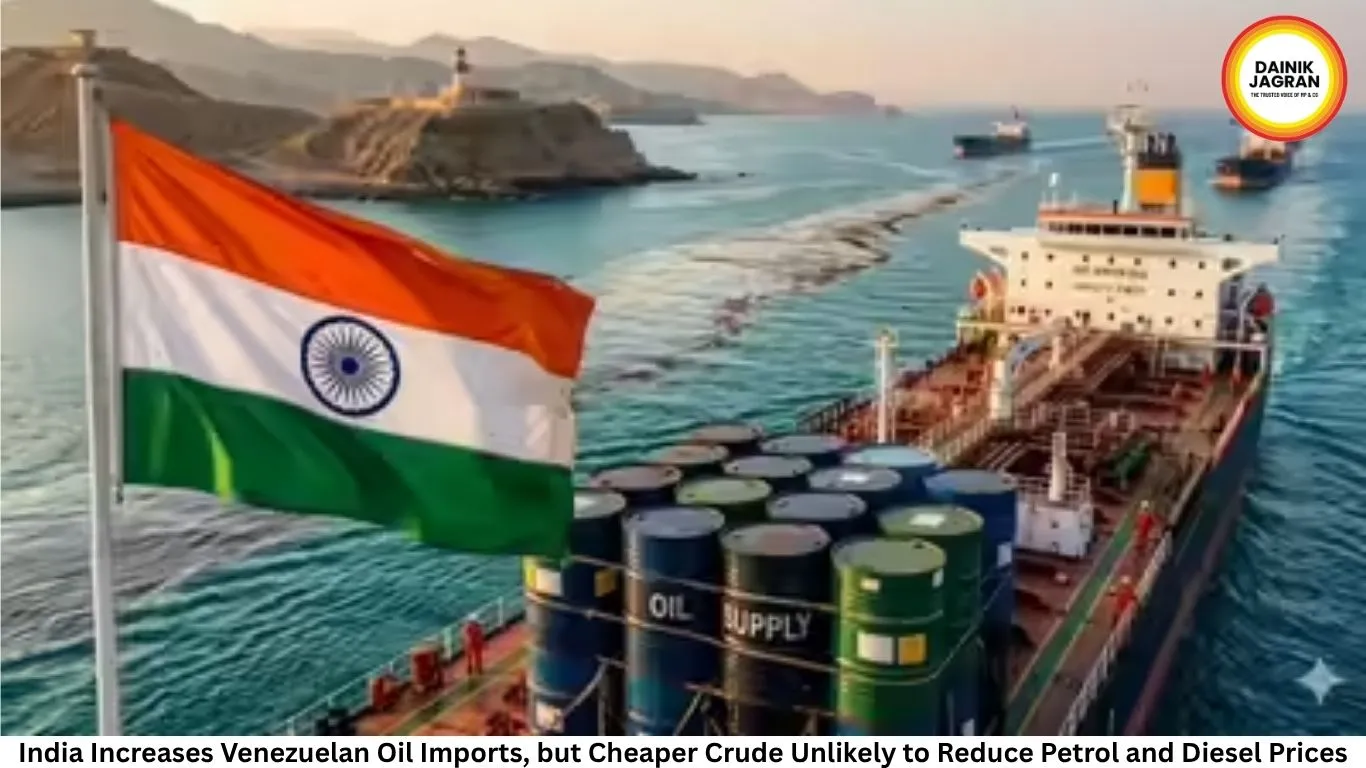
India Increases Venezuelan Oil Imports, but Cheaper Crude Unlikely to Reduce Petrol and Diesel Prices
Digital Desk
Venezuela has emerged as India's third-largest crude oil supplier, but experts say higher imports of discounted oil are unlikely to translate into lower fuel prices for consumers.
India has significantly increased its crude oil imports from Venezuela, making the South American nation the country's third-largest oil supplier in May 2026. According to energy market data, India imported nearly 420,000 barrels of Venezuelan crude per day, accounting for approximately 8.5% of its total crude oil imports. The surge comes as Indian refiners seek discounted crude amid global supply uncertainties. However, analysts say the increased purchases are unlikely to result in immediate reductions in petrol and diesel prices at retail fuel stations.
The renewed focus on Venezuelan oil also follows a series of earthquakes that disrupted refinery operations and oil logistics in the country, raising concerns about global crude supply and future price movements.
India Expands Venezuelan Oil Purchases
Market intelligence firm Kpler estimates that India's imports of Venezuelan crude rose sharply from around 283,000 barrels per day in April to nearly 417,000–420,000 barrels per day in May.
The increase has elevated Venezuela to the position of India's third-largest crude supplier, behind Russia and the United Arab Emirates (UAE). Industry experts attribute the rise to competitive pricing and supply diversification as geopolitical tensions continue to affect traditional oil trade routes.
Why Venezuelan Oil Matters
Venezuelan crude is among the cheapest available in the global market because of its heavy and high-viscosity nature. Although this type of crude is more difficult to refine, India's advanced private refineries, particularly Reliance Industries' Jamnagar complex, are equipped to process it efficiently.
The lower purchase price helps refiners improve their margins, making Venezuelan crude an attractive option despite logistical and political challenges.
Earthquake Raises Supply Concerns
Recent earthquakes near Venezuela's key industrial region disrupted refinery operations, pipelines, transportation networks, and export facilities. Authorities temporarily halted operations at several oil installations as a precaution, while damage to infrastructure affected power supply, communications, and logistics.
Analysts warn that any prolonged disruption in Venezuelan exports could tighten global crude supplies and place upward pressure on international oil prices.
Will Petrol and Diesel Become Cheaper?
Despite importing discounted crude, consumers in India should not expect an automatic reduction in petrol and diesel prices.
According to India's fuel pricing mechanism, retail fuel prices depend on several factors, including the average cost of global crude oil, refining expenses, transportation costs, dealer commissions, and central as well as state taxes. Savings earned by refiners from purchasing cheaper crude do not directly translate into lower prices at fuel stations.
As a result, unless international benchmark prices decline significantly or governments revise tax structures, retail fuel prices are expected to remain largely unchanged.
Indian Companies Strengthen Presence
Private and public sector companies continue to expand their engagement with Venezuela's energy sector.
Reliance Industries remains one of India's largest buyers of Venezuelan crude under long-term supply arrangements. Meanwhile, ONGC Videsh, along with Indian Oil Corporation (IOC) and Oil India, has investments in Venezuelan oil fields and is exploring opportunities to strengthen its presence in the country's upstream energy sector.
Outlook for Global Oil Prices
Market forecasts suggest that crude oil prices could remain relatively stable despite short-term volatility. Investment bank Goldman Sachs expects Brent crude to average around $80 per barrel during the fourth quarter of 2026 and approximately $75 per barrel in 2027.
Commodity analysts believe prices are likely to remain capped if geopolitical tensions ease and global shipping routes continue operating without major disruptions. However, any prolonged interruption to Venezuelan production could alter the outlook.

--------
๐จ Beat the News Rush โ Join Now!
Get breaking alerts, hot exclusives, and game-changing stories instantly on your phone. No delays, no fluff โ just the edge you need. โก
Tap to join:ย
๐ข WhatsApp Channel: Dainik Jagran MP CG
Crave more?
๐ Facebook: Dainik Jagran MP CG English
๐ ง Twitter (X): Dainik Jagran MP CG
๐ Instagram: Dainik Jagran MP CG
Share the fire โ keep your crew ahead! ๐๏ธ๐ฅ
India Increases Venezuelan Oil Imports, but Cheaper Crude Unlikely to Reduce Petrol and Diesel Prices
Digital Desk
India has significantly increased its crude oil imports from Venezuela, making the South American nation the country's third-largest oil supplier in May 2026. According to energy market data, India imported nearly 420,000 barrels of Venezuelan crude per day, accounting for approximately 8.5% of its total crude oil imports. The surge comes as Indian refiners seek discounted crude amid global supply uncertainties. However, analysts say the increased purchases are unlikely to result in immediate reductions in petrol and diesel prices at retail fuel stations.
The renewed focus on Venezuelan oil also follows a series of earthquakes that disrupted refinery operations and oil logistics in the country, raising concerns about global crude supply and future price movements.
India Expands Venezuelan Oil Purchases
Market intelligence firm Kpler estimates that India's imports of Venezuelan crude rose sharply from around 283,000 barrels per day in April to nearly 417,000–420,000 barrels per day in May.
The increase has elevated Venezuela to the position of India's third-largest crude supplier, behind Russia and the United Arab Emirates (UAE). Industry experts attribute the rise to competitive pricing and supply diversification as geopolitical tensions continue to affect traditional oil trade routes.
Why Venezuelan Oil Matters
Venezuelan crude is among the cheapest available in the global market because of its heavy and high-viscosity nature. Although this type of crude is more difficult to refine, India's advanced private refineries, particularly Reliance Industries' Jamnagar complex, are equipped to process it efficiently.
The lower purchase price helps refiners improve their margins, making Venezuelan crude an attractive option despite logistical and political challenges.
Earthquake Raises Supply Concerns
Recent earthquakes near Venezuela's key industrial region disrupted refinery operations, pipelines, transportation networks, and export facilities. Authorities temporarily halted operations at several oil installations as a precaution, while damage to infrastructure affected power supply, communications, and logistics.
Analysts warn that any prolonged disruption in Venezuelan exports could tighten global crude supplies and place upward pressure on international oil prices.
Will Petrol and Diesel Become Cheaper?
Despite importing discounted crude, consumers in India should not expect an automatic reduction in petrol and diesel prices.
According to India's fuel pricing mechanism, retail fuel prices depend on several factors, including the average cost of global crude oil, refining expenses, transportation costs, dealer commissions, and central as well as state taxes. Savings earned by refiners from purchasing cheaper crude do not directly translate into lower prices at fuel stations.
As a result, unless international benchmark prices decline significantly or governments revise tax structures, retail fuel prices are expected to remain largely unchanged.
Indian Companies Strengthen Presence
Private and public sector companies continue to expand their engagement with Venezuela's energy sector.
Reliance Industries remains one of India's largest buyers of Venezuelan crude under long-term supply arrangements. Meanwhile, ONGC Videsh, along with Indian Oil Corporation (IOC) and Oil India, has investments in Venezuelan oil fields and is exploring opportunities to strengthen its presence in the country's upstream energy sector.
Outlook for Global Oil Prices
Market forecasts suggest that crude oil prices could remain relatively stable despite short-term volatility. Investment bank Goldman Sachs expects Brent crude to average around $80 per barrel during the fourth quarter of 2026 and approximately $75 per barrel in 2027.
Commodity analysts believe prices are likely to remain capped if geopolitical tensions ease and global shipping routes continue operating without major disruptions. However, any prolonged interruption to Venezuelan production could alter the outlook.