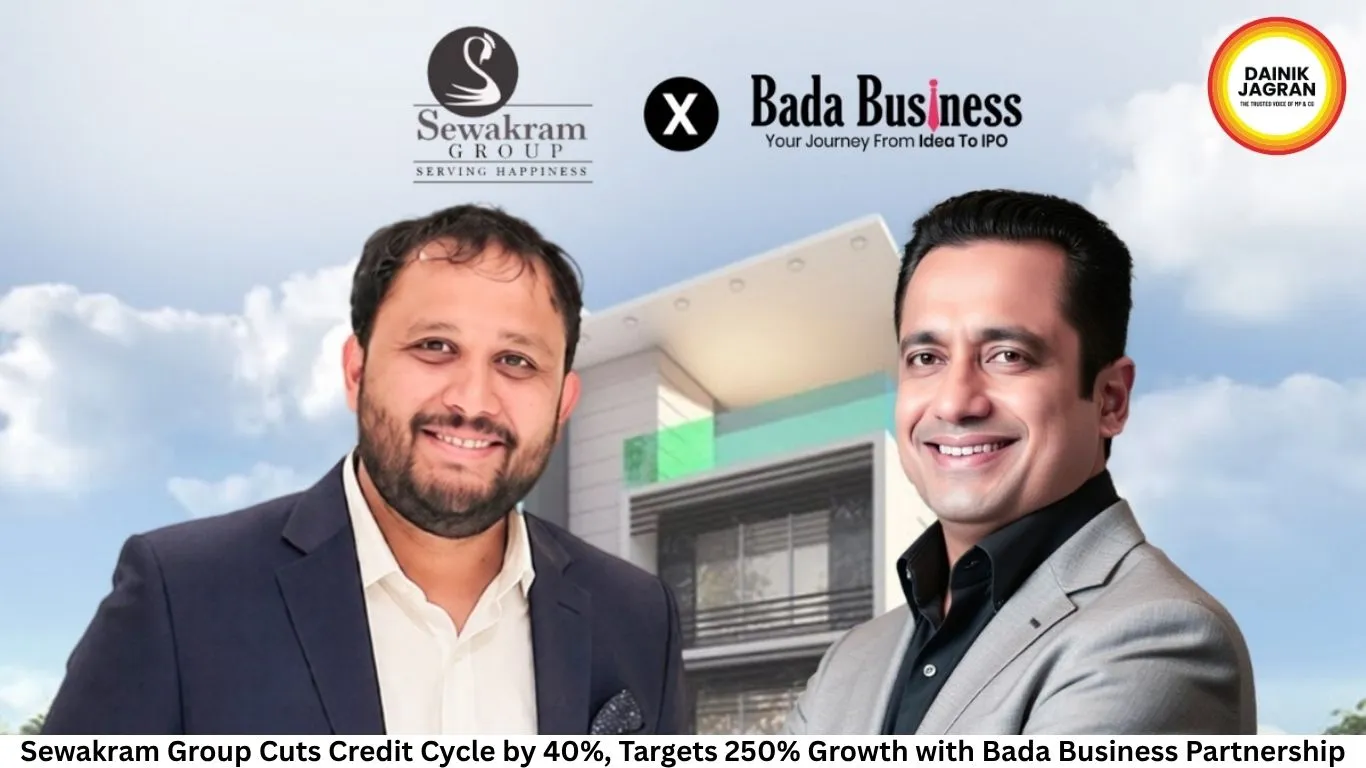
Sewakram Group Cuts Credit Cycle by 40%, Targets 250% Growth with Bada Business Partnership
Digital Desk
Sewakram Group has significantly improved its business performance after partnering with Dr. Vivek Bindra and Bada Business. The company reduced its credit cycle by 40%, expanded its distributor network, entered the UAE export market, launched an FMCG brand, and now projects over 250% growth in the next three years.
Sewakram Group, a leading wholesale grains and pulses enterprise based in Hubballi, Karnataka, has reported significant operational efficiency and business expansion following its strategic collaboration with Bada Business Private Limited under the guidance of renowned entrepreneur Dr. Vivek Bindra.
Known for its distributor-driven business model, Sewakram Group has steadily built its presence across regional commodity markets while simultaneously expanding into infrastructure development through Sewakram Realty. The real estate division has completed more than 25 residential, commercial, and industrial projects within six years across the Hubli-Dharwad region.
Despite its growth across sectors, the company was facing several operational bottlenecks within its trading business before the collaboration. One of the major challenges was the extended credit cycle, which had reached nearly 59 days. The delayed payment structure was impacting liquidity, restricting reinvestment opportunities, and slowing down the overall speed of business operations.
At the same time, the company’s distributor ecosystem lacked a structured framework for performance evaluation and engagement. Although Sewakram Group had approximately 250 distributors associated with the business, many remained inactive or contributed inconsistently, limiting the company’s market penetration and growth efficiency.
To address these concerns, Sewakram Group collaborated with Bada Business Private Limited under a Cash Growth Program (CGP) designed to strengthen operational systems, financial discipline, and long-term scalability.
Following the intervention, the company adopted a data-driven approach to distributor management. High-performing collaborators were identified through analytics, while inactive distributors were systematically reactivated through targeted engagement initiatives. This helped expand the active distributor base from 250 to more than 400 collaborators, significantly improving market reach and order consistency.
One of the most notable improvements came through the restructuring of distributor credit policies. By segmenting distributors based on payment history, reliability, and transaction volume, the company implemented optimized credit systems that reduced the credit cycle from 59 days to 35 days.
This nearly 40 percent reduction in the credit period improved working capital efficiency and accelerated cash flow across the organization. The improved liquidity also enabled faster reinvestment into expansion activities and operational upgrades.
Beyond operational improvements, the collaboration also opened new growth avenues for Sewakram Group. The company established a dedicated export vertical focused on the UAE market, successfully executing end-to-end export processes including compliance management, buyer acquisition, documentation, and payment structuring.
The export initiative resulted in a shipment volume of 1250 metric tons, marking the company’s entry into international trade and creating an additional revenue stream beyond domestic commodity operations.
In addition, Sewakram Group launched its own FMCG brand as part of a long-term diversification strategy. The shift from commodity trading to branded products was aimed at improving margins, reducing dependency on price fluctuations, and building long-term consumer loyalty.
As a result of these combined interventions, Sewakram Group is now projecting business growth of more than 250 percent over the next three years.
The company also worked closely with a consulting team that conducted detailed diagnostics to identify operational and revenue bottlenecks. Customized solutions were implemented across multiple business functions to ensure measurable and scalable outcomes.
Speaking about the collaboration, founder Arjun Agarwal said, “The guidance from Bada Business helped us bring discipline into our operational and financial systems. The improvements in cash flow management and distributor engagement have directly influenced our growth trajectory.”
The transformation of Sewakram Group demonstrates how traditional businesses can leverage structured mentorship, operational optimization, and strategic diversification to build sustainable and scalable growth in competitive markets.

--------
🚨 Beat the News Rush – Join Now!
Get breaking alerts, hot exclusives, and game-changing stories instantly on your phone. No delays, no fluff – just the edge you need. ⚡
Tap to join:
🟢 WhatsApp Channel: Dainik Jagran MP CG
Crave more?
🅕 Facebook: Dainik Jagran MP CG English
🅧 Twitter (X): Dainik Jagran MP CG
🅘 Instagram: Dainik Jagran MP CG
Share the fire – keep your crew ahead! 🗞️🔥
Sewakram Group Cuts Credit Cycle by 40%, Targets 250% Growth with Bada Business Partnership
Digital Desk
Sewakram Group, a leading wholesale grains and pulses enterprise based in Hubballi, Karnataka, has reported significant operational efficiency and business expansion following its strategic collaboration with Bada Business Private Limited under the guidance of renowned entrepreneur Dr. Vivek Bindra.
Known for its distributor-driven business model, Sewakram Group has steadily built its presence across regional commodity markets while simultaneously expanding into infrastructure development through Sewakram Realty. The real estate division has completed more than 25 residential, commercial, and industrial projects within six years across the Hubli-Dharwad region.
Despite its growth across sectors, the company was facing several operational bottlenecks within its trading business before the collaboration. One of the major challenges was the extended credit cycle, which had reached nearly 59 days. The delayed payment structure was impacting liquidity, restricting reinvestment opportunities, and slowing down the overall speed of business operations.
At the same time, the company’s distributor ecosystem lacked a structured framework for performance evaluation and engagement. Although Sewakram Group had approximately 250 distributors associated with the business, many remained inactive or contributed inconsistently, limiting the company’s market penetration and growth efficiency.
To address these concerns, Sewakram Group collaborated with Bada Business Private Limited under a Cash Growth Program (CGP) designed to strengthen operational systems, financial discipline, and long-term scalability.
Following the intervention, the company adopted a data-driven approach to distributor management. High-performing collaborators were identified through analytics, while inactive distributors were systematically reactivated through targeted engagement initiatives. This helped expand the active distributor base from 250 to more than 400 collaborators, significantly improving market reach and order consistency.
One of the most notable improvements came through the restructuring of distributor credit policies. By segmenting distributors based on payment history, reliability, and transaction volume, the company implemented optimized credit systems that reduced the credit cycle from 59 days to 35 days.
This nearly 40 percent reduction in the credit period improved working capital efficiency and accelerated cash flow across the organization. The improved liquidity also enabled faster reinvestment into expansion activities and operational upgrades.
Beyond operational improvements, the collaboration also opened new growth avenues for Sewakram Group. The company established a dedicated export vertical focused on the UAE market, successfully executing end-to-end export processes including compliance management, buyer acquisition, documentation, and payment structuring.
The export initiative resulted in a shipment volume of 1250 metric tons, marking the company’s entry into international trade and creating an additional revenue stream beyond domestic commodity operations.
In addition, Sewakram Group launched its own FMCG brand as part of a long-term diversification strategy. The shift from commodity trading to branded products was aimed at improving margins, reducing dependency on price fluctuations, and building long-term consumer loyalty.
As a result of these combined interventions, Sewakram Group is now projecting business growth of more than 250 percent over the next three years.
The company also worked closely with a consulting team that conducted detailed diagnostics to identify operational and revenue bottlenecks. Customized solutions were implemented across multiple business functions to ensure measurable and scalable outcomes.
Speaking about the collaboration, founder Arjun Agarwal said, “The guidance from Bada Business helped us bring discipline into our operational and financial systems. The improvements in cash flow management and distributor engagement have directly influenced our growth trajectory.”
The transformation of Sewakram Group demonstrates how traditional businesses can leverage structured mentorship, operational optimization, and strategic diversification to build sustainable and scalable growth in competitive markets.