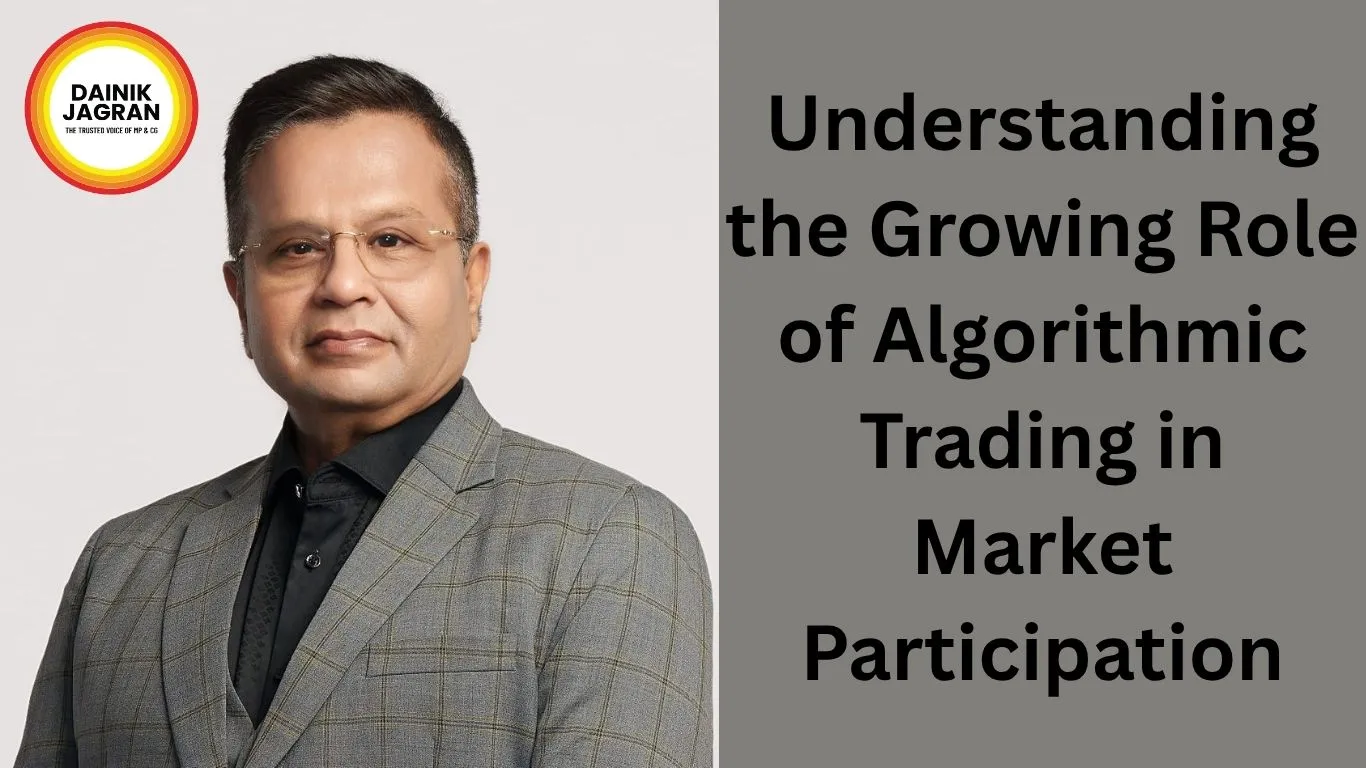
Understanding the Growing Role of Algorithmic Trading in Market Participation

By Milan Parikh, Chairman & Managing Director, Jainam Broking Limited

Understanding the Growing Role of Algorithmic Trading in Market Participation

Indian equity markets are witnessing a steady rise in participation, with both trading activity and investor interest expanding over time. In the equity cash segment, trading through highspeed systems have increased to 39.4%, mobile trading reached a five-year high, and algorithmic trading now accounts for nearly 55% of total trading activity.

These shifts reflect growth in market size along with a gradual evolution in how markets function. Earlier, the focus remained on access to information and the ability to interpret it. Today, outcomes are increasingly shaped by how efficiently that understanding translates into execution. In this context, algorithmic trading has become an important part of market activity.


The Market Is Already Algorithm Driven

India accounted for 5% of the global algorithmic trading market in 2024, reflecting the growing use of algorithmic systems in trade execution.These systems are now integral to the execution process, particularly among institutional participants who rely on structured frameworks to manage order flow in a consistent and controlled manner.In India, SEBI introduced algorithmic trading through Direct Market Access (DMA) in 2008, enabling brokers to offer clients direct access to exchange trading systems. Additionally, SEBI’s new rules on algorithmic trading for retail investors come into effect on 1 April 2026, marking a shift in how automated trading strategies are regulated in the country.

This is visible in how quickly prices respond to information, the pace at which markets adjust, and the overall efficiency of trade execution. Market behaviour reflects a combination of human decision-making and system-led execution, where ideas are implemented through clearly defined processes.

A similar pattern is visible globally, where a significant share of institutional trading activity is routed through algorithmic systems, with a strong focus on consistency and execution quality.

Access Has Expanded, Outcomes Still Depend on Structure

Over the past few years, improved market access and advancements in trading technology have enabled a wider set of participants to engage. Retail investors today are more connected and have access to tools that were once limited to institutional players.

Despite this broader access, outcomes continue to vary across participants. The difference often lies in execution discipline. While participation has increased, the ability to execute trades in a structured and repeatable manner remains uneven.

Institutional investors typically operate within defined frameworks where strategies are tested, execution is pre-planned, and risk is managed systematically. In contrast, a large segment of retail participation remains more discretionary, where execution may follow varying approaches.

Efficiency Matters More Than Speed

While algorithmic trading is often associated with speed, in recent years, the focus has shifted towards efficiency and consistency. In many segments, market depth remains adequate, and marginal advantages in speed rarely translate into better outcomes.

Greater importance now lies in how effectively trades interact with available liquidity, how market impact is managed, and how consistently execution is carried out.

Execution Is Becoming a Key Differentiator

As market dynamics evolve, execution has emerged as a key differentiator in performance. Two participants with similar market views can experience very different outcomes depending on how they enter and exit trades, manage order flow, and respond to price movements during execution.

Algorithmic systems support this by bringing consistency, reducing variability, and ensuring trades are executed within a defined framework.

India’s Market Structure Is Gradually Evolving

India’s market ecosystem continues to deepen, supported by rising participation, improving liquidity, and broader access to technology. At the same time, trade execution is becoming more structured, with an increasing number of participants adopting systematic approaches.As a result, market movements today are shaped by both investor sentiment and structured trading flows.

In this environment, trading strategies require greater emphasis on execution discipline and clarity in decision-making. Fully automated systems may not be necessary for all participants. There is, however, a clear shift toward more structured ways of engaging in the market.

Disclaimer: Investments in securities market are subject to market risks, read all the related documents carefully before investing. For more detail click on https://www.jainam.in/disclaimer/

--------

🚨 Beat the News Rush – Join Now!

Get breaking alerts, hot exclusives, and game-changing stories instantly on your phone. No delays, no fluff – just the edge you need. ⚡

Tap to join: 

🟢 WhatsApp Channel: Dainik Jagran MP CG

Crave more?

🅕 Facebook: Dainik Jagran MP CG English

🅧 Twitter (X): Dainik Jagran MP CG

🅘 Instagram: Dainik Jagran MP CG

Share the fire – keep your crew ahead! 🗞️🔥

english.dainikjagranmpcg.com
15 May 2026 By Abhishek Joshi

Understanding the Growing Role of Algorithmic Trading in Market Participation

By Milan Parikh, Chairman & Managing Director, Jainam Broking Limited

These shifts reflect growth in market size along with a gradual evolution in how markets function. Earlier, the focus remained on access to information and the ability to interpret it. Today, outcomes are increasingly shaped by how efficiently that understanding translates into execution. In this context, algorithmic trading has become an important part of market activity.


The Market Is Already Algorithm Driven

India accounted for 5% of the global algorithmic trading market in 2024, reflecting the growing use of algorithmic systems in trade execution.These systems are now integral to the execution process, particularly among institutional participants who rely on structured frameworks to manage order flow in a consistent and controlled manner.In India, SEBI introduced algorithmic trading through Direct Market Access (DMA) in 2008, enabling brokers to offer clients direct access to exchange trading systems. Additionally, SEBI’s new rules on algorithmic trading for retail investors come into effect on 1 April 2026, marking a shift in how automated trading strategies are regulated in the country.

This is visible in how quickly prices respond to information, the pace at which markets adjust, and the overall efficiency of trade execution. Market behaviour reflects a combination of human decision-making and system-led execution, where ideas are implemented through clearly defined processes.

A similar pattern is visible globally, where a significant share of institutional trading activity is routed through algorithmic systems, with a strong focus on consistency and execution quality.

Access Has Expanded, Outcomes Still Depend on Structure

Over the past few years, improved market access and advancements in trading technology have enabled a wider set of participants to engage. Retail investors today are more connected and have access to tools that were once limited to institutional players.

Despite this broader access, outcomes continue to vary across participants. The difference often lies in execution discipline. While participation has increased, the ability to execute trades in a structured and repeatable manner remains uneven.

Institutional investors typically operate within defined frameworks where strategies are tested, execution is pre-planned, and risk is managed systematically. In contrast, a large segment of retail participation remains more discretionary, where execution may follow varying approaches.

Efficiency Matters More Than Speed

While algorithmic trading is often associated with speed, in recent years, the focus has shifted towards efficiency and consistency. In many segments, market depth remains adequate, and marginal advantages in speed rarely translate into better outcomes.

Greater importance now lies in how effectively trades interact with available liquidity, how market impact is managed, and how consistently execution is carried out.

Execution Is Becoming a Key Differentiator

As market dynamics evolve, execution has emerged as a key differentiator in performance. Two participants with similar market views can experience very different outcomes depending on how they enter and exit trades, manage order flow, and respond to price movements during execution.

Algorithmic systems support this by bringing consistency, reducing variability, and ensuring trades are executed within a defined framework.

India’s Market Structure Is Gradually Evolving

India’s market ecosystem continues to deepen, supported by rising participation, improving liquidity, and broader access to technology. At the same time, trade execution is becoming more structured, with an increasing number of participants adopting systematic approaches.As a result, market movements today are shaped by both investor sentiment and structured trading flows.

In this environment, trading strategies require greater emphasis on execution discipline and clarity in decision-making. Fully automated systems may not be necessary for all participants. There is, however, a clear shift toward more structured ways of engaging in the market.

Disclaimer: Investments in securities market are subject to market risks, read all the related documents carefully before investing. For more detail click on https://www.jainam.in/disclaimer/

https://english.dainikjagranmpcg.com/business/understanding-the-growing-role-of-algorithmic-trading-in-market-participation/article-18445
Tags:

Latest News