Delhi HJS Recruitment 2026: Applications Close Today for 27 Judicial Posts

Digital desk

Delhi HJS Recruitment 2026: Applications Close Today for 27 Judicial Posts

Today marks the final day to apply for one of Delhi's most prestigious legal recruitments — 27 vacancies in the Delhi Higher Judicial Service, open only to seasoned advocates and judicial officers.

Key dates
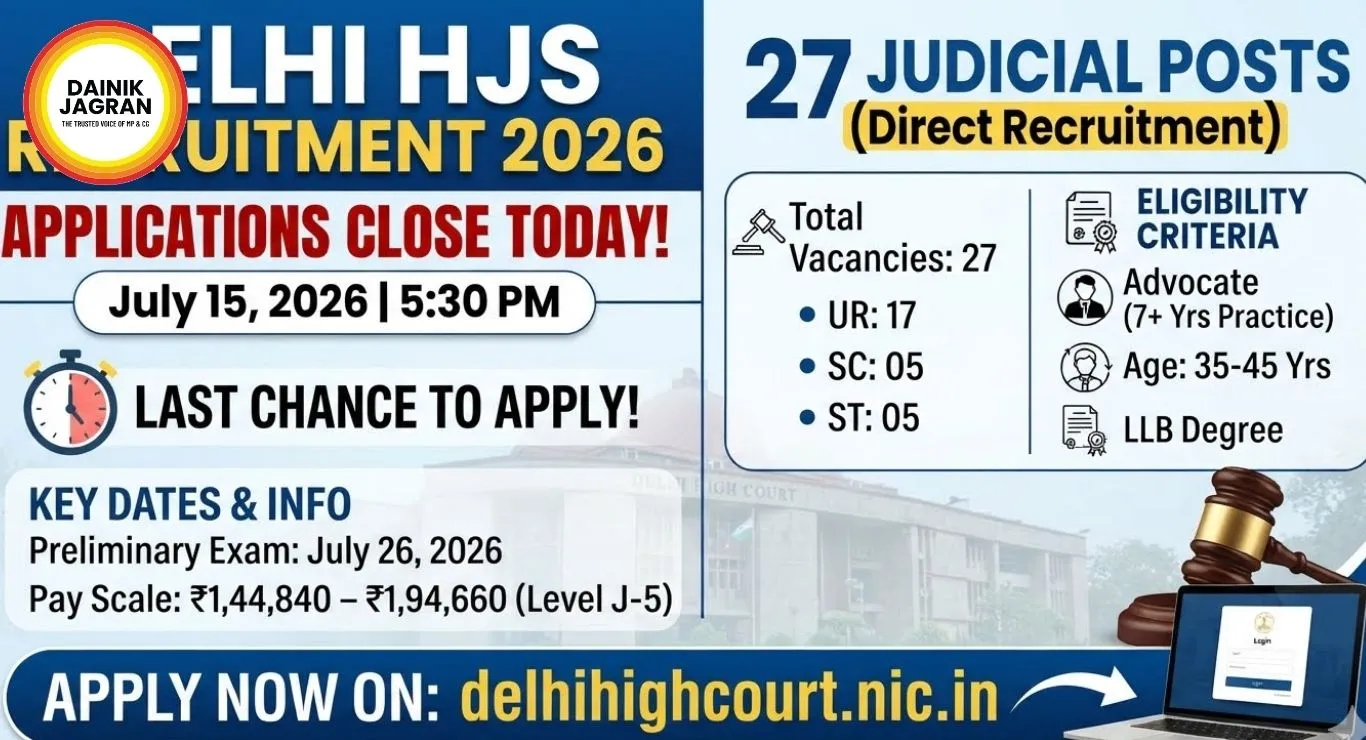
The High Court of Delhi opened applications on July 1, 2026, and the window closes today, July 15, at 5:30 pm. The Preliminary Examination is tentatively scheduled for July 26, 2026 (a Sunday), running 11 am to 1 pm.

Vacancy breakdown
A total of 27 posts are on offer — 24 existing vacancies plus 3 anticipated ones up to June 30, 2027. Category-wise, that breaks down to 17 Unreserved, 5 SC and 5 ST posts, with three of those SC/ST vacancies carrying over as backlog posts. Three vacancies are also reserved for candidates with benchmark disabilities of 40% or more, two of which are backlog posts.

Eligibility
Candidates need a Bachelor's Degree in Law (LLB) from a recognised university, along with at least seven years of continuous practice as an advocate as on the last date of application — today. Judicial officers can also apply if they have a combined seven years of experience as an advocate and judicial officer. Candidates must be Indian citizens, aged between 35 and 45 years as on July 15, 2026 — meaning born no earlier than July 15, 1981, and no later than July 15, 1991. Anyone previously dismissed from Central or State government, High Court, or statutory/local authority service is not eligible to apply.

Selection process
The recruitment runs through three stages: a Preliminary Examination (objective type, qualifying in nature only), a Mains Examination, and a Viva-Voce. Only the Mains and interview scores count toward the final merit list — the Prelims exist purely to shortlist candidates for the next stage.

Application fee
General, OBC and EWS candidates pay ₹2,000; SC, ST and PwD candidates pay ₹500. Fees must be paid online via debit card, credit card, net banking or UPI, and are non-refundable.

Salary
Selected officers will be placed in the J-5 pay scale, ranging from ₹1,44,840 to ₹1,94,660 a month.

Documents to have ready before submitting
Candidates will need a Bar Council certificate confirming their years of practice, countersigned by the Registrar General or an authorised High Court/District Judge officer; copies of at least two case order sheets or judgments per year across the preceding seven years; Income Tax Return acknowledgements; an original No Objection Certificate from their employer if currently in government or judicial service; and, where applicable, original caste or disability certificates from the prescribed authority.

Common mistakes to avoid
The High Court has flagged a few recurring errors that lead to disqualification: applying without having completed the full seven years of continuous practice by today's deadline, and — for those who eventually reach the OMR-based stage — using correction fluid or marking multiple answers per question. Applicants are also reminded not to send a printout of their application to the court; the process is entirely online, with the printout meant only for personal record-keeping.

With the window closing at 5:30 pm today, any advocate still finalising their application should prioritise getting the eligibility documents in order first, since incomplete practice-period verification is the single most common reason candidates get disqualified at a later stage.


--------

🚨 Beat the News Rush – Join Now!

Get breaking alerts, hot exclusives, and game-changing stories instantly on your phone. No delays, no fluff – just the edge you need. ⚡

Tap to join: 

🟢 WhatsApp Channel: Dainik Jagran MP CG

Crave more?

🅕 Facebook: Dainik Jagran MP CG English

🅧 Twitter (X): Dainik Jagran MP CG

🅘 Instagram: Dainik Jagran MP CG

Share the fire – keep your crew ahead! 🗞️🔥

english.dainikjagranmpcg.com
16 Jul 2026 By Priyanshu.Jha

Delhi HJS Recruitment 2026: Applications Close Today for 27 Judicial Posts

Digital desk

Key dates
The High Court of Delhi opened applications on July 1, 2026, and the window closes today, July 15, at 5:30 pm. The Preliminary Examination is tentatively scheduled for July 26, 2026 (a Sunday), running 11 am to 1 pm.

Vacancy breakdown
A total of 27 posts are on offer — 24 existing vacancies plus 3 anticipated ones up to June 30, 2027. Category-wise, that breaks down to 17 Unreserved, 5 SC and 5 ST posts, with three of those SC/ST vacancies carrying over as backlog posts. Three vacancies are also reserved for candidates with benchmark disabilities of 40% or more, two of which are backlog posts.

Eligibility
Candidates need a Bachelor's Degree in Law (LLB) from a recognised university, along with at least seven years of continuous practice as an advocate as on the last date of application — today. Judicial officers can also apply if they have a combined seven years of experience as an advocate and judicial officer. Candidates must be Indian citizens, aged between 35 and 45 years as on July 15, 2026 — meaning born no earlier than July 15, 1981, and no later than July 15, 1991. Anyone previously dismissed from Central or State government, High Court, or statutory/local authority service is not eligible to apply.

Selection process
The recruitment runs through three stages: a Preliminary Examination (objective type, qualifying in nature only), a Mains Examination, and a Viva-Voce. Only the Mains and interview scores count toward the final merit list — the Prelims exist purely to shortlist candidates for the next stage.

Application fee
General, OBC and EWS candidates pay ₹2,000; SC, ST and PwD candidates pay ₹500. Fees must be paid online via debit card, credit card, net banking or UPI, and are non-refundable.

Salary
Selected officers will be placed in the J-5 pay scale, ranging from ₹1,44,840 to ₹1,94,660 a month.

Documents to have ready before submitting
Candidates will need a Bar Council certificate confirming their years of practice, countersigned by the Registrar General or an authorised High Court/District Judge officer; copies of at least two case order sheets or judgments per year across the preceding seven years; Income Tax Return acknowledgements; an original No Objection Certificate from their employer if currently in government or judicial service; and, where applicable, original caste or disability certificates from the prescribed authority.

Common mistakes to avoid
The High Court has flagged a few recurring errors that lead to disqualification: applying without having completed the full seven years of continuous practice by today's deadline, and — for those who eventually reach the OMR-based stage — using correction fluid or marking multiple answers per question. Applicants are also reminded not to send a printout of their application to the court; the process is entirely online, with the printout meant only for personal record-keeping.

With the window closing at 5:30 pm today, any advocate still finalising their application should prioritise getting the eligibility documents in order first, since incomplete practice-period verification is the single most common reason candidates get disqualified at a later stage.

https://english.dainikjagranmpcg.com/education/6a577db39c32a/article-22352

Related Posts

Trending News