Career Opportunities in Ayurveda: UPSC AYUSH Medical Officer Recruitment and BAMS Scope Explained
Digital desk
Ayurveda has moved well past its old image as a fallback career option — today it's a genuine government-service pathway with UPSC-level postings, structured promotions, and a fast-growing public infrastructure behind it. Here's what the career path actually looks like for BAMS graduates.
The foundation: BAMS
A Bachelor of Ayurvedic Medicine and Surgery is a 5.5-year professional degree — 4.5 years of academic study plus a mandatory one-year rotating internship. Admission requires Class 12 with Physics, Chemistry and Biology, a qualifying NEET-UG score, and a seat secured through AYUSH counselling. The curriculum blends classical texts like the Charaka Samhita and Sushruta Samhita with modern anatomy, physiology and pathology. On graduating, registration with the State or Central Council of Indian Medicine (now NCISM) is mandatory before practising.
Government recruitment routes
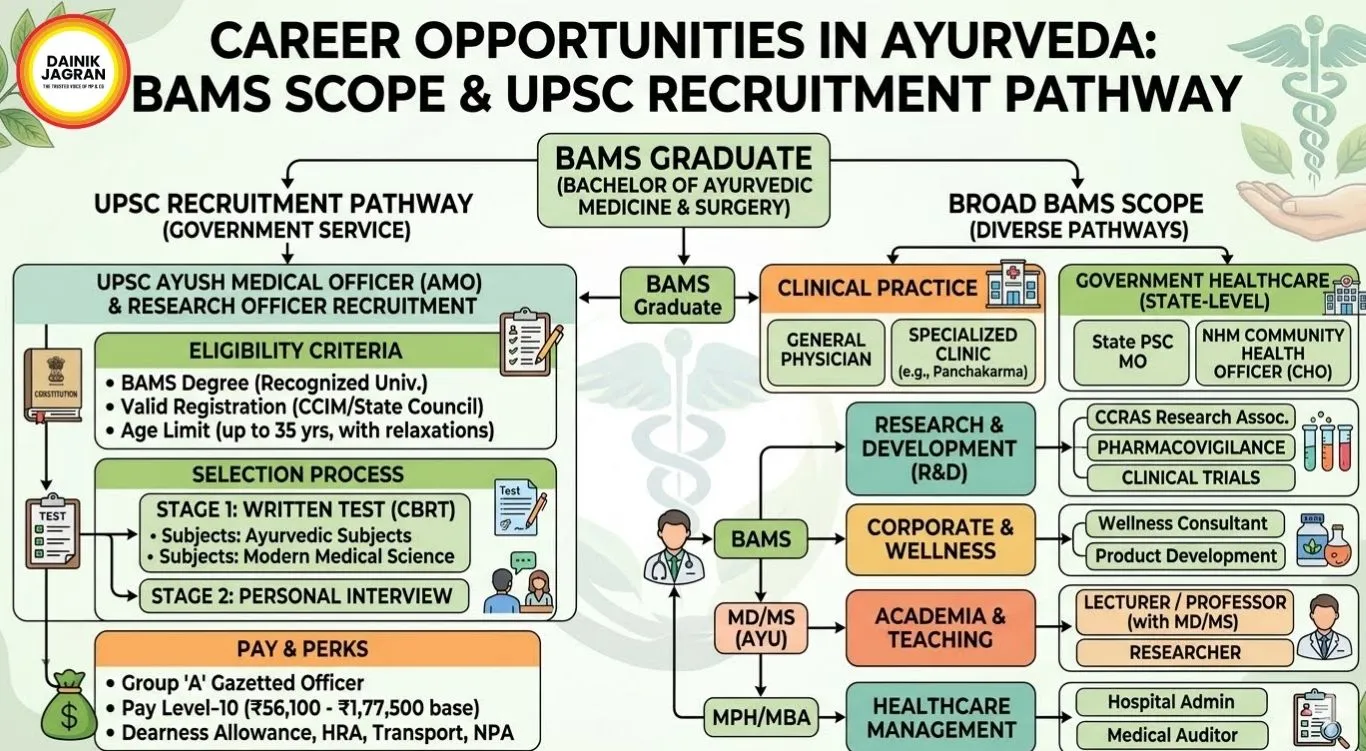
BAMS graduates can apply for Medical Officer (Ayurveda) posts through multiple channels: UPSC, state Public Service Commissions, and the National Ayush Mission under the Ministry of AYUSH. UPSC periodically releases vacancies for Medical Officer and Research Officer posts specifically — recent notifications have included postings under the Ministry of AYUSH and in Union Territories like Ladakh, typically requiring a BAMS degree from a recognised university and active enrolment on the National or State Register for Indian Systems of Medicine. Age limits generally run from 21 to 40 years, with standard relaxations for reserved categories.
Selection process
Most permanent, gazetted Medical Officer posts are filled through a written exam — either the Combined Medical Services Examination route or a dedicated AYUSH entrance test — followed by document verification and, in many cases, a personality test or interview. The written exam typically draws heavily from core BAMS subjects like Kayachikitsa, Dravyaguna and Panchakarma, alongside general knowledge and reasoning. Contractual roles, such as Community Health Officer positions under the National Health Mission, are often filled through merit-based screening of BAMS marks or a shorter test instead.
Pay and progression
Entry-level Medical Officer (Ayurveda) posts under central government recruitment typically fall at Level 9 or Level 10 of the pay matrix, with basic pay in the ₹56,100 to ₹1,77,500 range depending on the specific post and location, plus Dearness Allowance and House Rent Allowance. Career progression usually moves from Medical Officer to Senior Medical Officer, then District AYUSH Officer, with further administrative roles like Joint Director or Director of AYUSH available at the state level over time. Community Health Officer roles, by comparison, typically pay a fixed monthly amount alongside a performance-based incentive, working out to a more modest total.
Beyond government service
The scope extends well past clinical postings. BAMS graduates can pursue an MD or MS in Ayurveda through the All India AYUSH Postgraduate Entrance Test to specialise further and unlock lecturer or research roles at government Ayurvedic colleges and institutions like the Central Council for Research in Ayurvedic Sciences. Other paths include private practice and clinic ownership, roles in Ayurvedic pharmaceutical and wellness companies, and increasingly, positions with the Armed Forces medical wings and ECHS polyclinics, which have started recruiting AYUSH doctors on both permanent and contractual bases.
With India's AYUSH sector valued at billions of dollars and still growing at a steady annual pace, and Ayurveda now recognised as a system of medicine in more than thirty countries, the career runway for BAMS graduates looks considerably longer than it did even a decade ago.

--------
🚨 Beat the News Rush – Join Now!
Get breaking alerts, hot exclusives, and game-changing stories instantly on your phone. No delays, no fluff – just the edge you need. ⚡
Tap to join:
🟢 WhatsApp Channel: Dainik Jagran MP CG
Crave more?
🅕 Facebook: Dainik Jagran MP CG English
🅧 Twitter (X): Dainik Jagran MP CG
🅘 Instagram: Dainik Jagran MP CG
Share the fire – keep your crew ahead! 🗞️🔥
Career Opportunities in Ayurveda: UPSC AYUSH Medical Officer Recruitment and BAMS Scope Explained
Digital desk
The foundation: BAMS
A Bachelor of Ayurvedic Medicine and Surgery is a 5.5-year professional degree — 4.5 years of academic study plus a mandatory one-year rotating internship. Admission requires Class 12 with Physics, Chemistry and Biology, a qualifying NEET-UG score, and a seat secured through AYUSH counselling. The curriculum blends classical texts like the Charaka Samhita and Sushruta Samhita with modern anatomy, physiology and pathology. On graduating, registration with the State or Central Council of Indian Medicine (now NCISM) is mandatory before practising.
Government recruitment routes
BAMS graduates can apply for Medical Officer (Ayurveda) posts through multiple channels: UPSC, state Public Service Commissions, and the National Ayush Mission under the Ministry of AYUSH. UPSC periodically releases vacancies for Medical Officer and Research Officer posts specifically — recent notifications have included postings under the Ministry of AYUSH and in Union Territories like Ladakh, typically requiring a BAMS degree from a recognised university and active enrolment on the National or State Register for Indian Systems of Medicine. Age limits generally run from 21 to 40 years, with standard relaxations for reserved categories.
Selection process
Most permanent, gazetted Medical Officer posts are filled through a written exam — either the Combined Medical Services Examination route or a dedicated AYUSH entrance test — followed by document verification and, in many cases, a personality test or interview. The written exam typically draws heavily from core BAMS subjects like Kayachikitsa, Dravyaguna and Panchakarma, alongside general knowledge and reasoning. Contractual roles, such as Community Health Officer positions under the National Health Mission, are often filled through merit-based screening of BAMS marks or a shorter test instead.
Pay and progression
Entry-level Medical Officer (Ayurveda) posts under central government recruitment typically fall at Level 9 or Level 10 of the pay matrix, with basic pay in the ₹56,100 to ₹1,77,500 range depending on the specific post and location, plus Dearness Allowance and House Rent Allowance. Career progression usually moves from Medical Officer to Senior Medical Officer, then District AYUSH Officer, with further administrative roles like Joint Director or Director of AYUSH available at the state level over time. Community Health Officer roles, by comparison, typically pay a fixed monthly amount alongside a performance-based incentive, working out to a more modest total.
Beyond government service
The scope extends well past clinical postings. BAMS graduates can pursue an MD or MS in Ayurveda through the All India AYUSH Postgraduate Entrance Test to specialise further and unlock lecturer or research roles at government Ayurvedic colleges and institutions like the Central Council for Research in Ayurvedic Sciences. Other paths include private practice and clinic ownership, roles in Ayurvedic pharmaceutical and wellness companies, and increasingly, positions with the Armed Forces medical wings and ECHS polyclinics, which have started recruiting AYUSH doctors on both permanent and contractual bases.
With India's AYUSH sector valued at billions of dollars and still growing at a steady annual pace, and Ayurveda now recognised as a system of medicine in more than thirty countries, the career runway for BAMS graduates looks considerably longer than it did even a decade ago.