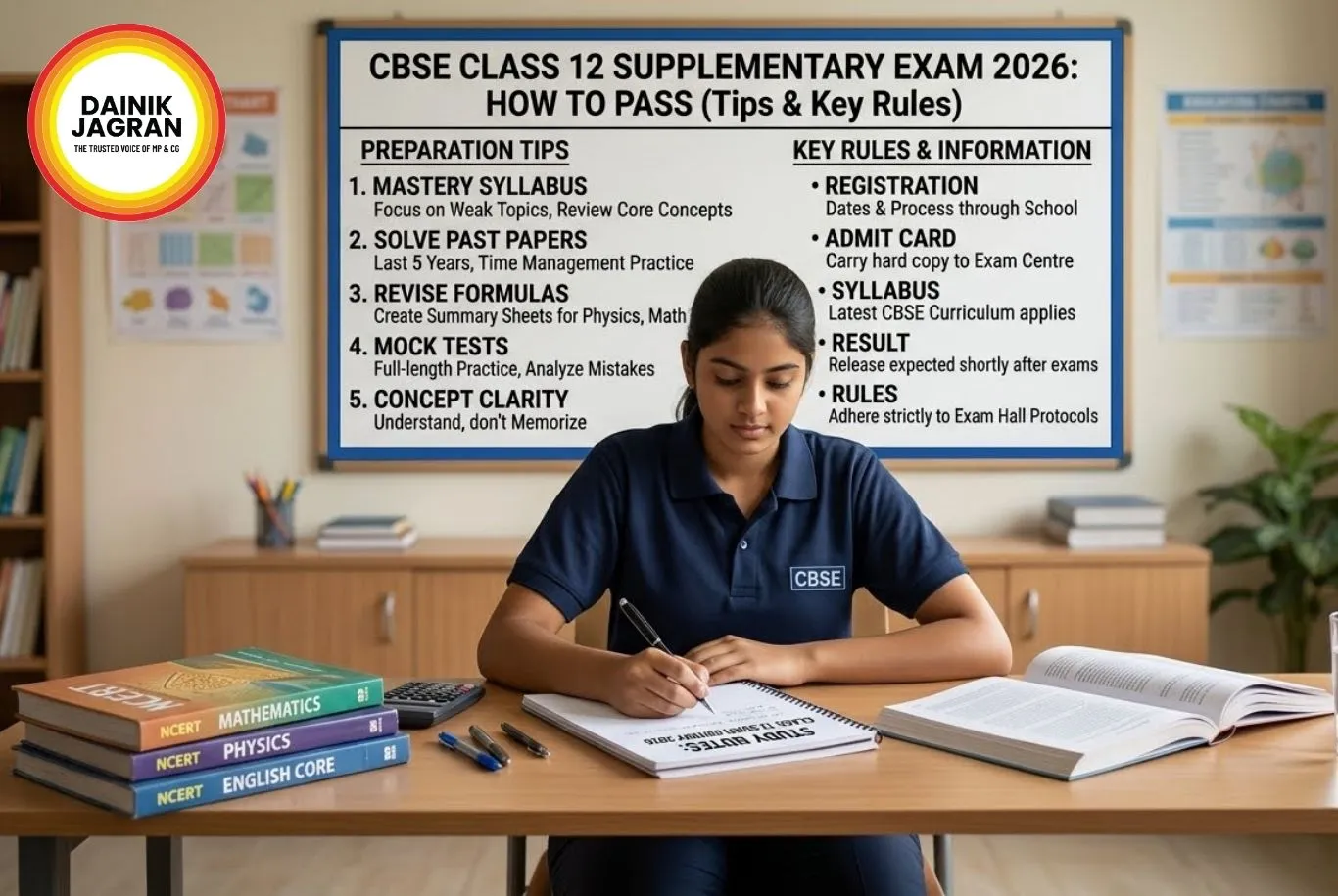
CBSE Class 12 Supplementary Exam 2026: How to Pass — Tips and Key Rules
Digital desk
For the nearly 1.9 lakh CBSE Class 12 students placed in the compartment category this year — up notably from around 1.22 lakh last year — the supplementary exam offers a genuine second chance to clear the subject that held them back, without losing an academic year. Here's what to know and how to approach it.
Who's eligible
Students who failed exactly one subject in the main Class 12 board exam are eligible for the compartment exam. Those who failed two or more subjects are not eligible and must reappear for the full board examination the following year. Students who already passed but want to improve their marks in one subject can also apply under the improvement category, and students who cleared a compartment in one subject but still have another can, in specific eligible cases, appear for two subjects.
How many attempts you get
CBSE allows students up to three attempts to clear a failed subject within a defined window — spanning the supplementary examination and subsequent board sessions. This isn't a one-shot, do-or-die exam; there's structured room to try again if needed.
Same difficulty, same syllabus
The compartment exam follows the exact same syllabus, question paper pattern and marking scheme as the main board exam — there's no additional or different material to prepare, and the exam isn't designed to be any harder than the one you already sat for.
Passing criteria
To pass, students need to score at least 33% marks overall, with separate 33% minimums required in both the theory and practical components where applicable.
How to prepare effectively
- Prioritise untouched chapters first. Many students lose marks simply because certain chapters were never properly covered before the main exam. Start there rather than repeatedly revising material you're already comfortable with — even a few high-weightage chapters done properly can meaningfully shift your final score.
- Practice with previous years' papers. This builds familiarity with CBSE's actual question style and writing expectations, which matters especially in theory-heavy subjects. Timed practice also builds speed and reduces exam-day anxiety.
- Stick to NCERT as your core material. For most CBSE subjects, NCERT textbooks remain the primary source for both direct and conceptual questions. A common mistake after a first failed attempt is over-relying on multiple reference books instead of mastering NCERT thoroughly first.
- Don't skip the admit card and logistics. Admit cards are typically released 7-10 days before the exam through schools or the official portal. Confirm your exam centre and reporting time well in advance rather than scrambling at the last minute.
Registration process
Regular students apply through their school, while private candidates apply directly through the CBSE portal — CBSE does not accept direct applications from regular students outside the school channel. Fees can only be paid online.
What happens after clearing
A cleared compartment result is treated exactly the same as a regular pass on your final marksheet — there's no distinction or flag indicating you needed a second attempt. Your academic career moves forward without any lost time, though it's worth checking whether any college admission deadlines have already passed, since some institutions run separate spot-admission rounds specifically for students clearing compartment exams later in the cycle.
Given some uncertainty in exact 2026 exam dates circulating across sources, students and parents should confirm the precise date and reporting details directly with their school or the official CBSE website rather than relying on any single secondary source.

--------
🚨 Beat the News Rush – Join Now!
Get breaking alerts, hot exclusives, and game-changing stories instantly on your phone. No delays, no fluff – just the edge you need. ⚡
Tap to join:
🟢 WhatsApp Channel: Dainik Jagran MP CG
Crave more?
🅕 Facebook: Dainik Jagran MP CG English
🅧 Twitter (X): Dainik Jagran MP CG
🅘 Instagram: Dainik Jagran MP CG
Share the fire – keep your crew ahead! 🗞️🔥
CBSE Class 12 Supplementary Exam 2026: How to Pass — Tips and Key Rules
Digital desk
Who's eligible
Students who failed exactly one subject in the main Class 12 board exam are eligible for the compartment exam. Those who failed two or more subjects are not eligible and must reappear for the full board examination the following year. Students who already passed but want to improve their marks in one subject can also apply under the improvement category, and students who cleared a compartment in one subject but still have another can, in specific eligible cases, appear for two subjects.
How many attempts you get
CBSE allows students up to three attempts to clear a failed subject within a defined window — spanning the supplementary examination and subsequent board sessions. This isn't a one-shot, do-or-die exam; there's structured room to try again if needed.
Same difficulty, same syllabus
The compartment exam follows the exact same syllabus, question paper pattern and marking scheme as the main board exam — there's no additional or different material to prepare, and the exam isn't designed to be any harder than the one you already sat for.
Passing criteria
To pass, students need to score at least 33% marks overall, with separate 33% minimums required in both the theory and practical components where applicable.
How to prepare effectively
- Prioritise untouched chapters first. Many students lose marks simply because certain chapters were never properly covered before the main exam. Start there rather than repeatedly revising material you're already comfortable with — even a few high-weightage chapters done properly can meaningfully shift your final score.
- Practice with previous years' papers. This builds familiarity with CBSE's actual question style and writing expectations, which matters especially in theory-heavy subjects. Timed practice also builds speed and reduces exam-day anxiety.
- Stick to NCERT as your core material. For most CBSE subjects, NCERT textbooks remain the primary source for both direct and conceptual questions. A common mistake after a first failed attempt is over-relying on multiple reference books instead of mastering NCERT thoroughly first.
- Don't skip the admit card and logistics. Admit cards are typically released 7-10 days before the exam through schools or the official portal. Confirm your exam centre and reporting time well in advance rather than scrambling at the last minute.
Registration process
Regular students apply through their school, while private candidates apply directly through the CBSE portal — CBSE does not accept direct applications from regular students outside the school channel. Fees can only be paid online.
What happens after clearing
A cleared compartment result is treated exactly the same as a regular pass on your final marksheet — there's no distinction or flag indicating you needed a second attempt. Your academic career moves forward without any lost time, though it's worth checking whether any college admission deadlines have already passed, since some institutions run separate spot-admission rounds specifically for students clearing compartment exams later in the cycle.
Given some uncertainty in exact 2026 exam dates circulating across sources, students and parents should confirm the precise date and reporting details directly with their school or the official CBSE website rather than relying on any single secondary source.