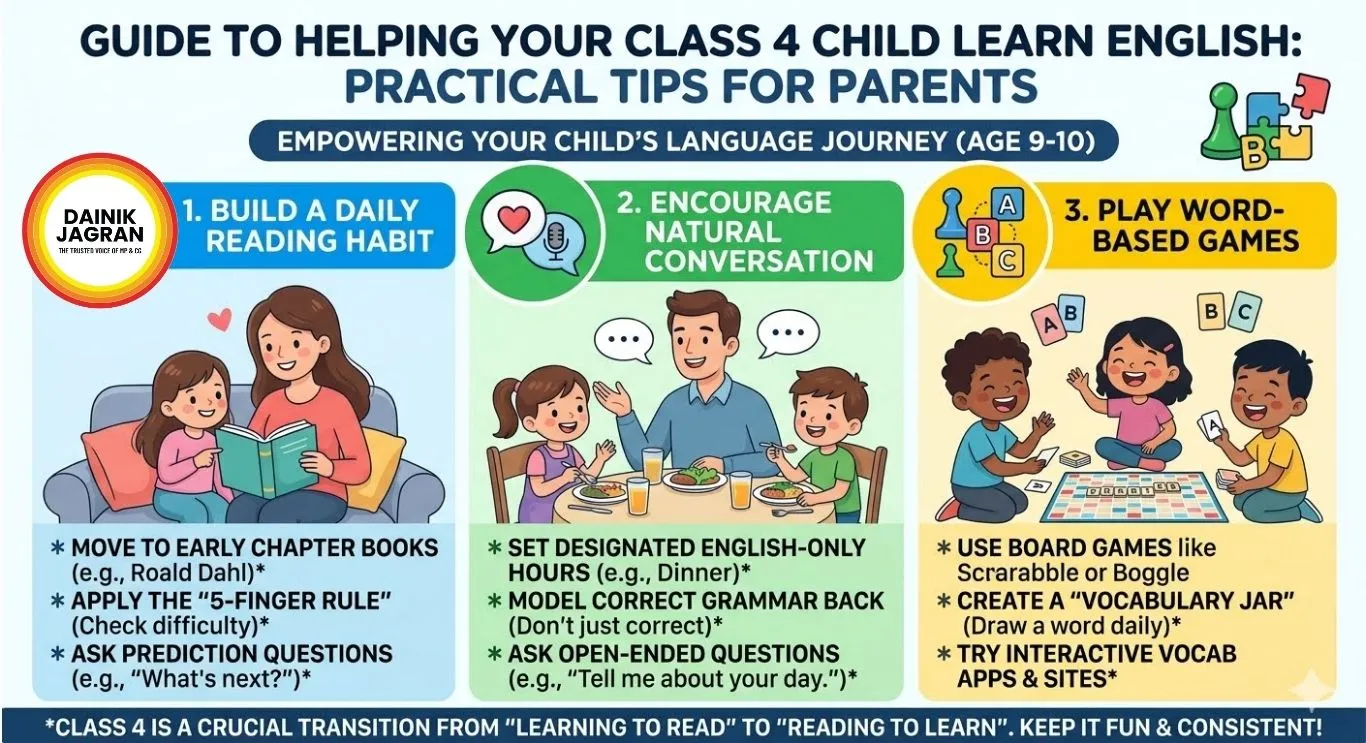
How to Help Your Class 4 Child Learn English: Practical Tips for Parents

Digital desk

How to Help Your Class 4 Child Learn English: Practical Tips for Parents

Class 4 marks a real shift in how children use English — it's no longer just about recognising letters and simple words, but about reading longer texts, writing in complete thoughts, and speaking with more confidence. Here's how parents can support that shift at home.

Make reading a daily, independent habit
Set aside time each day where your child reads on their own — not just school textbooks, but anything that holds their interest: story books, comics, even magazines. Regular library visits help keep a steady supply of fresh material, and letting children pick their own books (within reason) tends to build far more genuine reading enthusiasm than assigning fixed titles.

Talk about what they're reading
Rather than just asking "did you finish the book," ask questions that go a little deeper — what did a character do, why do they think that happened, what would they have done differently. This kind of discussion pushes comprehension beyond just following the plot, and helps children get comfortable expressing opinions in English rather than only reading passively.

Connect writing to real situations
Children respond far better to writing tasks that feel real rather than like homework. A birthday invitation to a friend, a short note listing what they want for their next trip, a simple diary entry about their day — these give writing an actual purpose, which makes the practice stick better than a worksheet ever could.

Build vocabulary through everyday conversation
Use new words naturally in conversation rather than presenting them as a formal vocabulary list. If you've just read an interesting news story or watched something on TV, tell your child about it in a bit of detail — car rides and mealtimes are a natural, low-pressure setting for this kind of exposure.

Use technology as a supplement, not a replacement
Age-appropriate audiobooks, podcasts, and educational apps with interactive storytelling or grammar games can genuinely help — particularly for listening comprehension and pronunciation. They work best as an addition to reading and conversation, not a substitute for either.

Keep grammar practice light and consistent
At this stage, children should be getting comfortable with the basics — correct sentence structure, capitalization, punctuation, and spotting run-on or incomplete sentences. Short, regular practice, ideally through worksheets or simple games rather than long grammar lectures, tends to work better than infrequent, intense sessions.

Don't let mistakes become a source of anxiety
Children learning a language — especially one that isn't spoken at home — need to feel safe making mistakes. Correct gently and move on, rather than dwelling on every error; confidence in speaking tends to matter more at this age than immediate grammatical precision.

Keep sessions reasonably short
For focused, at-home practice, 30 to 45 minutes tends to work well for a Class 4 child, split across reading, a bit of writing, and conversation — long enough to build the habit, short enough that it doesn't become a chore they start resisting.

The common thread across all of this: consistency beats intensity. A little reading, a little conversation, and a little writing practice most days will do far more for a Class 4 child's English than an occasional long, heavy session.


--------

๐Ÿšจ Beat the News Rush โ€“ Join Now!

Get breaking alerts, hot exclusives, and game-changing stories instantly on your phone. No delays, no fluff โ€“ just the edge you need. โšก

Tap to join:ย 

๐ŸŸข WhatsApp Channel: Dainik Jagran MP CG

Crave more?

๐Ÿ…• Facebook: Dainik Jagran MP CG English

๐Ÿ…ง Twitter (X): Dainik Jagran MP CG

๐Ÿ…˜ Instagram: Dainik Jagran MP CG

Share the fire โ€“ keep your crew ahead! ๐Ÿ—ž๏ธ๐Ÿ”ฅ

english.dainikjagranmpcg.com
24 Jul 2026 By Priyanshu.Jha

How to Help Your Class 4 Child Learn English: Practical Tips for Parents

Digital desk

Make reading a daily, independent habit
Set aside time each day where your child reads on their own — not just school textbooks, but anything that holds their interest: story books, comics, even magazines. Regular library visits help keep a steady supply of fresh material, and letting children pick their own books (within reason) tends to build far more genuine reading enthusiasm than assigning fixed titles.

Talk about what they're reading
Rather than just asking "did you finish the book," ask questions that go a little deeper — what did a character do, why do they think that happened, what would they have done differently. This kind of discussion pushes comprehension beyond just following the plot, and helps children get comfortable expressing opinions in English rather than only reading passively.

Connect writing to real situations
Children respond far better to writing tasks that feel real rather than like homework. A birthday invitation to a friend, a short note listing what they want for their next trip, a simple diary entry about their day — these give writing an actual purpose, which makes the practice stick better than a worksheet ever could.

Build vocabulary through everyday conversation
Use new words naturally in conversation rather than presenting them as a formal vocabulary list. If you've just read an interesting news story or watched something on TV, tell your child about it in a bit of detail — car rides and mealtimes are a natural, low-pressure setting for this kind of exposure.

Use technology as a supplement, not a replacement
Age-appropriate audiobooks, podcasts, and educational apps with interactive storytelling or grammar games can genuinely help — particularly for listening comprehension and pronunciation. They work best as an addition to reading and conversation, not a substitute for either.

Keep grammar practice light and consistent
At this stage, children should be getting comfortable with the basics — correct sentence structure, capitalization, punctuation, and spotting run-on or incomplete sentences. Short, regular practice, ideally through worksheets or simple games rather than long grammar lectures, tends to work better than infrequent, intense sessions.

Don't let mistakes become a source of anxiety
Children learning a language — especially one that isn't spoken at home — need to feel safe making mistakes. Correct gently and move on, rather than dwelling on every error; confidence in speaking tends to matter more at this age than immediate grammatical precision.

Keep sessions reasonably short
For focused, at-home practice, 30 to 45 minutes tends to work well for a Class 4 child, split across reading, a bit of writing, and conversation — long enough to build the habit, short enough that it doesn't become a chore they start resisting.

The common thread across all of this: consistency beats intensity. A little reading, a little conversation, and a little writing practice most days will do far more for a Class 4 child's English than an occasional long, heavy session.

https://english.dainikjagranmpcg.com/education/how-to-help-your-class-4-child-learn-english-practical/article-23431

Related Posts

Trending News