Supreme Court to Direct CBSE: Parents Must Get Opt-Out Option for APAAR ID Nationwide

Digital desk

Supreme Court to Direct CBSE: Parents Must Get Opt-Out Option for APAAR ID Nationwide

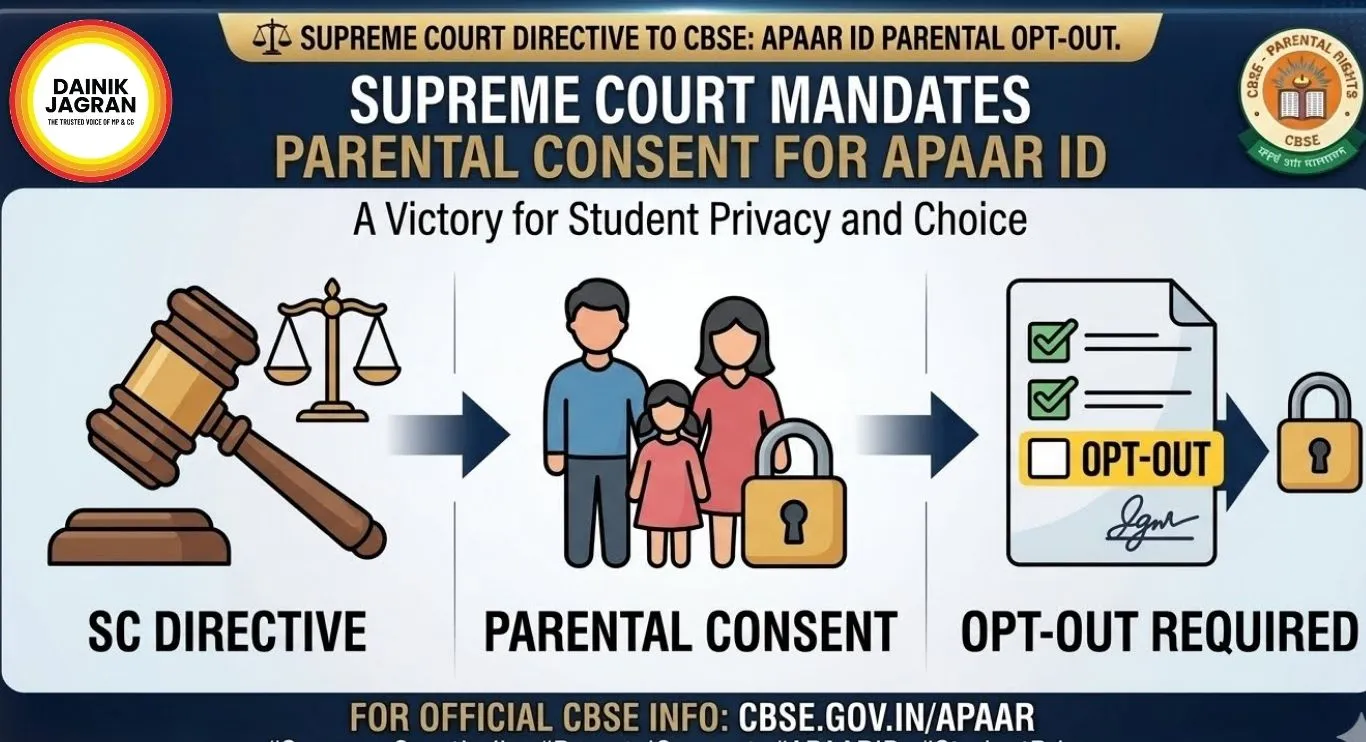
Parents across India will soon have an explicit right to say no to their children's APAAR ID, after the Supreme Court indicated Monday that it will direct the CBSE to implement a privacy-protecting consent requirement on a pan-India basis.

A bench comprising Chief Justice of India Surya Kant, Justice Joymalya Bagchi and Justice V. Mohana was hearing a writ petition filed by the parents of four students challenging the constitutional validity of the APAAR — Automated Permanent Academic Account Registry — ID scheme, arguing it effectively compels students to obtain Aadhaar-linked academic identifiers despite officially being described as voluntary. Senior Advocate Indira Jaising, representing the petitioners, pointed the court to a December 2025 Orissa High Court ruling that had already directed the Union Ministry of Education to amend the model APAAR consent form to explicitly let parents refuse consent and opt out.

When informed that the Centre had not challenged that High Court order, the bench indicated it would extend the ruling nationwide. The Chief Justice said the court would direct CBSE to implement the judgment on a pan-India basis since the High Court's order had been accepted, adding that CBSE would also be asked to examine the broader concerns raised in the petition. A formal written order is expected to be uploaded at a later date.

The Orissa High Court's original ruling, delivered by Justice Sashikanta Mishra, had found that the absence of an explicit opt-out option in the existing consent form undermined the government's own stated position that APAAR is voluntary, and raised legitimate concerns about the fundamental right to privacy. That court also held that education cannot be made conditional on Aadhaar, and specifically rejected the idea that a right to withdraw consent after the fact could substitute for the right to refuse consent at the outset. The Orissa case originated after a kindergarten student's father objected to being asked to submit consent for the scheme through his child's school.

The Supreme Court also clarified that any CBSE circulars implementing APAAR would remain subject to the Digital Personal Data Protection Act, 2023, and cannot override that legal framework. The petitioners' broader case argues that APAAR — introduced by the Ministry of Education in July 2023 under the "One Student, One ID" framework — creates a centralised digital architecture capable of long-term tracking and profiling of students, and that treating it as effectively mandatory for board exam registration violates the rights to privacy, education and decisional autonomy under Articles 21 and 21A of the Constitution.

With the Supreme Court's direction still pending formal written order, the immediate practical question for schools and parents is timing — how quickly CBSE moves to revise its model consent form nationwide, and whether the same explicit opt-out standard extends to state boards and other education bodies beyond CBSE's direct jurisdiction.

--------

🚨 Beat the News Rush – Join Now!

Get breaking alerts, hot exclusives, and game-changing stories instantly on your phone. No delays, no fluff – just the edge you need. ⚡

Tap to join: 

🟢 WhatsApp Channel: Dainik Jagran MP CG

Crave more?

🅕 Facebook: Dainik Jagran MP CG English

🅧 Twitter (X): Dainik Jagran MP CG

🅘 Instagram: Dainik Jagran MP CG

Share the fire – keep your crew ahead! 🗞️🔥

english.dainikjagranmpcg.com
20 Jul 2026 By Priyanshu.Jha

Supreme Court to Direct CBSE: Parents Must Get Opt-Out Option for APAAR ID Nationwide

Digital desk

A bench comprising Chief Justice of India Surya Kant, Justice Joymalya Bagchi and Justice V. Mohana was hearing a writ petition filed by the parents of four students challenging the constitutional validity of the APAAR — Automated Permanent Academic Account Registry — ID scheme, arguing it effectively compels students to obtain Aadhaar-linked academic identifiers despite officially being described as voluntary. Senior Advocate Indira Jaising, representing the petitioners, pointed the court to a December 2025 Orissa High Court ruling that had already directed the Union Ministry of Education to amend the model APAAR consent form to explicitly let parents refuse consent and opt out.

When informed that the Centre had not challenged that High Court order, the bench indicated it would extend the ruling nationwide. The Chief Justice said the court would direct CBSE to implement the judgment on a pan-India basis since the High Court's order had been accepted, adding that CBSE would also be asked to examine the broader concerns raised in the petition. A formal written order is expected to be uploaded at a later date.

The Orissa High Court's original ruling, delivered by Justice Sashikanta Mishra, had found that the absence of an explicit opt-out option in the existing consent form undermined the government's own stated position that APAAR is voluntary, and raised legitimate concerns about the fundamental right to privacy. That court also held that education cannot be made conditional on Aadhaar, and specifically rejected the idea that a right to withdraw consent after the fact could substitute for the right to refuse consent at the outset. The Orissa case originated after a kindergarten student's father objected to being asked to submit consent for the scheme through his child's school.

The Supreme Court also clarified that any CBSE circulars implementing APAAR would remain subject to the Digital Personal Data Protection Act, 2023, and cannot override that legal framework. The petitioners' broader case argues that APAAR — introduced by the Ministry of Education in July 2023 under the "One Student, One ID" framework — creates a centralised digital architecture capable of long-term tracking and profiling of students, and that treating it as effectively mandatory for board exam registration violates the rights to privacy, education and decisional autonomy under Articles 21 and 21A of the Constitution.

With the Supreme Court's direction still pending formal written order, the immediate practical question for schools and parents is timing — how quickly CBSE moves to revise its model consent form nationwide, and whether the same explicit opt-out standard extends to state boards and other education bodies beyond CBSE's direct jurisdiction.

https://english.dainikjagranmpcg.com/education/supreme-court-to-direct-cbse-parents-must-get-opt-out-option/article-22956

Trending News