Web Developer vs App Developer: Which Career Path Should You Choose?

Digital desk

Web Developer vs App Developer: Which Career Path Should You Choose?

Both roles fall under "software development," but the day-to-day work, skill sets, and even the tools you'll spend years mastering are genuinely different. Here's how they actually compare.

What each role actually builds
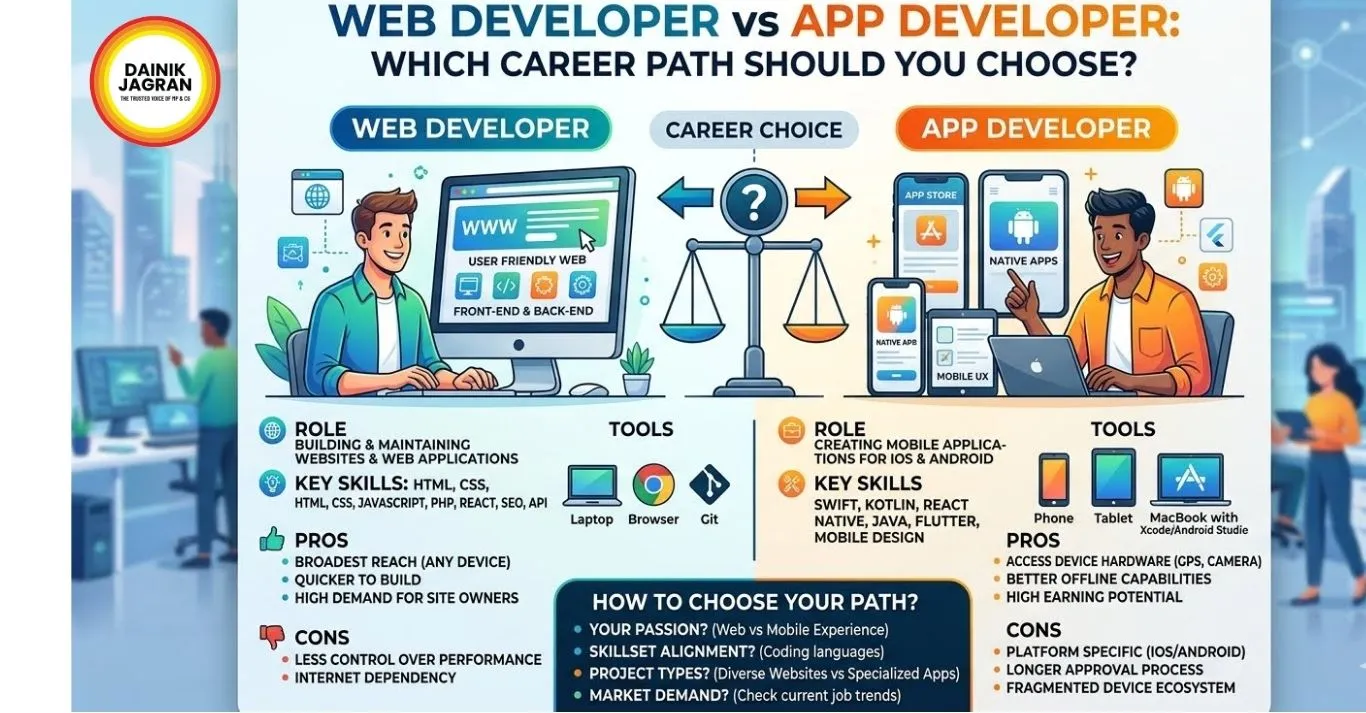
Web developers build websites and web applications that run inside a browser — everything from e-commerce sites to internal business dashboards. App developers build native or cross-platform applications designed to run directly on a device, typically a smartphone, with deeper access to hardware features like the camera, GPS or push notifications.

Core skills required
Web development centres on HTML, CSS and JavaScript for front-end work, with frameworks like React, Angular or Vue commonly layered on top, plus back-end languages like Node.js, Python or PHP for full-stack roles. App development instead requires platform-specific languages — Swift or Objective-C for iOS, Kotlin or Java for Android — or cross-platform frameworks like Flutter or React Native for developers who want to target both platforms without maintaining two separate codebases.

Learning curve
Web development is generally considered the more accessible entry point for beginners — the tools are simpler to start with, free hosting and deployment options are widely available, and there's a shorter path from "first line of code" to a working, shareable project. App development tends to involve a steeper initial learning curve, particularly around platform-specific development environments, app store submission processes, and device compatibility testing.

Career opportunities
Web development offers a notably strong freelance and remote market, given how universally businesses need an online presence — nearly every company, regardless of industry, eventually needs a website. App development opportunities are more concentrated around specific industries where mobile experience is central to the business, such as e-commerce, fintech, gaming and consumer-facing startups, but tend to offer strong growth given how central mobile usage has become globally.

Salary comparison in India
Figures vary considerably across sources and how "average" is calculated, but the general pattern holds: entry-level web developers in India typically start around ₹2.5-4.5 LPA, moving to ₹6-10 LPA at mid-level and ₹12-24 LPA-plus at senior levels, with full-stack developers commanding a 20-30% premium over single-specialisation roles. App developers tend to command a modest premium over web developers globally, though the gap in India is less pronounced than it is internationally — much of the difference shows up more clearly in senior and specialist roles than at entry level. Developers skilled in integrating AI APIs or large language models into applications — whether web or app-based — are increasingly commanding pay above the baseline for their experience level, reflecting how much that specific skill is currently in demand.

Remote and international opportunities
Web development in particular has opened a significant income gap between domestic and international remote work — an entry-level full-stack developer in India might earn ₹6-9 LPA domestically, while the same skill set working remotely for a US-based company could realistically command $70,000-90,000 annually. App developers have similar remote opportunities, though the market is somewhat more concentrated around companies specifically building consumer mobile products.

Which one should you choose?
There's no universally correct answer — both fields offer strong career prospects in 2026. If you want a faster entry point into tech, a broader freelance market, and flexibility across industries, web development is generally the easier starting point. If you're specifically drawn to mobile technology, enjoy working closer to hardware-level features, and don't mind a steeper initial learning curve, app development offers strong long-term growth, particularly as mobile usage continues to dominate global internet access. Many developers eventually build skills across both, since the underlying programming logic transfers reasonably well between the two paths.


--------

🚨 Beat the News Rush – Join Now!

Get breaking alerts, hot exclusives, and game-changing stories instantly on your phone. No delays, no fluff – just the edge you need. ⚡

Tap to join: 

🟢 WhatsApp Channel: Dainik Jagran MP CG

Crave more?

🅕 Facebook: Dainik Jagran MP CG English

🅧 Twitter (X): Dainik Jagran MP CG

🅘 Instagram: Dainik Jagran MP CG

Share the fire – keep your crew ahead! 🗞️🔥

english.dainikjagranmpcg.com
25 Jul 2026 By Priyanshu.Jha

Web Developer vs App Developer: Which Career Path Should You Choose?

Digital desk

What each role actually builds
Web developers build websites and web applications that run inside a browser — everything from e-commerce sites to internal business dashboards. App developers build native or cross-platform applications designed to run directly on a device, typically a smartphone, with deeper access to hardware features like the camera, GPS or push notifications.

Core skills required
Web development centres on HTML, CSS and JavaScript for front-end work, with frameworks like React, Angular or Vue commonly layered on top, plus back-end languages like Node.js, Python or PHP for full-stack roles. App development instead requires platform-specific languages — Swift or Objective-C for iOS, Kotlin or Java for Android — or cross-platform frameworks like Flutter or React Native for developers who want to target both platforms without maintaining two separate codebases.

Learning curve
Web development is generally considered the more accessible entry point for beginners — the tools are simpler to start with, free hosting and deployment options are widely available, and there's a shorter path from "first line of code" to a working, shareable project. App development tends to involve a steeper initial learning curve, particularly around platform-specific development environments, app store submission processes, and device compatibility testing.

Career opportunities
Web development offers a notably strong freelance and remote market, given how universally businesses need an online presence — nearly every company, regardless of industry, eventually needs a website. App development opportunities are more concentrated around specific industries where mobile experience is central to the business, such as e-commerce, fintech, gaming and consumer-facing startups, but tend to offer strong growth given how central mobile usage has become globally.

Salary comparison in India
Figures vary considerably across sources and how "average" is calculated, but the general pattern holds: entry-level web developers in India typically start around ₹2.5-4.5 LPA, moving to ₹6-10 LPA at mid-level and ₹12-24 LPA-plus at senior levels, with full-stack developers commanding a 20-30% premium over single-specialisation roles. App developers tend to command a modest premium over web developers globally, though the gap in India is less pronounced than it is internationally — much of the difference shows up more clearly in senior and specialist roles than at entry level. Developers skilled in integrating AI APIs or large language models into applications — whether web or app-based — are increasingly commanding pay above the baseline for their experience level, reflecting how much that specific skill is currently in demand.

Remote and international opportunities
Web development in particular has opened a significant income gap between domestic and international remote work — an entry-level full-stack developer in India might earn ₹6-9 LPA domestically, while the same skill set working remotely for a US-based company could realistically command $70,000-90,000 annually. App developers have similar remote opportunities, though the market is somewhat more concentrated around companies specifically building consumer mobile products.

Which one should you choose?
There's no universally correct answer — both fields offer strong career prospects in 2026. If you want a faster entry point into tech, a broader freelance market, and flexibility across industries, web development is generally the easier starting point. If you're specifically drawn to mobile technology, enjoy working closer to hardware-level features, and don't mind a steeper initial learning curve, app development offers strong long-term growth, particularly as mobile usage continues to dominate global internet access. Many developers eventually build skills across both, since the underlying programming logic transfers reasonably well between the two paths.

https://english.dainikjagranmpcg.com/education/web-developer-vs-app-developer-which-career-path-should-you/article-23578

Related Posts

Trending News