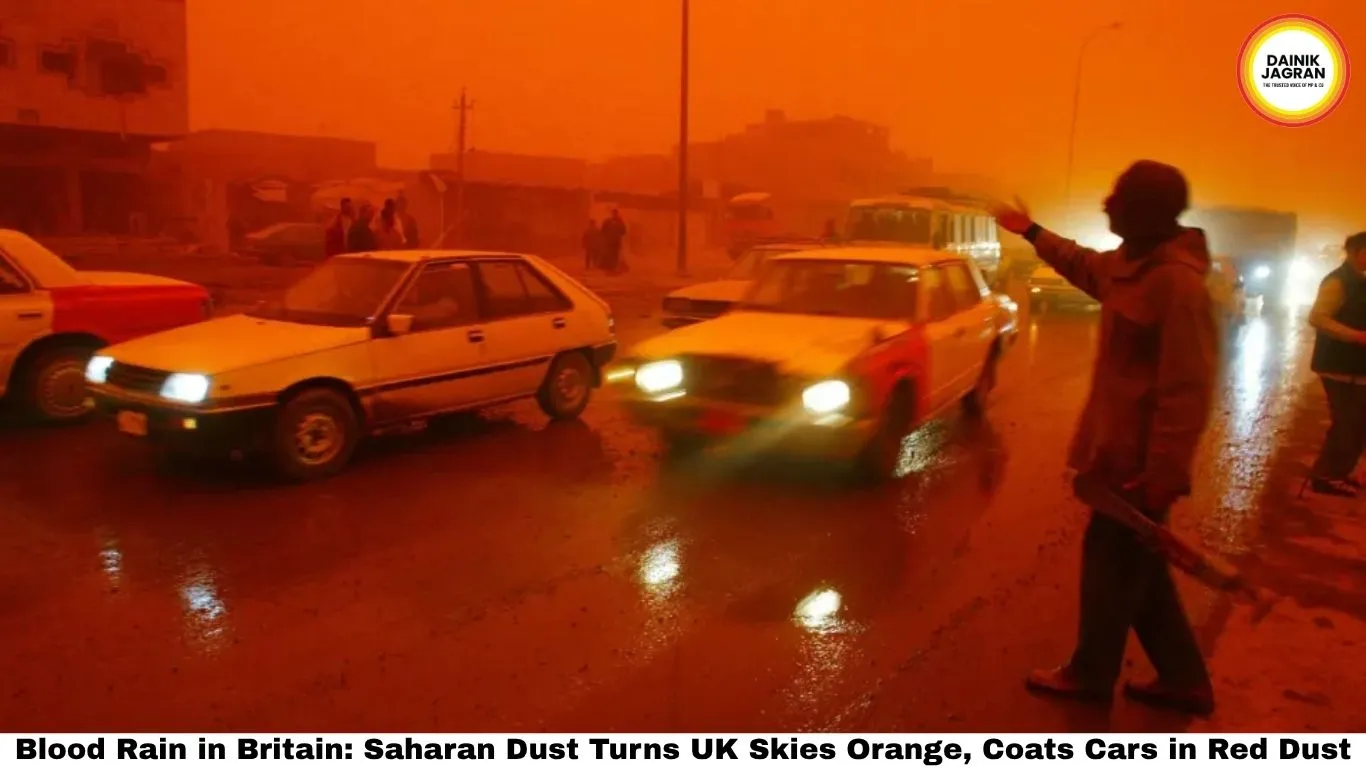
Blood Rain in Britain: Saharan Dust Turns UK Skies Orange, Coats Cars in Red Dust

Digital Desk

Blood Rain in Britain: Saharan Dust Turns UK Skies Orange, Coats Cars in Red Dust

Britain experienced 'blood rain' in March 2026 as Saharan dust swept across the UK. Learn what causes this phenomenon, the health risks, and why climate change will bring more orange skies.

Blood Rain in Britain: Saharan Dust Turns Skies Orange and Leaves Cars Coated in Red

If you woke up in parts of the UK earlier this month to find your car covered in a strange reddish-brown film, you weren't alone. Britain experienced a striking weather phenomenon known as "blood rain" in early March 2026, as a massive plume of Saharan dust swept across the country .

The dust, carried by warm southerly winds, transformed ordinary sunrises and sunsets into vivid displays of deep orange and burnt red. But when it mixed with rainfall, it left behind a gritty residue that had homeowners reaching for their garden hoses .

https://example.com/saharan-dust-plume.jpg
NASA satellite imagery showed the Saharan dust plume moving from North Africa across Europe in early March 2026 .


What Is Blood Rain? The Science Behind the Red Film

Despite its dramatic name, blood rain contains no blood at all. The phenomenon occurs when strong winds lift fine sand and mineral particles from the Sahara Desert into the atmosphere . These particles—smaller than a grain of hair—can travel thousands of miles before being captured by raindrops .

When the rain falls, the dust leaves behind a thin, gritty, reddish-brown coating on surfaces like cars, windows, and garden furniture . The colour varies from a faint rusty hue to deeper reds, depending on how much dust is present in the atmosphere at the time of rainfall .

Jim Dale, senior meteorological observer at British Weather Services, explained: "Blood rain is a dramatic title. There is no blood involved at all, it is the colour. The dust of the sand comes down, joins with raindrops and it leaves a film of sand or dust that is red/brown coloured on surfaces such as cars" .


The March 2026 Event: What Happened and When

The Saharan dust event unfolded between March 4 and March 9, 2026, coinciding with some of the warmest weather the UK had seen all year .

Key dates of the event:

  • March 4-5: A south-easterly air feed carried dust and continental pollution from the Mediterranean, reaching southern England 

  • March 5-6: The highest concentrations of Saharan dust arrived, with reports of blood rain in parts of the Midlands 

  • March 7-9: Dust levels accumulated again due to recirculation and poor dispersion of local emissions 

  • March 9: A fresher, cleaner air feed from the Atlantic swept the dust out over the North Sea, ending the episode 

The dust was brought north by southerly winds following Storm Regina, which had battered the Iberian Peninsula . NASA's GEOS model captured the dramatic movement of the dust plume across the Mediterranean and into Western Europe .

BBC Weather Watchers captured striking images of hazy, orange skies across parts of southern England and the east of England during the peak of the event .


Health Concerns: Is Blood Rain Dangerous?

The short answer: for most people, blood rain is not harmful. However, there are important caveats.

The Met Office stated that "there is no need for concern from a health perspective for the levels currently expected over the UK" . The dust concentrations remained well below levels associated with air quality alerts.

However, experts warn that Saharan dust can degrade air quality. The fine particles—classified as PM10—can penetrate deep into the lungs. In Spain and Italy, modelling studies suggest Saharan dust may account for up to 44% of deaths linked to PM10 pollution .

Professor Claire Ryder, a weather expert at the University of Reading, noted that those with respiratory sensitivities may notice a slight increase in airborne particulates before rainfall clears the atmosphere .


A Dramatic Weather Whiplash

Perhaps the most remarkable aspect of March's weather was the sudden swing. Within just 48 hours, the UK experienced:

  • The warmest day of the year so far (19.2°C in west London) 

  • Blood rain and spectacular orange sunsets 

  • Hill snow in Scotland and northern England 

By March 6, temperatures had plunged, with snow falling in parts of County Durham and the Yorkshire Dales—a stark contrast to the spring-like warmth just a day earlier .


Climate Change: More Blood Rain on the Horizon?

Here's the concerning part: these events are likely to become more frequent.

Hossein Hashemi, Senior Lecturer at Lund University, explained that climate change is altering the Sahara Desert in ways that will send more dust towards Europe. Rising temperatures dry out soils and accelerate desertification, making it easier for wind to dislodge fine particles .

Under extreme warming scenarios, the amount of Saharan dust lifted into the atmosphere could rise by 40% to 60% by the end of the century .

"Whether orange skies remain a curiosity or become a regular feature of European life, governments throughout Europe and Africa must take this shared risk seriously," Hashemi warned .


Tips for Dealing with Blood Rain

If you find your car or windows coated in red dust after a Saharan dust event:

  1. Don't use a dry cloth—this can scratch the paintwork

  2. Rinse thoroughly with water before washing

  3. Use a mild detergent to remove the fine grit

  4. Check air quality forecasts if you have respiratory conditions


The Bottom Line

The March 2026 blood rain event was a striking reminder of how interconnected our world truly is. Dust from the Sahara Desert traveled thousands of miles to paint British skies orange and leave its mark on cars across the Midlands.

While the phenomenon is natural and relatively common—occurring several times a year—scientists warn that climate change may soon make these dramatic orange skies a much more regular feature of British life .

For now, it remains a fascinating—if messy—spectacle, offering a rare glimpse of how global weather systems connect the Sahara Desert to the streets of London and the hills of Yorkshire.

--------

🚨 Beat the News Rush – Join Now!

Get breaking alerts, hot exclusives, and game-changing stories instantly on your phone. No delays, no fluff – just the edge you need. ⚡

Tap to join: 

🟢 WhatsApp Channel: https://whatsapp.com/channel/0029VbAeWYG72WTxso1CFr2g

Crave more?

🅕 Facebook: English Dainik Jagran MP CG

🅧 Twitter (X): Jagran MP CG

🅘 Instagram: Dainik Jagran MP CG

Share the fire – keep your crew ahead! 🗞️🔥

english.dainikjagranmpcg.com
27 Mar 2026 By Jiya.S

Blood Rain in Britain: Saharan Dust Turns UK Skies Orange, Coats Cars in Red Dust

Digital Desk

Blood Rain in Britain: Saharan Dust Turns Skies Orange and Leaves Cars Coated in Red

If you woke up in parts of the UK earlier this month to find your car covered in a strange reddish-brown film, you weren't alone. Britain experienced a striking weather phenomenon known as "blood rain" in early March 2026, as a massive plume of Saharan dust swept across the country .

The dust, carried by warm southerly winds, transformed ordinary sunrises and sunsets into vivid displays of deep orange and burnt red. But when it mixed with rainfall, it left behind a gritty residue that had homeowners reaching for their garden hoses .

https://example.com/saharan-dust-plume.jpg
NASA satellite imagery showed the Saharan dust plume moving from North Africa across Europe in early March 2026 .


What Is Blood Rain? The Science Behind the Red Film

Despite its dramatic name, blood rain contains no blood at all. The phenomenon occurs when strong winds lift fine sand and mineral particles from the Sahara Desert into the atmosphere . These particles—smaller than a grain of hair—can travel thousands of miles before being captured by raindrops .

When the rain falls, the dust leaves behind a thin, gritty, reddish-brown coating on surfaces like cars, windows, and garden furniture . The colour varies from a faint rusty hue to deeper reds, depending on how much dust is present in the atmosphere at the time of rainfall .

Jim Dale, senior meteorological observer at British Weather Services, explained: "Blood rain is a dramatic title. There is no blood involved at all, it is the colour. The dust of the sand comes down, joins with raindrops and it leaves a film of sand or dust that is red/brown coloured on surfaces such as cars" .


The March 2026 Event: What Happened and When

The Saharan dust event unfolded between March 4 and March 9, 2026, coinciding with some of the warmest weather the UK had seen all year .

Key dates of the event:

  • March 4-5: A south-easterly air feed carried dust and continental pollution from the Mediterranean, reaching southern England 

  • March 5-6: The highest concentrations of Saharan dust arrived, with reports of blood rain in parts of the Midlands 

  • March 7-9: Dust levels accumulated again due to recirculation and poor dispersion of local emissions 

  • March 9: A fresher, cleaner air feed from the Atlantic swept the dust out over the North Sea, ending the episode 

The dust was brought north by southerly winds following Storm Regina, which had battered the Iberian Peninsula . NASA's GEOS model captured the dramatic movement of the dust plume across the Mediterranean and into Western Europe .

BBC Weather Watchers captured striking images of hazy, orange skies across parts of southern England and the east of England during the peak of the event .


Health Concerns: Is Blood Rain Dangerous?

The short answer: for most people, blood rain is not harmful. However, there are important caveats.

The Met Office stated that "there is no need for concern from a health perspective for the levels currently expected over the UK" . The dust concentrations remained well below levels associated with air quality alerts.

However, experts warn that Saharan dust can degrade air quality. The fine particles—classified as PM10—can penetrate deep into the lungs. In Spain and Italy, modelling studies suggest Saharan dust may account for up to 44% of deaths linked to PM10 pollution .

Professor Claire Ryder, a weather expert at the University of Reading, noted that those with respiratory sensitivities may notice a slight increase in airborne particulates before rainfall clears the atmosphere .


A Dramatic Weather Whiplash

Perhaps the most remarkable aspect of March's weather was the sudden swing. Within just 48 hours, the UK experienced:

  • The warmest day of the year so far (19.2°C in west London) 

  • Blood rain and spectacular orange sunsets 

  • Hill snow in Scotland and northern England 

By March 6, temperatures had plunged, with snow falling in parts of County Durham and the Yorkshire Dales—a stark contrast to the spring-like warmth just a day earlier .


Climate Change: More Blood Rain on the Horizon?

Here's the concerning part: these events are likely to become more frequent.

Hossein Hashemi, Senior Lecturer at Lund University, explained that climate change is altering the Sahara Desert in ways that will send more dust towards Europe. Rising temperatures dry out soils and accelerate desertification, making it easier for wind to dislodge fine particles .

Under extreme warming scenarios, the amount of Saharan dust lifted into the atmosphere could rise by 40% to 60% by the end of the century .

"Whether orange skies remain a curiosity or become a regular feature of European life, governments throughout Europe and Africa must take this shared risk seriously," Hashemi warned .


Tips for Dealing with Blood Rain

If you find your car or windows coated in red dust after a Saharan dust event:

  1. Don't use a dry cloth—this can scratch the paintwork

  2. Rinse thoroughly with water before washing

  3. Use a mild detergent to remove the fine grit

  4. Check air quality forecasts if you have respiratory conditions


The Bottom Line

The March 2026 blood rain event was a striking reminder of how interconnected our world truly is. Dust from the Sahara Desert traveled thousands of miles to paint British skies orange and leave its mark on cars across the Midlands.

While the phenomenon is natural and relatively common—occurring several times a year—scientists warn that climate change may soon make these dramatic orange skies a much more regular feature of British life .

For now, it remains a fascinating—if messy—spectacle, offering a rare glimpse of how global weather systems connect the Sahara Desert to the streets of London and the hills of Yorkshire.

https://english.dainikjagranmpcg.com/international/-blood-rain-in-britain-saharan-dust-turns-uk-skies/article-16111

Related Posts

Advertisement

Latest News