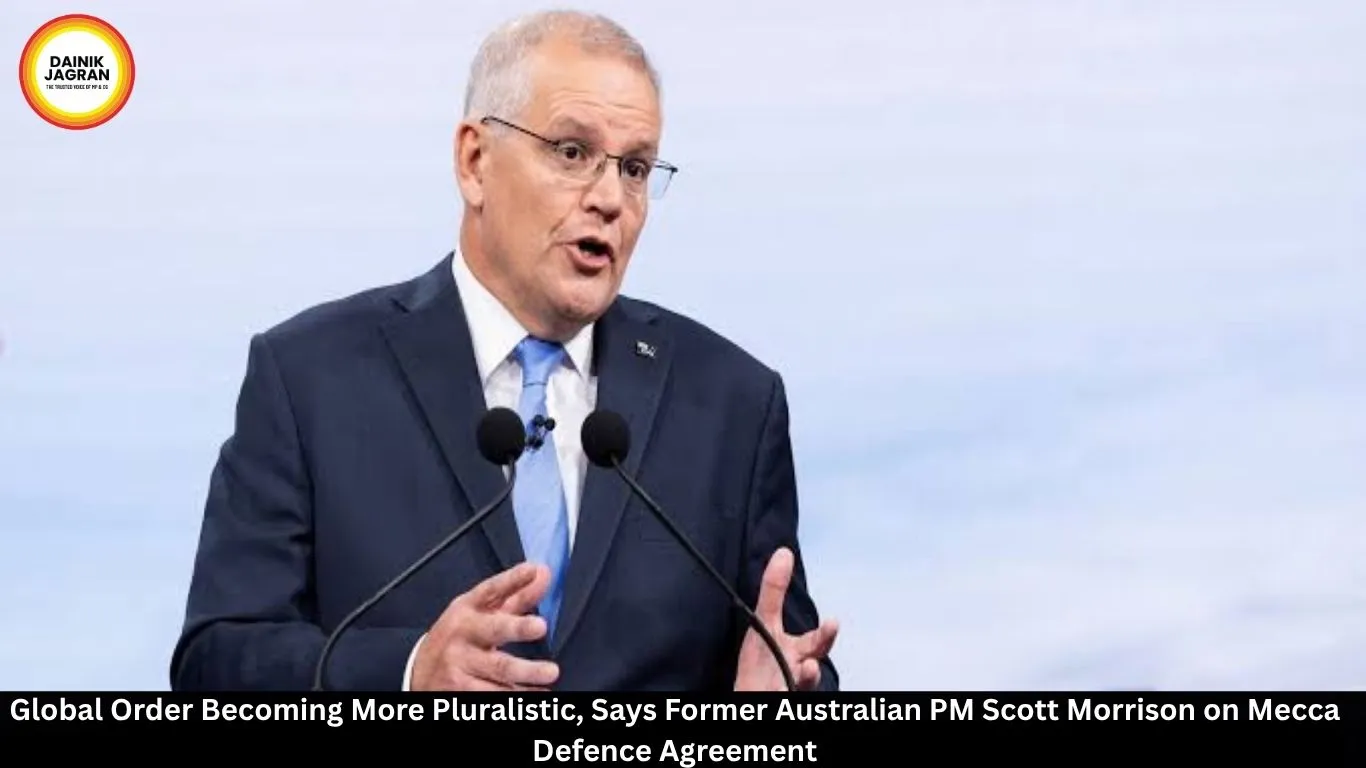
Global Order Becoming More Pluralistic, Says Former Australian PM Scott Morrison on Mecca Defence Agreement
Digital desk
Former Australian PM Scott Morrison says the Mecca Defence Agreement reflects a changing global order, with more pluralism, flexible partnerships and India's growing strategic role.
Former Australian Prime Minister Scott Morrison has said the emergence of the Mecca Defence Agreementinvolving Saudi Arabia, Pakistan and Turkey reflects a wider shift in global geopolitics, with the international order becoming increasingly pluralistic and power more widely distributed among different countries and regional groupings.
Speaking during the Indo-Mediterranean Dialogues, Morrison said the changing international environment was likely to create greater space for new security partnerships and smaller strategic groupings.
“We're going to see more and more pluralism in the global order,” Morrison said while discussing the recently formed defence arrangement and broader geopolitical developments.
Shift in Global Power
According to Morrison, the traditional structure of international power is undergoing significant changes as countries increasingly pursue partnerships based on specific strategic and national interests.
He said the world was moving towards a more distributed geopolitical system, where different countries could form flexible alliances and cooperative arrangements instead of relying entirely on large, established blocs.
The former Australian leader linked this development to the growing importance of regional and “minilateral” partnerships, particularly across the Indo-Pacific and the wider Middle East.
Mecca Defence Agreement in Focus
Morrison's remarks came amid discussions over the new defence cooperation framework involving Saudi Arabia, Pakistan and Turkey.
The agreement has generated international attention because of its potential implications for regional security and military cooperation.
While details of how the arrangement will evolve remain subject to further institutional and political developments, Morrison said its emergence should be viewed within the larger transformation taking place in the global order.
The growing number of regional arrangements, he suggested, reflects a world in which strategic influence is no longer concentrated in a small number of traditional power centres.
India’s Growing Strategic Role
During the discussion, Morrison also highlighted India's increasing geopolitical importance and described New Delhi as a key player in the future strategic balance of the Indo-Pacific.
He said India's role was becoming increasingly significant as the global distribution of economic and political power changes.
Morrison particularly emphasised India's importance to the Quad, which brings together India, Australia, Japan and the United States.
According to him, India's participation gives the grouping a distinctive strategic character and will remain critical to its future effectiveness. He also argued that the Quad should maintain a broad agenda covering security, economic cooperation, technology and humanitarian issues rather than becoming solely a military alliance.
More Flexible Partnerships Ahead
Morrison said geopolitical cooperation in the coming years could increasingly involve countries working together on selected issues without necessarily joining rigid alliance structures.
This could lead to what he described as greater “mix and match” among countries and partnerships, particularly in the Indo-Pacific region.
Such arrangements may focus on areas including maritime security, technology, trade, critical minerals, supply chains and defence cooperation.
The development of new regional frameworks, including the Mecca Defence Agreement, could therefore become part of a broader trend towards more flexible international partnerships.
China and Regional Security
The former Australian prime minister also discussed China's expanding strategic influence and the challenges facing countries across the Indo-Pacific.
He pointed to developments involving Sri Lanka, Pakistan and Myanmar while underlining the strategic importance of the Indian Ocean.
Morrison said India would remain central to efforts aimed at maintaining regional balance, particularly as geopolitical and economic competition intensifies.
He also highlighted India's growing potential in areas such as technology, manufacturing, space and defence-industrial cooperation.
Changing Geopolitical Landscape
Morrison's comments underline the growing debate over how the global order may evolve as established alliances face new challenges and emerging powers expand their influence.
The rise of new defence arrangements and issue-based partnerships could reshape regional diplomacy in the years ahead.
For countries such as India, the changing environment could create greater opportunities to pursue strategic partnerships while maintaining flexibility in foreign policy.
As new groupings emerge across different regions, Morrison's assessment suggests that the future global order may be defined less by a single dominant structure and more by multiple centres of power, competing interests and increasingly diverse strategic partnerships.

Global Order Becoming More Pluralistic, Says Former Australian PM Scott Morrison on Mecca Defence Agreement
Digital desk
Former Australian Prime Minister Scott Morrison has said the emergence of the Mecca Defence Agreementinvolving Saudi Arabia, Pakistan and Turkey reflects a wider shift in global geopolitics, with the international order becoming increasingly pluralistic and power more widely distributed among different countries and regional groupings.
Speaking during the Indo-Mediterranean Dialogues, Morrison said the changing international environment was likely to create greater space for new security partnerships and smaller strategic groupings.
“We're going to see more and more pluralism in the global order,” Morrison said while discussing the recently formed defence arrangement and broader geopolitical developments.
Shift in Global Power
According to Morrison, the traditional structure of international power is undergoing significant changes as countries increasingly pursue partnerships based on specific strategic and national interests.
He said the world was moving towards a more distributed geopolitical system, where different countries could form flexible alliances and cooperative arrangements instead of relying entirely on large, established blocs.
The former Australian leader linked this development to the growing importance of regional and “minilateral” partnerships, particularly across the Indo-Pacific and the wider Middle East.
Mecca Defence Agreement in Focus
Morrison's remarks came amid discussions over the new defence cooperation framework involving Saudi Arabia, Pakistan and Turkey.
The agreement has generated international attention because of its potential implications for regional security and military cooperation.
While details of how the arrangement will evolve remain subject to further institutional and political developments, Morrison said its emergence should be viewed within the larger transformation taking place in the global order.
The growing number of regional arrangements, he suggested, reflects a world in which strategic influence is no longer concentrated in a small number of traditional power centres.
India’s Growing Strategic Role
During the discussion, Morrison also highlighted India's increasing geopolitical importance and described New Delhi as a key player in the future strategic balance of the Indo-Pacific.
He said India's role was becoming increasingly significant as the global distribution of economic and political power changes.
Morrison particularly emphasised India's importance to the Quad, which brings together India, Australia, Japan and the United States.
According to him, India's participation gives the grouping a distinctive strategic character and will remain critical to its future effectiveness. He also argued that the Quad should maintain a broad agenda covering security, economic cooperation, technology and humanitarian issues rather than becoming solely a military alliance.
More Flexible Partnerships Ahead
Morrison said geopolitical cooperation in the coming years could increasingly involve countries working together on selected issues without necessarily joining rigid alliance structures.
This could lead to what he described as greater “mix and match” among countries and partnerships, particularly in the Indo-Pacific region.
Such arrangements may focus on areas including maritime security, technology, trade, critical minerals, supply chains and defence cooperation.
The development of new regional frameworks, including the Mecca Defence Agreement, could therefore become part of a broader trend towards more flexible international partnerships.
China and Regional Security
The former Australian prime minister also discussed China's expanding strategic influence and the challenges facing countries across the Indo-Pacific.
He pointed to developments involving Sri Lanka, Pakistan and Myanmar while underlining the strategic importance of the Indian Ocean.
Morrison said India would remain central to efforts aimed at maintaining regional balance, particularly as geopolitical and economic competition intensifies.
He also highlighted India's growing potential in areas such as technology, manufacturing, space and defence-industrial cooperation.
Changing Geopolitical Landscape
Morrison's comments underline the growing debate over how the global order may evolve as established alliances face new challenges and emerging powers expand their influence.
The rise of new defence arrangements and issue-based partnerships could reshape regional diplomacy in the years ahead.
For countries such as India, the changing environment could create greater opportunities to pursue strategic partnerships while maintaining flexibility in foreign policy.
As new groupings emerge across different regions, Morrison's assessment suggests that the future global order may be defined less by a single dominant structure and more by multiple centres of power, competing interests and increasingly diverse strategic partnerships.
Recommended For You
--------
🚨 Beat the News Rush – Join Now!
Get breaking alerts, hot exclusives, and game-changing stories instantly on your phone. No delays, no fluff – just the edge you need. ⚡
Tap to join:
🟢 WhatsApp Channel: Dainik Jagran MP CG
Crave more?
🅕 Facebook: Dainik Jagran MP CG English
🅧 Twitter (X): Dainik Jagran MP CG
🅘 Instagram: Dainik Jagran MP CG
Share the fire – keep your crew ahead! 🗞️🔥